ASRock AI BOX-A395 Runs Nearly 44% Ahead of Slowest Ryzen AI Max+ 395 Box
ServeTheHome's estimated SPEC CPU2026 integer test puts ASRock's AI BOX-A395 first among four Ryzen AI Max+ 395 boxes; ServeTheHome credits cooling and power limits, a best guess it did not test.
Chips & Power DeskEdited by Ege Erten
3 min readAI-assisted
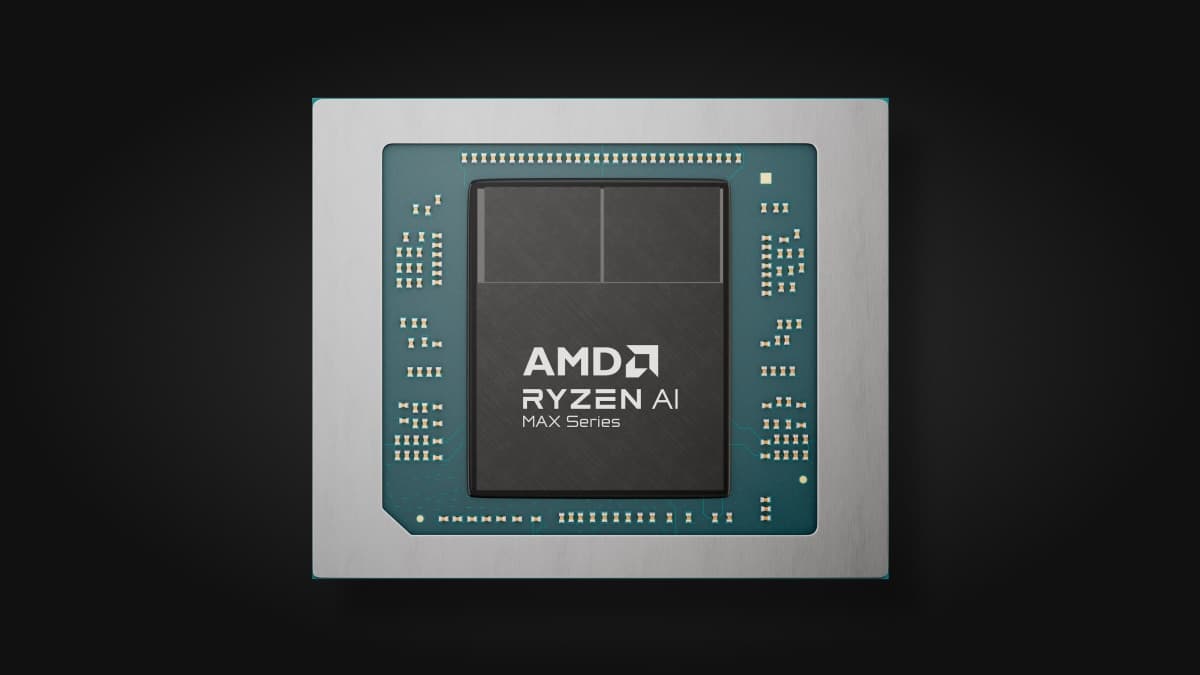
AMD's Ryzen AI Max Series processor, the chip that ServeTheHome compared across four mini-PCs. Not the ASRock Industrial AI BOX-A395 itself.
Image: AMD
Source · Press image from the AMD product page, used for news reporting.
ASRock Industrial's AI BOX-A395 ran nearly 44% faster than the slowest of four AMD Ryzen AI Max+ 395 systems in ServeTheHome's estimated SPEC CPU2026 integer tests, in a review published on Oct. 29.
All four machines use the same 16-core chip, the part AMD formerly code-named Strix Halo, with 128 GB of soldered LPDDR5X-8000 in the ASRock unit. ServeTheHome found the gap only under long, heavy multi-core work. Geekbench 7 single-core scores sat within 2.8% of each other, and multi-core within about 8%. In its own AgentSTH V7 agentic CPU test, single-core results were within 1%, while the A395 finished 15% ahead of the next-closest 395 box with all 32 threads running. The outlet notes its SPEC figures are estimates built with open-source compilers and compare only with its own runs, not with official SPEC submissions.
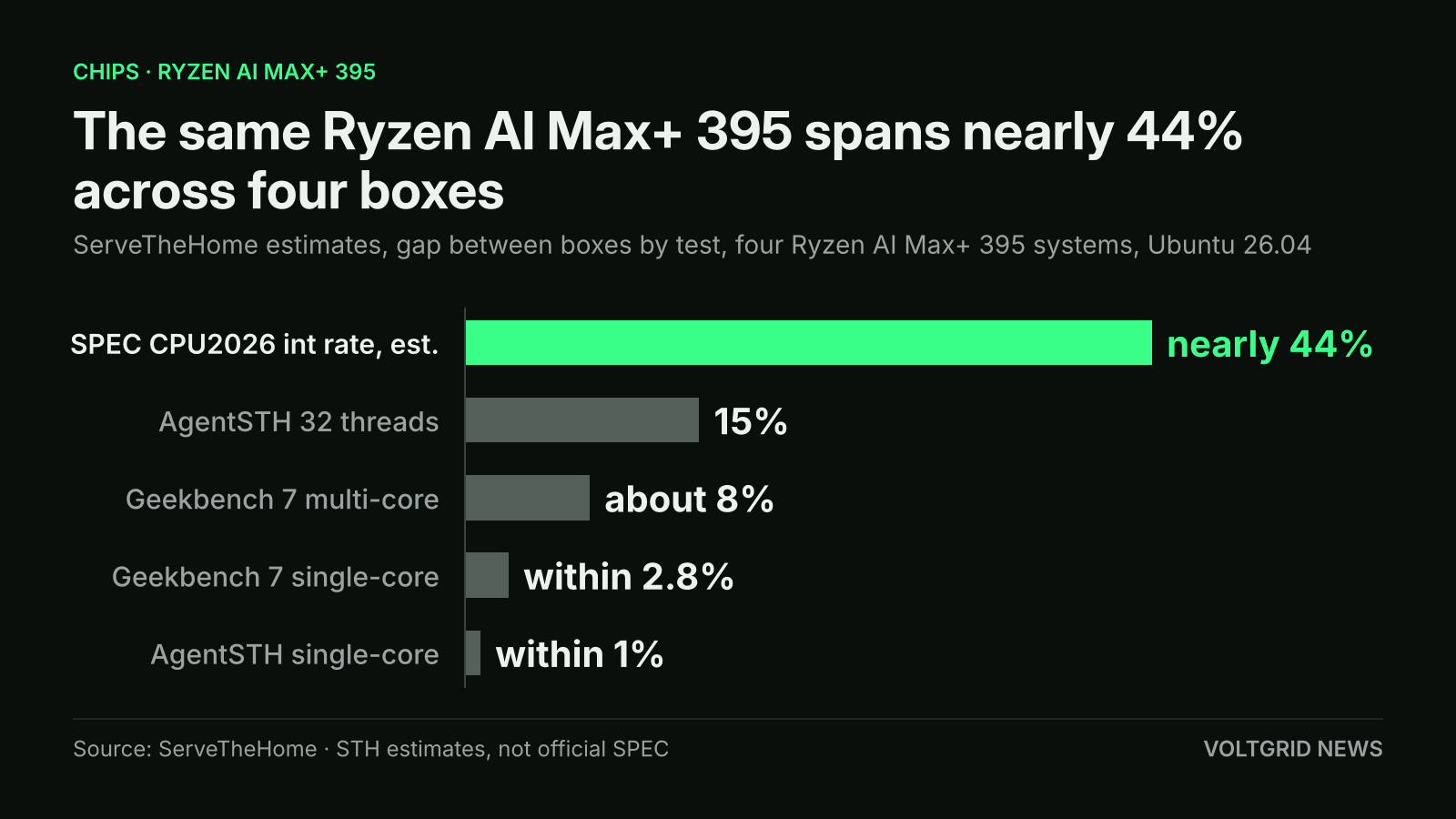
ServeTheHome's estimates show the same Ryzen AI Max+ 395 spanning nearly 44% in heavy multi-core work but within 1% to 2.8% single-core.
Illustration (AI-generated)
Why the same chip lands so far apart
ServeTheHome's best guess is that the gap comes from power limits and cooling; it did not test that by changing the limit. AMD's spec page lists the Ryzen AI Max+ 395 at a 55 W default TDP and lets system makers configure it anywhere from 45 W to 120 W. That range is the lever. ServeTheHome reasons that a box maker that can remove more heat can let the chip turbo harder for longer, and multi-core throughput follows.
ASRock built the A395 as a small aluminium tower around a mini-ITX board, with a 400 W internal power supply, a heatsink with six heat pipes and a 120 mm fan. ServeTheHome called it the most PC-like of the group in construction and cooling, against rivals it described as laptop-like. Under CPU load, the SoC reported its own power topping out at 130 to 140 W on Ubuntu 26.04, and the CPU held 4.6 to 4.7 GHz for hours. That is chip-reported package power, a different measure from AMD's TDP rating and not wall power, which the review did not publish. Noise stayed at about 35 dBA idle in a studio of roughly 34 dBA, and 42 dBA under load.
The memory system does not explain the gap. In AgentSTH V7's memory-influenced dimension the top-to-bottom spread was only 17%, which ServeTheHome reads as a sign that the gap comes from CPU performance rather than memory performance. The GPU edge was narrower too: in SPECviewperf 15.0.1 the A395 beat the Minisforum N5 in every test, but never by more than 15%.
What it means for local AI buyers
For anyone buying these machines to run agents and models around the clock, the chip name on the box is not the spec that matters. ServeTheHome's best guess is that the power limit and the cooler set the sustained result; the other three boxes' limits were not published. A spec sheet that lists only "Ryzen AI Max+ 395" leaves that number out. The trade-off cuts both ways: a box tuned higher should finish heavy jobs sooner, but the A395's SoC reported 130 to 140 W under CPU load, above AMD's 45-120 W configurable range (55 W default); reported package power and a TDP rating are different measures.
ServeTheHome also ran local models on the A395's Radeon 8060S graphics, including gpt-oss-120b, Qwen3.6-35B-A3B, Qwen3.8-27B and NVIDIA's Nemotron-3 Nano 30B-A3B, but published those results as charts. In its larger gpt-oss-120b input and output cases, with stock inference engines, ServeTheHome saw users getting only the mid-teens of tokens per second. Its Qwen3.8 Flash Next test, about 93.7 GB on disk in its UD-IQ4_XS quantization, came close to the limit of the 128 GB machine. The 128 GB class is the same one that NVIDIA's DGX Spark, which now lists at $6,950, competes in. AMD's software stack is moving as well, with its Loom 0.1 SDK.
What is not confirmed yet
The review gives no list price, linking only to a retailer, and no wall-power figure under load. ServeTheHome judged the A395 a niche industrial PC rather than a desktop workstation, citing industrial features such as dual BIOS chips and a BIOS watchdog timer, and drawbacks such as 480 Mbps USB ports on top and a cramped M.2 slot under the heatsink. It also wrote that AMD's follow-on Gorgon Halo silicon launches within days, so this may be the last Strix Halo box it reviews; AMD's own date for that consumer launch was not in the pages read for this story.