TSMC Says It Stays a Logic Foundry After 3D DRAM Report for NVIDIA
TSMC said on Nov. 7 it remains a dedicated logic foundry after a report that it is preparing 3D DRAM for NVIDIA. It did not address the reported request, and the technology is years from market.
Chips & Power DeskEdited by Ege Erten
2 min readAI-assisted
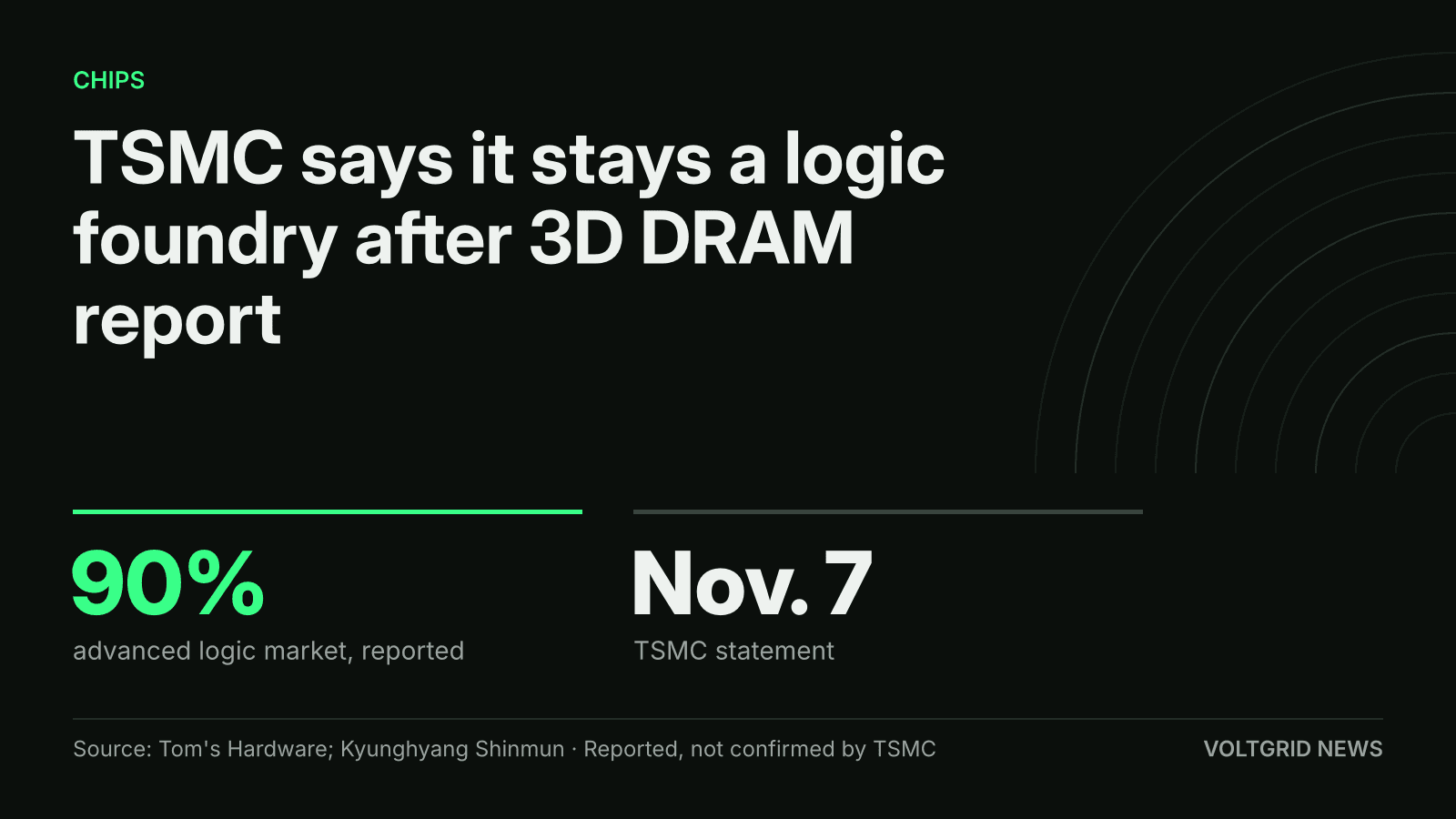
TSMC's Nov. 7 statement and its reported share of the advanced logic market.
Illustration (AI-generated)
TSMC said on Nov. 7 that it "focuses on our core business at all times, which is dedicated IC foundry," after a report that it is preparing 3D DRAM production for NVIDIA, its largest customer.
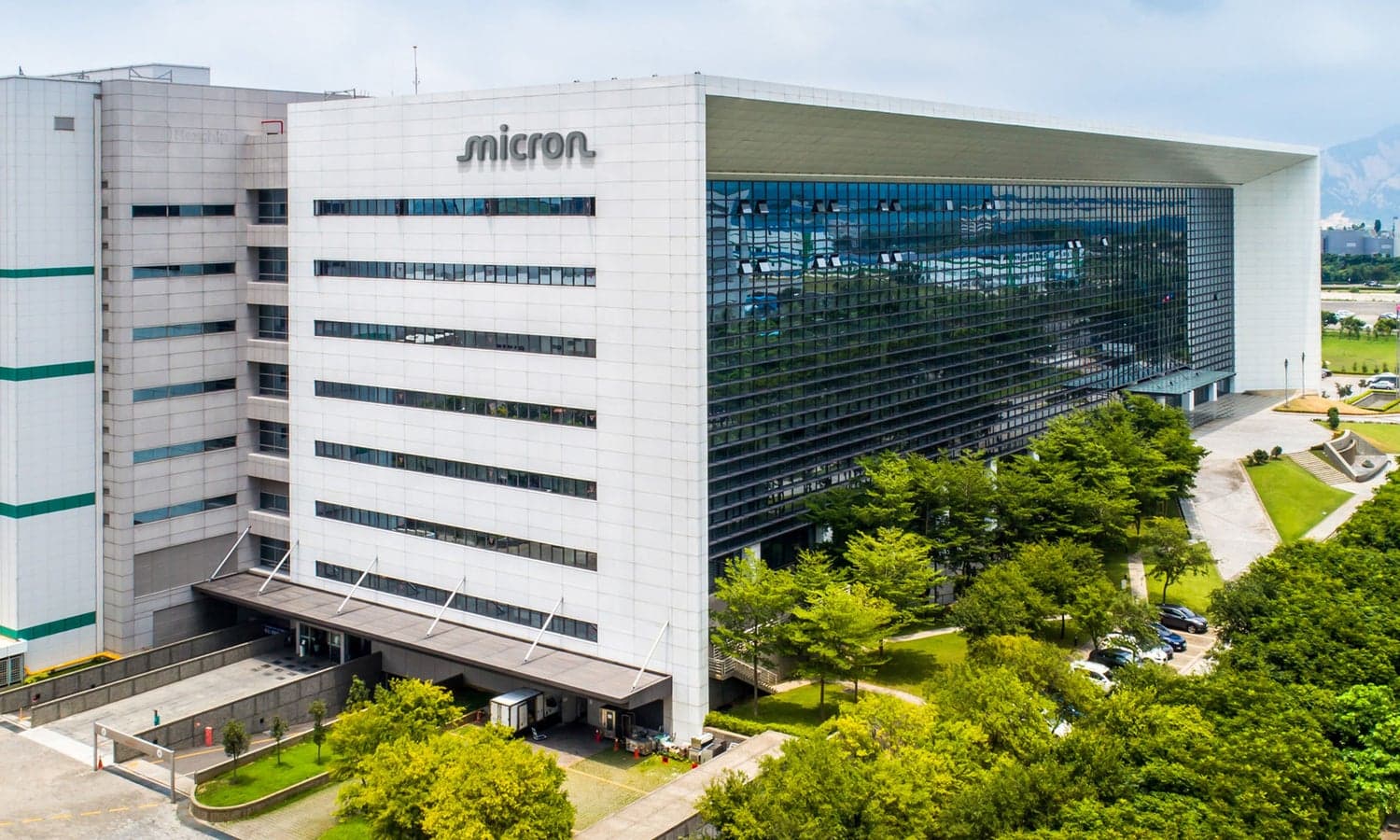
The Information reported, citing two people familiar with the initiative, that TSMC had begun preparing plans for 3D DRAM manufacturing at NVIDIA's request, according to Tom's Hardware. The effort is reportedly overseen by Hsu Kuo-chin, the TSMC vice president for advanced packaging and a former head of Micron's Taiwan operations. A TSMC spokesperson gave Tom's Hardware the statement above and added that the company's mission is to be the trusted technology and capacity provider of the global logic IC industry.
The wording is a reaffirmation, not a point-by-point rebuttal. South Korea's Kyunghyang Shinmun, relaying Bloomberg's account of the same statement, noted that TSMC did not say whether NVIDIA had made a request or address memory businesses such as DRAM. The Information's report is therefore unconfirmed by TSMC and not flatly refuted.
Why 3D DRAM would not ease the memory shortage soon
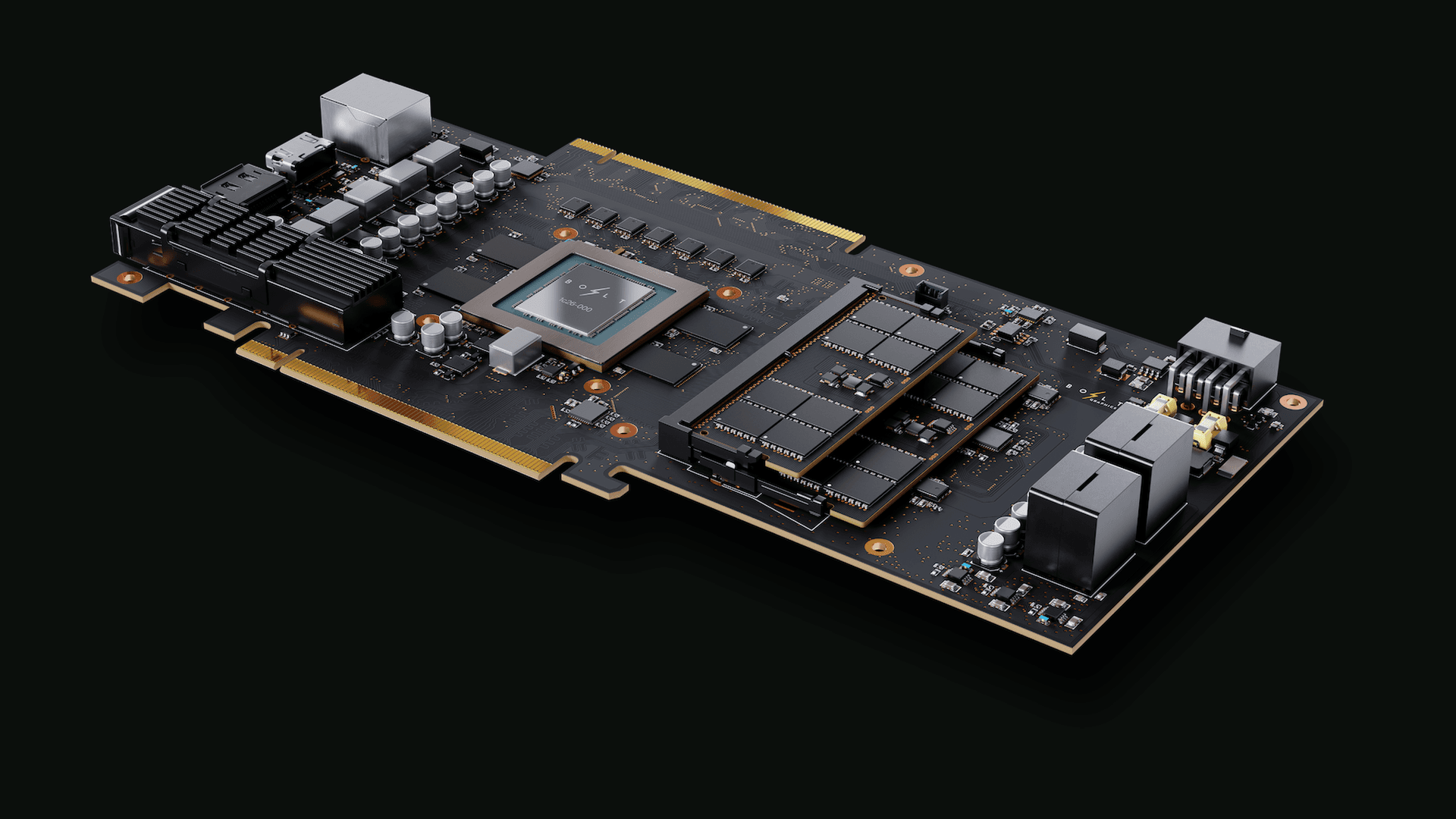
3D DRAM stacks memory cells in several vertical layers, rather than in a single plane, to raise capacity per wafer. Samsung, SK hynix and Micron are all developing it, and Tom's Hardware says it is years away even for them. Micron's roadmap, it adds, includes at least four more planar DRAM processes first. Voltgrid News reported earlier on SK hynix's plan to stretch 6F2 DRAM with EUV before it moves to 4F2 or 3D designs.
Tom's Hardware concludes that a TSMC 3D DRAM strategy could not relieve shortages for at least five years. It argues TSMC lacks the DRAM expertise and capacity, and has no competitive planar DRAM process to build on. One route would be buying a small specialty memory maker, but such firms lack leading-edge commodity DRAM nodes, so billions of dollars and years of development would still be needed.
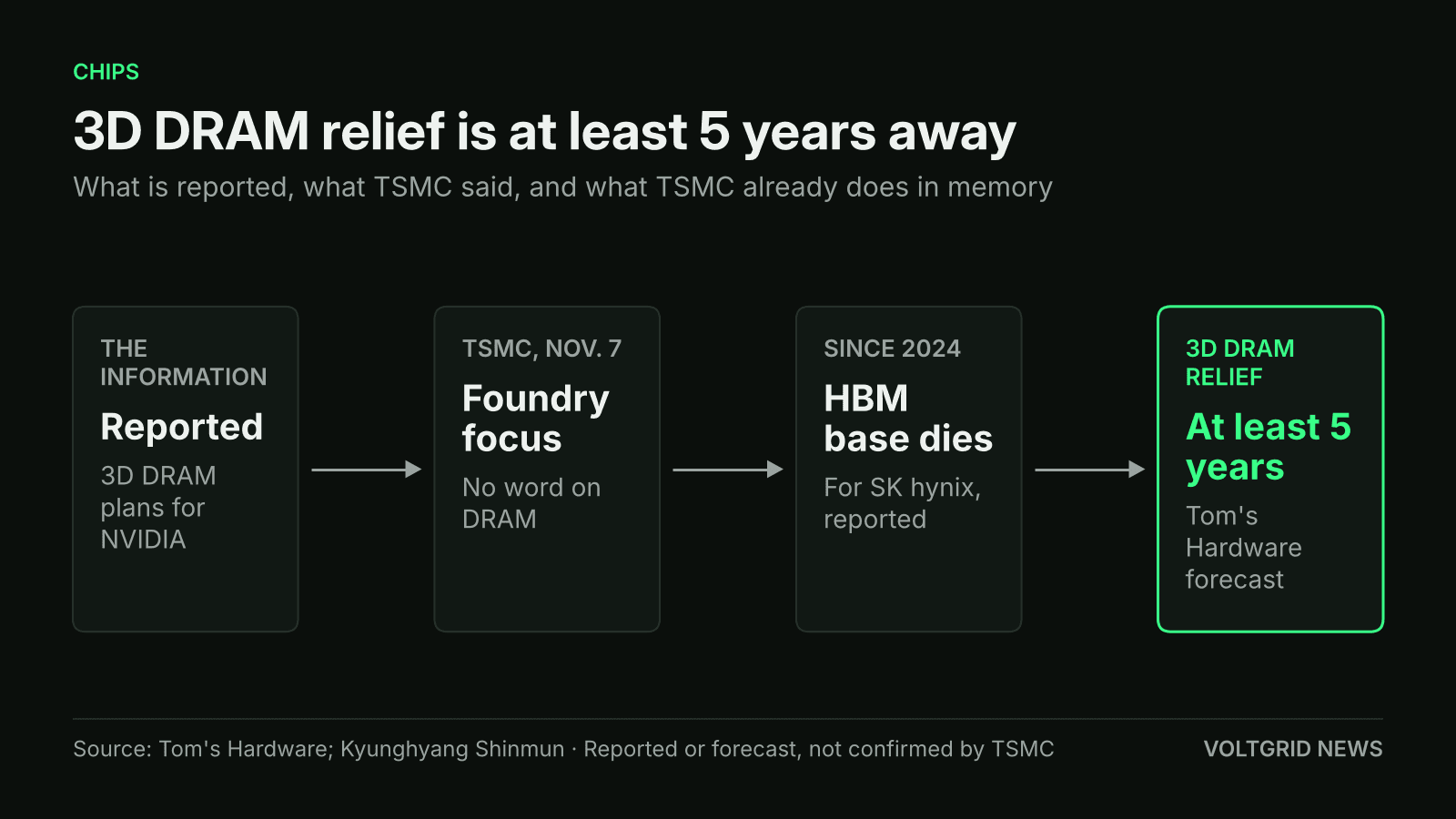
Tom's Hardware forecasts at least 5 years before 3D DRAM could ease shortages; the NVIDIA plans are reported, not confirmed by TSMC.
Illustration (AI-generated)
What TSMC already does in memory
TSMC does not have to make DRAM to profit from the shortage. It packages memory with processors for customers, and since 2024 it has made logic base dies for SK hynix's next-generation HBM (high-bandwidth memory), according to Tom's Hardware. That outlet lists further options: SoIC hybrid-bonding integration of memory with processors and custom memory work with partners such as GUC. TSMC's packaging capacity is already a pinch point, as Voltgrid News reported on a possible CoWoS price rise of up to 20%, which TSMC has not confirmed.
Kyunghyang Shinmun adds that TSMC holds more than 90% of the advanced logic market, and that a move into memory would give it an unusual position in the AI hardware supply chain. Both outlets point to the shortage that is pushing NVIDIA and Apple to diversify memory supply.
What is not confirmed yet
TSMC has not said whether NVIDIA asked for 3D DRAM, and has not denied preparing plans for memory. The Information's two sources are unnamed. Tom's Hardware also flags risks if TSMC did enter DRAM: exposure to the boom-and-bust memory cycle, strain on its relationship with SK hynix, and possible antitrust questions over combining logic, packaging and memory. No capacity, node, customer volume or timeline has been disclosed by anyone.