EU Methane Rules for Gas Importers Delayed Two Years to Jan. 1, 2029
EU negotiators agreed on Nov. 19 to postpone methane reporting duties for oil and gas importers to 2029, per Reuters and Bloomberg, but Parliament and Council must still formally adopt the deal.
3 min read
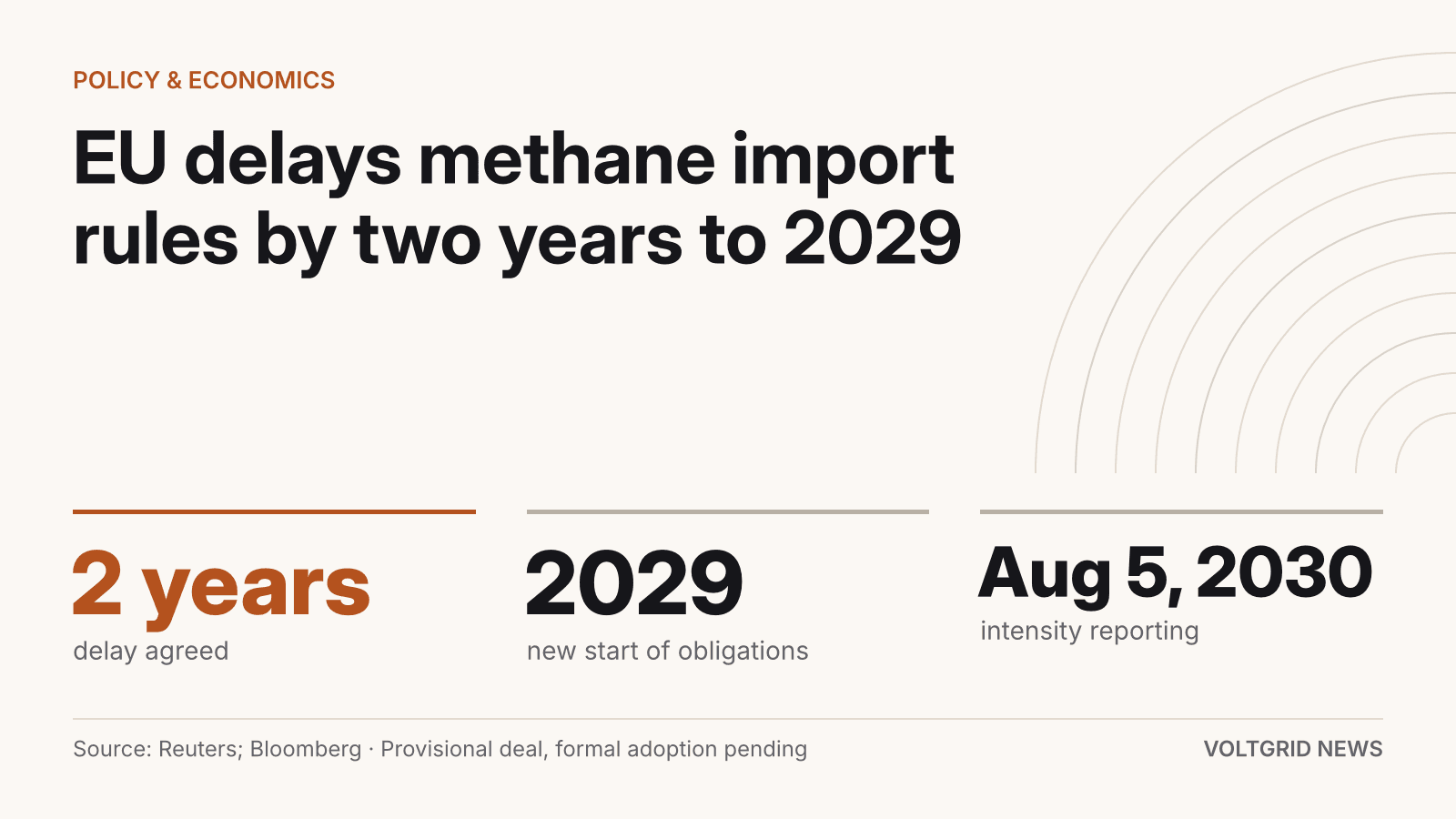
The provisional EU deal moves the start of methane obligations for importers to 2029, per Reuters and Bloomberg.
Graphic: Voltgrid News
EU negotiators agreed on Nov. 19, 2026 to delay by two years the methane rules for oil and gas importers, moving the start date from Jan. 1, 2027 to Jan. 1, 2029, according to Reuters and Bloomberg, which both cite statements from the European Parliament and the EU Council.
The deal is provisional. Reuters reported that the delay covers rules requiring oil, gas and coal importers to report methane emissions, and that the European Parliament cited disruptions from the US-Israeli war with Iran as the reason. Bloomberg, citing the Council, said negotiators from the European Commission, Parliament and member states postponed the monitoring, verification and reporting obligations for importers to the start of 2029. Methane-intensity reporting for both importers and EU producers moves by two years to Aug. 5, 2030.
For LNG and pipeline-gas importers, the practical change is time. Documentation of the methane emissions behind imported cargoes would have applied from the start of 2027; it now applies from the start of 2029. The US, which Bloomberg describes as Europe's largest supplier of liquefied natural gas, had warned that its output would head elsewhere if the bloc did not ease the rules, and the industry argued the regulation could jeopardise supply. Borys Budka, the Parliament's lead lawmaker for the industry committee, called the deal a matter of energy security and economic stability and said it would bring predictability for operators and help stabilise prices. Darragh O'Brien, Ireland's climate minister, spoke of a pragmatic balance that keeps the EU's leadership in cutting methane.
How the two years were reached
The outcome sits between the two positions in the talks. Member states wanted a 12-month delay, and Parliament had backed a three-year delay, according to Reuters and Bloomberg. The Commission proposed a one-year delay in October after pressure from governments including France and the United States, Reuters reported; Bloomberg put the number of governments at a dozen, alongside top exporting nations led by the US. Earlier in November the Council had suggested keeping one year but adding a mechanism for two further one-year delays if the Commission could not show implementation was ready.
The provisional deal's two years sits between the one-year positions and Parliament's three, per Reuters and Bloomberg.
Graphic: Voltgrid News
Before this deal, the Commission had recommended that governments not impose penalties for non-compliance between 2027 and 2029, Bloomberg reported. Industry has repeatedly said such guidance was not enough. The agreement replaces that stopgap with a change to the dates in the regulation itself, once it is adopted.
What it means for gas supply
Both outlets frame the delay as a response to market stress after the Iran war disrupted energy flows. For importers, the agreement removes the 2027 start date that exporters and the US government had flagged as a supply risk. It does not remove the rule: the Parliament statement, as Bloomberg relays it, includes a Commission review of implementation by the start of 2028 and every five years afterwards. That review is the next point at which the content of the requirements could be revisited.
Methane is the second-largest contributor to climate change after carbon dioxide, according to Reuters, and Bloomberg notes it traps 80 times as much heat as carbon dioxide over its first two decades in the atmosphere. Importers still face the 2029 and 2030 dates.
What is not confirmed yet
The agreement is provisional. For the revision to enter into force, the EU Council and the Parliament must formally approve it and it must be published in the Official Journal of the European Union, Bloomberg reported. No adoption dates have been reported in the coverage Voltgrid read, so the date the amendment takes legal effect is not confirmed. The Council's own press release was not available to Voltgrid on Nov. 19, so the dates above rest on Reuters and Bloomberg, which agree with each other, and the full legal text of the amendment has not been reviewed.
Sources
- Published
- Sources
- 2 cited