GS Breaks Ground on 1.2 GW Donghae AI Data Center, 2.4 GW Planned
GS began building the first 1.2 GW of a 2.4 GW Donghae AI campus on Nov. 28, starting with 100 MW due in 2028, but power supply and tenants are still unnamed.
3 min read
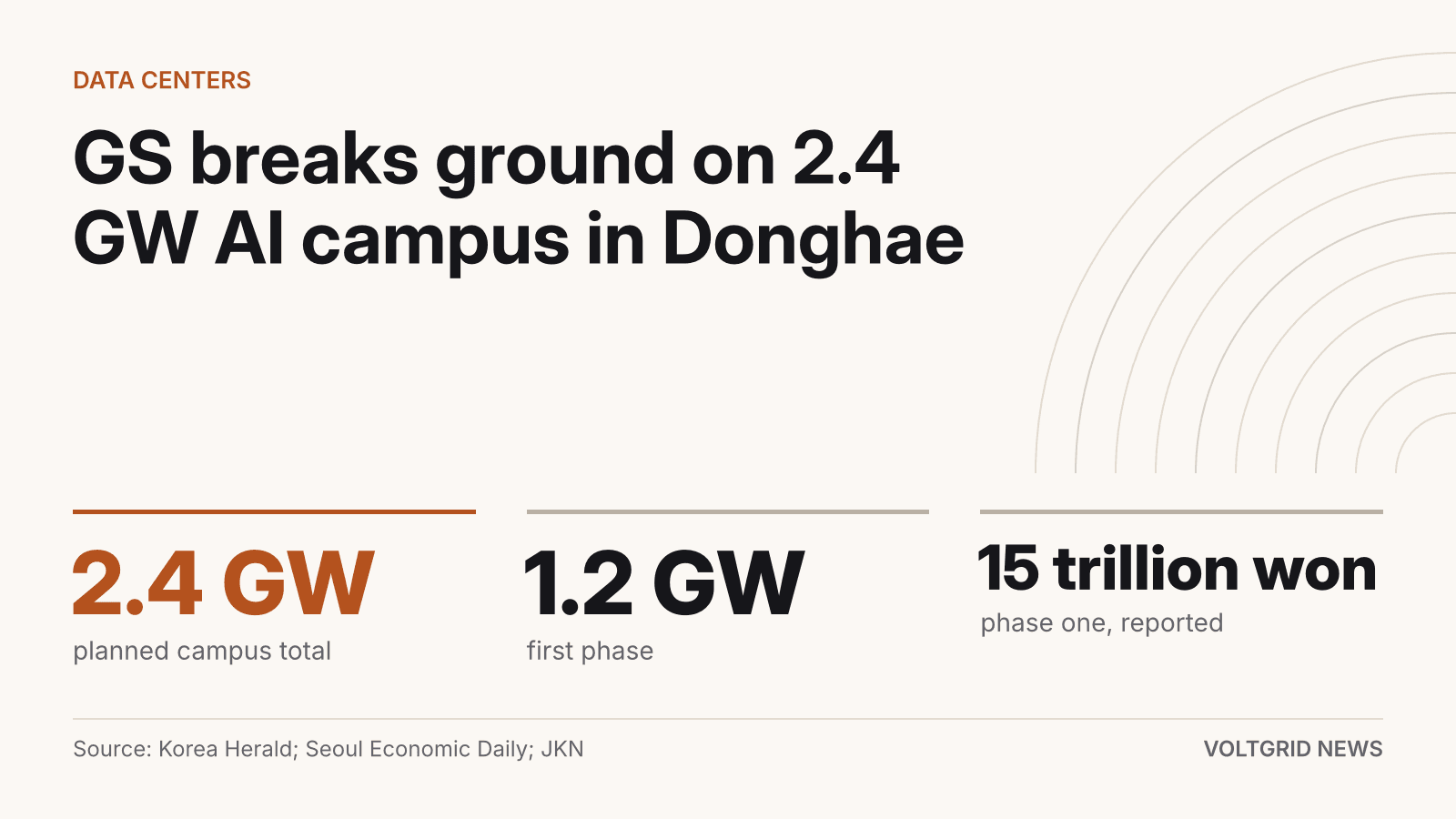
GS plans a 2.4 GW campus in Donghae; the first 1.2 GW phase carries a reported 15 trillion won investment.
Graphic: Voltgrid News
GS Group broke ground on Nov. 28, 2026 on the first 1.2 GW phase of a planned 2.4 GW AI data center campus in Donghae, Gangwon Province, with President Lee Jae Myung attending the ceremony.
The site is the Bukpyeong 2nd General Industrial Complex. According to Seoul Economic Daily, about 270 people attended, including GS Group Chairman Huh Tae-soo, Science and ICT Minister Bae Kyung-hoon and Gangwon Governor Woo Sang-ho. Yonhap, as carried by The Korea Herald, quoted the presidential office as calling it the first megaproject in Gangwon and Asia's largest AI infrastructure facility. It is one of the government's three megaprojects announced in June.
The campus is built in stages through 2030. Seoul Economic Daily reports that construction began on a 100 MW portion that holds its building and power permits, due for completion in the first half of 2028. The first 1.2 GW phase is due in 2029 and the second 1.2 GW phase in 2030.
GS plans a 100 MW block in H1 2028 and 1.2 GW in 2029, with a second 1.2 GW phase in 2030, according to Seoul Economic Daily.
Graphic: Voltgrid News
The first 100 MW is the grid figure to watch. The Ministry of Science and ICT issued draft rules on Nov. 20 that would exempt non-capital-region data centers of up to 50 MW from power grid impact assessments, according to Digital Today. A 100 MW first block is already above that line, and the JKN report says Gangwon completed a power system impact assessment within three months of the July agreement.
Money, site and phasing
JKN (Jaekyung Ilbo) reports that the 1.2 GW first phase breaks down into about 700 MW on roughly 80,000 pyeong at Bukpyeong, split into three zones, plus a 500 MW centre on additional land. It gives the first-phase investment as about 15 trillion won, citing the figure announced in September, and puts infrastructure spending for the full 2.4 GW at about 30 trillion won. With GPUs and memory included, JKN says the project could reach up to 120 trillion won. These are estimates reported by the outlet, not a figure from a filing, and the phase one amount excludes the GPU cost.
GS set up a dedicated company, GS AI Infrastructure, under GS Corp. on June 11, per JKN. Gangwon signed a memorandum with GS and Donghae in July, and the city granted the building permit for the 100 MW facility in October. Digital Today quotes GS as saying the east coast was chosen for its power generation base and the option of seawater-based cooling in the future; no cooling design has been announced.
Voltgrid News reported earlier that kt cloud took all 60 MW of Keppel's Ansan data center near Seoul. Donghae sits outside the Seoul metropolitan area, where Korea's AI infrastructure is concentrated, and JKN's English edition says the government plans 18.4 GW of total capacity by 2035.
What is not confirmed yet
None of the reports names the power source, the utility supply arrangement or the transmission upgrade that would deliver 100 MW in 2028 and 1.2 GW in 2029. GS AI Infrastructure's own listing says its 100 MW, 1.2 GW and 2.4 GW figures are plan-scale values and not defined as grid intake, IT load or UPS capacity, so the figures should not be read as critical IT capacity.
No tenant, GPU supplier or financing partner has been named. Reports differ on the first completion date: second quarter of 2028 in JKN and first half of 2028 in Seoul Economic Daily. GS's own press release could not be read for this report, so the figures come from the outlets cited above. The 15 trillion won figure is for phase one only, and it is not the same as the 30 trillion won or 120 trillion won totals.
Sources
- 01President Lee Attends Groundbreaking for GS AI Data Center in DonghaeSeoul Economic Dailyen.sedaily.com
- 02AIDC megaproject breaks ground as GS starts 1.2-GW centre in DonghaeDigital Todaydigitaltoday.co.kr
- 03Lee attends groundbreaking ceremony for major AI data center in GangwonThe Korea Heraldkoreaherald.com
- 04동해 GS AI데이터센터 착공…1단계 1.2GWJKN (Jaekyung Ilbo)news.jkn.co.kr
- Published
- Sources
- 4 cited