First published Changes log
TrendForce Sees NAND Falling in 1Q27, DRAM in 2028; KB Sees 40% Rise
Two forecasts split on 2027 memory prices. TrendForce sees NAND contract prices 0% to 5% lower in 1Q27 and DRAM falling from 1Q28; KB Securities expects Samsung's and SK hynix's DRAM prices up 40% and NAND up 30%.
7 min read
- TrendForce: NAND contract price fall, 1Q27
- 0-5%forecast, QoQ
- TrendForce: DRAM decline begins, base case
- 1Q284Q27 in bear case
- KB: Samsung, SK hynix DRAM prices, 2027
- 40%forecast
- KB: Samsung, SK hynix NAND prices, 2027
- 30%forecast
As ofSourceTrendForce, KB Securities via Seoul Economic Daily
Two memory forecasts published this month disagree on 2027. TrendForce expects NAND contract prices to fall 0% to 5% quarter-on-quarter in the first quarter and DRAM potentially to level off in the second half, while KB Securities expects Samsung's and SK hynix's DRAM prices to rise 40%.
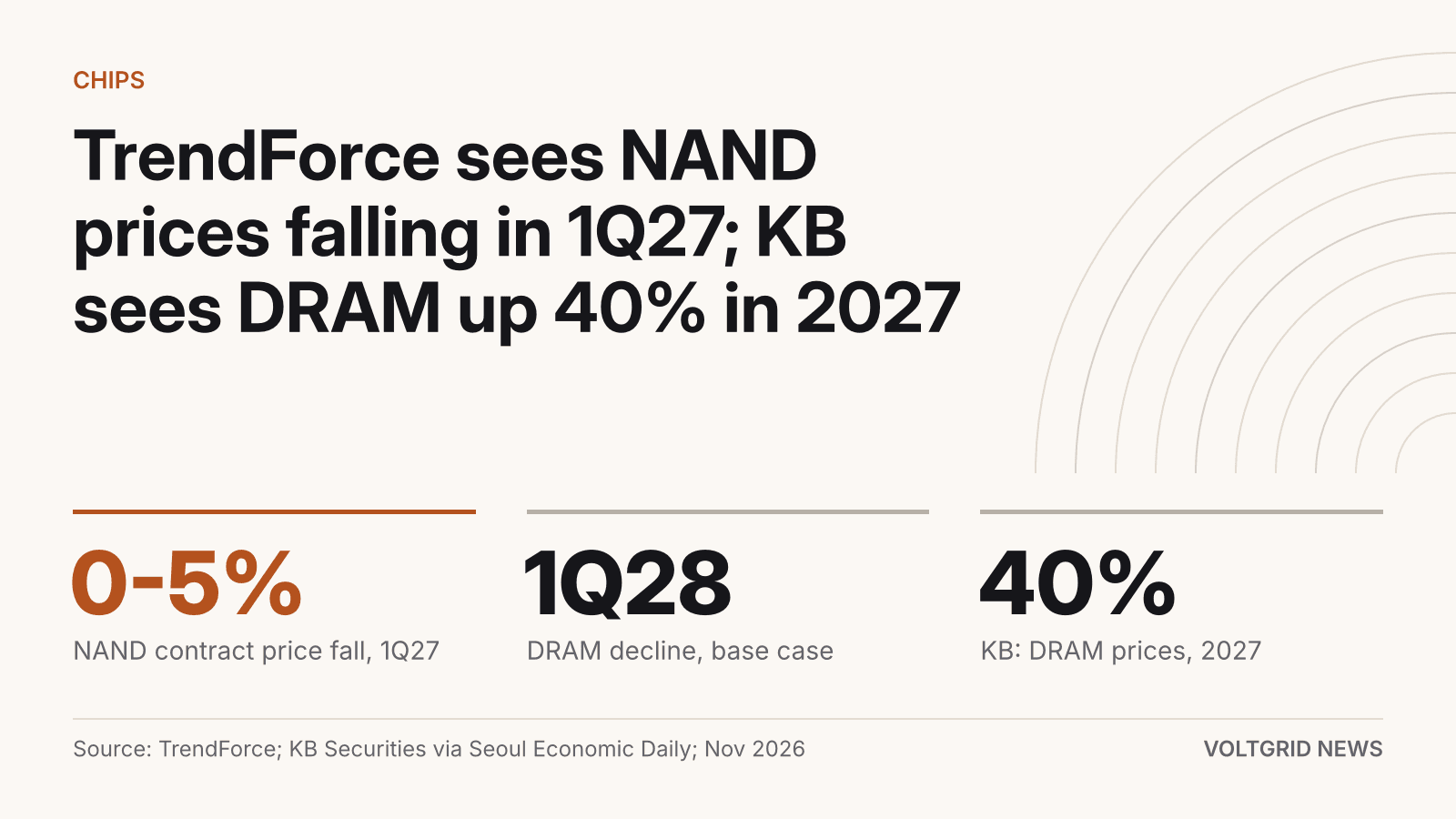
TrendForce sees NAND contract prices 0% to 5% lower in 1Q27; KB Securities expects Samsung's and SK hynix's DRAM prices up 40% in 2027.
Graphic: Voltgrid News
The two views measure different things, and that explains much of the gap. TrendForce forecasts market-wide contract prices quarter by quarter; KB Securities forecasts the average selling prices of two companies whose sales lean toward server memory and enterprise SSDs. Our earlier stories covered each forecast as it came: TrendForce on DRAM, TrendForce on NAND and KB Securities.
Who expects what for 2027?
Lined up by forecaster, the calls split by product more than by optimism. TrendForce is bearish on NAND, with contract prices 0% to 5% lower in the first quarter, and cautious on DRAM from late 2027; KB Securities sees both rising for its two companies over the full year, by 40% and 30%; SK hynix itself expects demand to exceed supply through 2030 and says more than 50% of its 2027 to 2028 capacity is under long-term agreements.
| Forecaster | Measure | Call | Status |
|---|---|---|---|
| TrendForce | NAND contract prices | 0% to 5% lower in 1Q27; all categories down from 2Q27 | Forecast |
| TrendForce | DRAM contract prices | Level off in 2H27, then decline from 1Q28 in the base case; from 4Q27 in the bear case | Forecast |
| KB Securities | Samsung, SK hynix DRAM selling prices | Up 40% in 2027 | Forecast |
| KB Securities | Samsung, SK hynix NAND selling prices | Up 30% in 2027 | Forecast |
| SK hynix | Memory supply and demand | Demand above supply through 2030 | Company view |
NoteTrendForce figures are quarter-on-quarter market contract prices; KB Securities figures are full-year averages for two companies.
SourceTrendForce, Nov. 19 and 27, Seoul Economic Daily, Nov. 20, SK hynix, Oct. 28
As of
Why does NAND turn first?
TrendForce's Nov. 19 release puts the turn in NAND at the start of 2027. It cut its forecast for fourth-quarter contract price increases to 8% to 13%, and expects a decline of 0% to 5% in the first quarter, with all product categories in a downward cycle from the second quarter. Spot prices have already corrected by more than 20%, it says.
The reason is supply. TrendForce expects global NAND bit supply to grow 25% to 30% in 2027 and industry capital spending to rise 26.7% to US$29.9 billion, while Chinese cloud providers cut their 2027 enterprise SSD orders by more than U.S. cloud providers added. Phone and PC makers, facing higher memory costs, are expected to ship devices with less storage.
TrendForce names what could change the NAND path: how fast Chinese cloud providers work down their inventories, whether limits on their overseas GPU purchases change, whether device makers keep cutting memory specifications into 2028, and whether U.S. policy after the midterm elections affects AI data center projects planned for 2028. The pace of those approvals, it says, will set how much inventory buyers lay in during the second half of 2027.
Even so, TrendForce's Nov. 25 release still has 2027 NAND revenue at $419.3 billion, up 29% on 2026, after a lower forecast. A falling quarterly price from a high starting level can still leave a year's revenue well above the year before.
Why does DRAM hold up longer?
For DRAM, TrendForce expects supply to stay tight through 2027. Its Nov. 25 release cut the 2027 DRAM revenue forecast to $1.15 trillion, still 69% above 2026, because quarterly price increases are expected to narrow rather than reverse. Some Chinese cloud providers reduced server DRAM demand outside long-term agreements in the fourth quarter, but North American providers took up the volume.
On the supply side, TrendForce expects global DRAM bit supply to keep growing strongly from 2026 through 2028 as makers add capacity and move to more advanced processes. That growth is what turns a shortage into a looser market once server demand slows; on its numbers, the shortage eases in 2028 rather than in 2027.
The Nov. 27 release sets out two paths. In the base case, increases narrow through 2027, prices may level off in the second half, and contract prices fall across all product categories from the first quarter of 2028 as server shipment growth slows. In the bear case, server makers cut orders further and inventories are reduced across the supply chain, and DRAM contract prices begin to fall in the fourth quarter of 2027, with the declines widening in 2028.
TrendForce names the risks behind the bear case: the outcome of the U.S. midterm elections for data center building, changes to NVIDIA's financing for neocloud providers, and new U.S. export rules on advanced AI chips and on access to computing for Chinese companies.
Why does KB Securities see prices rising?
KB Securities' report, as Seoul Economic Daily reported on Nov. 20, rests on a DRAM shortage that deepens in 2027. It expects global DRAM demand to grow 25% against supply growth of 18%, a gap of 7 percentage points by our math, with server DRAM demand up 56% and enterprise SSD demand up 54%. Major customers would receive only about 70% of the DRAM they need, the brokerage estimates.
KB Securities sees 2027 server DRAM demand up 56%, against DRAM supply growth of 18%
KB Securities forecasts for 2027, growth from 2026, percent
NoteBrokerage forecasts as reported by Seoul Economic Daily; the report itself was not published in English.
SourceSeoul Economic Daily, Nov. 20, 2026
As of
Data table
| Category | 2027 growth forecast (%) |
|---|---|
| Server DRAM demand | 56 |
| Enterprise SSD demand | 54 |
| DRAM demand | 25 |
| NAND demand | 19 |
| DRAM supply | 18 |
Its NAND call depends on the product mix. KB Securities expects global NAND demand to grow 19% in 2027, roughly in line with supply, but enterprise SSDs make up more than 65% of NAND revenue at Samsung and SK hynix, against 30% to 40% at SanDisk and Kioxia, so their selling prices follow the tight enterprise market rather than weaker phone and PC demand. That is how a 30% price rise for two companies can sit beside a falling market price.
The brokerage also notes that spot prices fell 5% for DRAM and 20% for NAND over the past month while contract prices kept rising. Spot prices react first to weak phone and PC sales; contract prices for server memory and enterprise SSDs, it argues, are what drive the two companies' earnings. As of November, it estimated, the gap between spot and contract prices had widened to more than 20%, which is the gap the two forecasts read differently.
What do the memory makers say?
SK hynix, in its Oct. 28 results, said it expects demand to exceed supply through 2030, given the difficulty of leading-edge processes and the long lead time for new fabs, and that long-term agreements cover more than 50% of its 2027 to 2028 production capacity. On its earnings call the same day, the company said achievable demand growth in 2027 would be similar to this year's, in the mid-twenties in percent for DRAM and the high teens for NAND, and that counting long-term agreements and demand under discussion, its DRAM and HBM volume through 2029 is effectively sold out. Winbond's chairman, in contrast, said this month that he hopes prices have peaked, as we reported.
The latest monthly prices show where the market stood before the forecasts. DRAMeXchange put October's average contract price for DDR4 8Gb chips at $27.5 a chip, up 5.77% from $26 in September, while MLC NAND held at $30.61, BusinessKorea reported. TrendForce then expected PC DRAM contract prices to rise 13% to 18% in the fourth quarter, and Korean makers' PC DRAM production to fall by more than 20% in 2027 as they shift capacity to servers. We covered the October record when it was published.
SK hynix sees demand above supply through 2030
DDR4 8Gb contract price at a record $27.5
TrendForce: NAND contract prices to fall in 1Q27
KB Securities: DRAM prices up 40% in 2027
TrendForce cuts 2027 revenue forecasts
TrendForce: DRAM declines from 1Q28, 4Q27 in bear case
What does this mean for AI server buyers?
For buyers of AI servers, the forecasts agree on more than their headlines suggest. Neither TrendForce nor KB Securities sees server DRAM getting cheaper in the first half of 2027; they differ on when the turn comes and on how far consumer weakness reaches the server market. NAND for enterprise SSDs is the closest call: market prices may fall from the first quarter while the two Korean suppliers expect to keep raising theirs.
Long-term agreements make the timing matter less for the largest buyers, who have locked in volumes, and more for smaller ones buying on contract each quarter. A decline in the first quarter of 2028 or the fourth quarter of 2027 would arrive as many 2028 data center projects are still in planning, which is why TrendForce ties its outlook to U.S. policy after the midterm elections.
The forecasts also leave open how much of the 2027 rise has already happened. Contract prices set records through October, and both forecasters start from that high level: a NAND decline of 0% to 5% in the first quarter still leaves prices far above where they were a year earlier, and a DRAM market that only levels off in the second half keeps buyers paying record prices for most of 2027. For a buyer, the question the forecasts answer is not whether memory gets cheap in 2027, but when it stops getting dearer.
Terms in this story
- contract price
- The price negotiated between memory makers and large buyers for a month or quarter, as opposed to the daily spot price.
- spot price
- The price of memory traded in the open market for immediate delivery; it reacts faster than contract prices.
- average selling price
- A company's revenue per unit sold, which depends on its product mix as well as on market prices.
- enterprise SSD
- A solid-state drive built for servers and data centers, made with NAND flash.
- long-term agreement
- A multi-year supply contract that fixes volumes, and sometimes pricing terms, between a memory maker and a customer.
- CSP
- Cloud service provider: a company such as a hyperscaler that rents computing and storage.
How we counted
We set side by side the memory price forecasts published between Oct. 28 and Nov. 27, 2026: three TrendForce releases, KB Securities' report as reported by Seoul Economic Daily, SK hynix's third-quarter release and DRAMeXchange's October prices as reported by BusinessKorea. TrendForce's figures are quarter-on-quarter market contract prices; KB Securities' are full-year averages for Samsung and SK hynix. The demand-supply gap is our own arithmetic.
What to watch
First test of TrendForce's NAND decline
Contract prices forecast 0% to 5% lower than in 4Q26.
All NAND categories forecast to fall
DRAM increases may level off, base case
DRAM decline begins in TrendForce's bear case
DRAM decline begins in TrendForce's base case
Changes
First published.
Sources
- 01NAND Flash Prices Set to Decline in 2027 as Chinese CSP Order Cuts Outweigh North American Demand Growth, Says TrendForceTrendForcetrendforce.com
- 02SK hynix Announces 3Q26 Financial ResultsSK hynixnews.skhynix.com
- 03SK hynix Q3 2026 earnings call transcriptYahoo Financefinance.yahoo.com
- 04KB Securities Sees DRAM Contract Prices Jumping 40% Next YearSeoul Economic Dailyen.sedaily.com
- 05Limited Demand Visibility and Growing Supply Chain Caution Heighten Risk of DRAM Contract Price Declines in 2028, Says TrendForceTrendForcetrendforce.com
- 06Cuts to Chinese CSP Demand Weigh on Price Outlook, Slowing Memory Industry Revenue Growth in 2027, Says TrendForceTrendForcetrendforce.com
- Published
- Sources
- 6 cited