Intel Driver Page Lists Raptor Lake-S NEXT Beside Bartlett Lake-S
Intel's Bartlett Lake-S driver page, dated Nov 26, lists Raptor Lake-S NEXT. Hardware Busters calls it the first official mention of the name; specs, socket, memory support and timing are still only reported.
3 min read
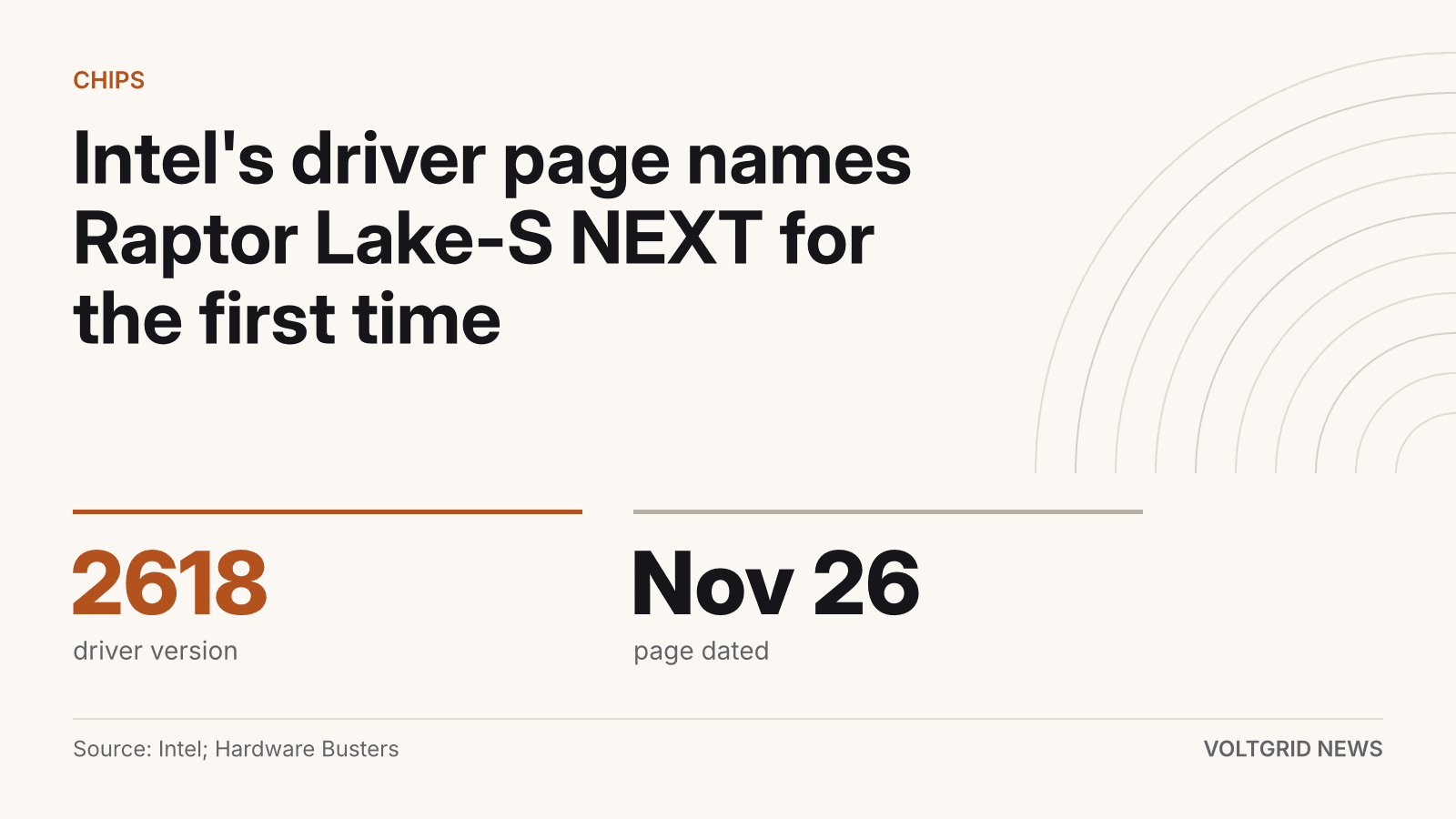
Intel's Bartlett Lake-S driver page, version 2618, dated Nov 26, is the first official mention of Raptor Lake-S NEXT, according to Hardware Busters.
Graphic: Voltgrid News
Intel's own display virtualization driver page for Bartlett Lake-S, version 2618 and dated November 26, 2026, lists Raptor Lake-S NEXT, a name that until now had surfaced only in leaks.
The page says the Windows zero-copy build applies to Bartlett Lake-S Hybrid MR4 and 12P MR2 "and Raptor Lake-S NEXT PV", and its detailed description names the two platforms together. It lists Ubuntu 26.04 as the host operating system and Windows 11 as the guest. Hardware Busters, which reported the listing on November 28, says it appears to be the first time the codename has appeared in official Intel material; it credits TechPowerUp with spotting the entry. Intel has not announced the family.
A VM driver, not a launch
The package is plumbing for virtual machines. Hardware Busters says Intel states the driver is required for SR-IOV and KVM multi-OS operation, in which one chip runs several operating systems side by side. It places such setups in industrial PCs, kiosks and edge systems, reads the listing as Bartlett Lake-S territory and calls Raptor Lake-S NEXT its sibling platform; Intel does not describe the relationship.
Intel does not define "PV". Hardware Busters notes that the suffix commonly marks a production-validation or production-version stage, past engineering samples, but the page itself does not say so.
What a Zero-Copy Display Driver Does
A virtual machine has no screen of its own, so its display frames must reach the real one through the host. A zero-copy driver hands those frames over without duplicating them in memory. Intel's version 2618 package does this for a Windows 11 guest on an Ubuntu 26.04 host running QEMU, using Microsoft's Indirect Display Driver model.
The consequence is for embedded and edge designs: one chip can run Linux and Windows side by side while frames move without extra copies. The page names Raptor Lake-S NEXT PV as a target, but it gives no specification, memory support or launch date.
Why LGA1700 gets another round
The platform logic matters more than the codename. Hardware Busters argues the reason is memory: it says Arrow Lake and the coming Nova Lake-S parts take only DDR5 (Intel has not confirmed Nova Lake-S memory support), that DDR5 prices have been high for most of 2026, and that LGA1700 boards can still use DDR4. If the refresh supports both, Intel could sell new chips into existing boards and cheaper builds. Intel has not said which memory Raptor Lake-S NEXT supports.
Everything about the chips themselves remains reported, not confirmed. Shipping records reported in October and cited by Hardware Busters list four Raptor Lake Next SKUs, none of them an Intel specification, including a 16-core part with 8 performance and 8 efficient cores at up to 125 W and a 20-core part with 8 and 12 at 65 W. Hardware Busters also reports that Gigabyte has issued BIOS updates for B760 and H610 boards ahead of new LGA1700 processors in early 2027. For Nova Lake-S, a leaked document points to seven Core Ultra 4000 chips led by a 28-core part, as Voltgrid reported.
Intel's page confirms driver version 2618 for Raptor Lake-S NEXT PV; core counts, boards and memory are only reported.
Graphic: Voltgrid News
What is not confirmed yet
Intel has given no SKU names, core counts, memory support, prices or launch date, and has not said whether the chips will carry Core or Core Ultra branding. The 2027 timing comes from leaks and board makers, not from Intel. Hardware Busters also notes that Raptor Lake is the architecture behind the 13th- and 14th-generation instability, which Intel traced to elevated operating voltage and patched with microcode in 2024, and that a refresh of the same design will have to win back buyers. Intel has not said what silicon Raptor Lake-S NEXT uses. The next signal to watch is a product listing or SKU announcement from Intel itself.
Sources
- Published
- Sources
- 2 cited