Intel Moon Lake Leak: 62.79 mm² Compute Die, 19% Below Wildcat Lake
Leaker Jaykihn says Moon Lake's 18A compute die is 62.79 mm² and Wildcat Lake Refresh grows to 93.30 mm². Intel has not confirmed any figure, and TechPowerUp prints 62.70 mm².
3 min read
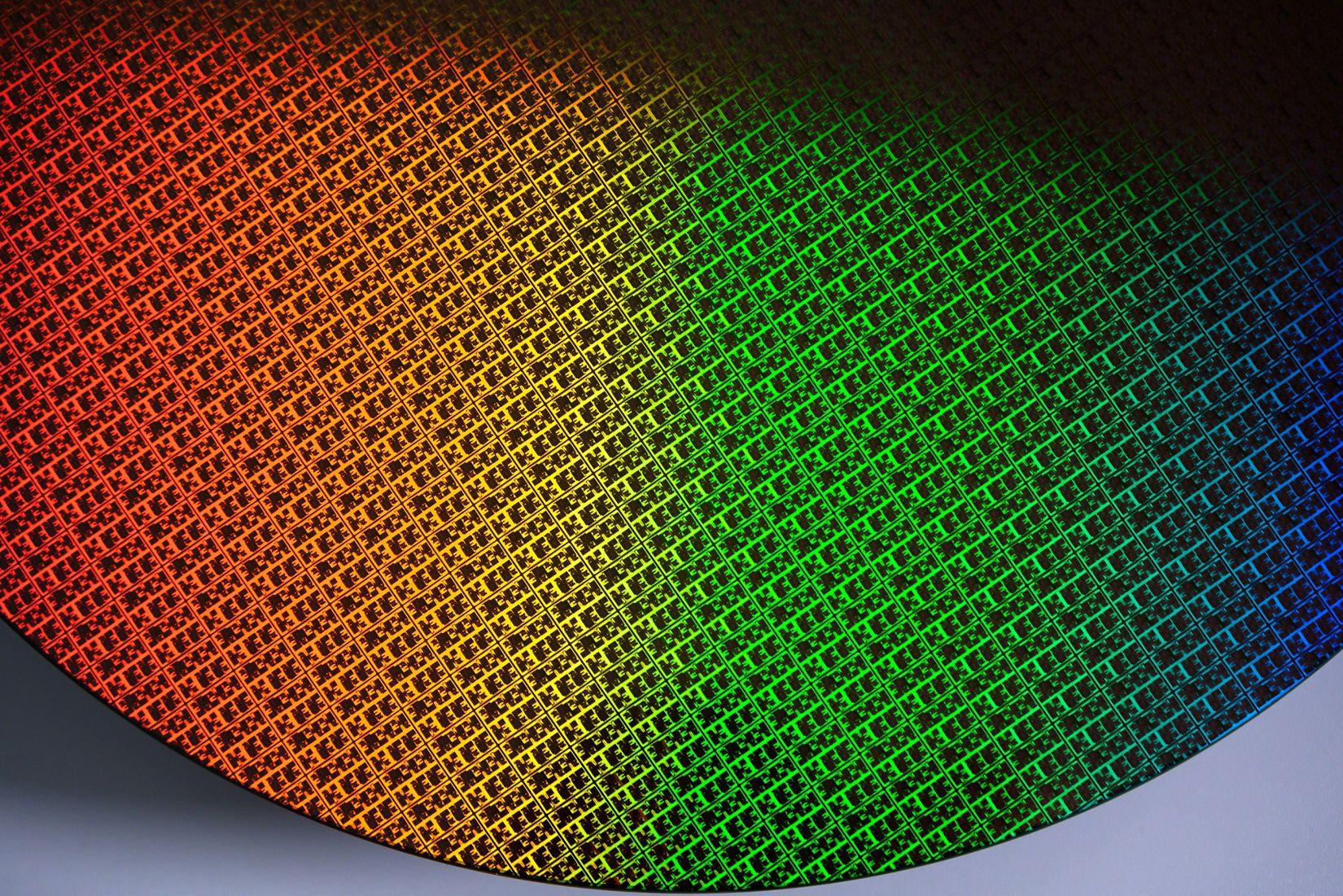
An Intel 18A wafer. File photo of the process node, not a picture of Moon Lake or Wildcat Lake.
Image: Intel
Source · Press image from the Intel newsroom, used for news reporting.
Intel's Moon Lake mobile chip has a compute die of 62.79 mm², about 19% smaller than the current Wildcat Lake compute die, according to die sizes the leaker Jaykihn posted on X on 26 November 2026. Intel has not confirmed any of the figures.
TweakTown and TechPowerUp both relayed the post. It lists the Wildcat Lake compute die on Intel 18A at 77.42 mm², the Wildcat Lake Refresh compute die on 18A-P at 93.30 mm², and Moon Lake on 18A at 62.79 mm². A shared platform controller die (PCD) on TSMC N6 is listed at 41.91 mm² for all three. TechPowerUp prints the Moon Lake figure as 62.70 mm², but the leaker's post itself reads 62.79 mm², which TweakTown also prints, so Voltgrid uses 62.79 mm².
Moon Lake's reported compute die is the smallest of the three; the platform controller die is the same 41.91 mm² on all of them. Leaker figures, not confirmed by Intel.
Graphic: Voltgrid News
Why die area matters
Compute-die area is the main driver of how many chips fit on an 18A wafer, and Intel's CFO has said Oregon 18A capacity is being swapped for Intel 3 data center output, as Voltgrid reported earlier. A smaller entry-level die would stretch that scarce capacity further, if the leak is accurate. Adding the reported PCD, Voltgrid's own arithmetic puts total silicon at about 104.70 mm² for Moon Lake against 119.33 mm² for Wildcat Lake, a gap of roughly 12%, narrower than the 19% compute-tile gap because the N6 die does not shrink. These are leaked figures and say nothing about yield or cost per die.
Why 18A-P Does Not Shrink the Die
Intel's 18A-P is a tuned version of its 18A node, not a new one. Intel says it is design-rule compatible with 18A, so a chip can move to it without redrawing its transistor layout, and quotes 9% higher performance at the same power or 18% lower power at the same performance. That is why the leaker's claim of no optical shrink is plausible: the node gains speed or efficiency, not density.
So the Wildcat Lake Refresh compute die grows from 77.42 mm² to 93.30 mm² because it adds cores and cache, not because the node is looser. Moon Lake stays on plain 18A at 62.79 mm², and a smaller die only matters if yield and wafer cost hold.
What the leaker says changed
Per TechPowerUp, the Wildcat Lake Refresh compute die is about 21% larger than Wildcat Lake (the leaker's rounded figure; 93.30 against 77.42 mm² is about 20.5%) because it reportedly doubles the P-cores from two to four, while keeping four low-power efficiency (LPE) cores and two Xe3 graphics cores. TweakTown adds 6 MB of extra L3 cache to the list of reasons. Jaykihn says there is no optical shrink from 18A to 18A-P, which matches Intel's comparable-density claim for the newer node, according to TechPowerUp.
Moon Lake drops P-cores entirely, stays on standard 18A, and carries four Darkmont LPE cores with a 6 W base power rating, per TechPowerUp. That is a very different design from the Wildcat Lake chip Intel's CFO said is selling out, as Voltgrid reported.
Timing and open questions
TechPowerUp reports Wildcat Lake Refresh is expected in Q2 2027 and Moon Lake in Q4 2027. TweakTown's earlier Moon Lake report says leaks point to a 2028 debut, so the Moon Lake date is not settled. It also says reports suggest Intel is refreshing Wildcat Lake because the original is not competitive with Apple's MacBook Neo; TechPowerUp does not name the source, and it is not an Intel statement.
Intel has not published die sizes, core counts or dates for either chip. Both outlets rely on one X account, and no second source has measured a die. Intel's next roadmap disclosures, and any Linux or driver enablement for the new parts, would be the first sign of whether the sizes hold. Voltgrid News also covered Intel's Razor Lake-AX leak.
Sources
- Published
- Sources
- 2 cited