NextSilicon Arbel RISC-V Test Chip Hits 2.5 GHz; 64-Core Part Due 2028
NextSilicon's 5nm Arbel RISC-V test chip runs at 2.5 GHz, ServeTheHome saw at SC26. The 64-core server part, targeting 3.4 GHz, is planned for early 2028.
3 min read
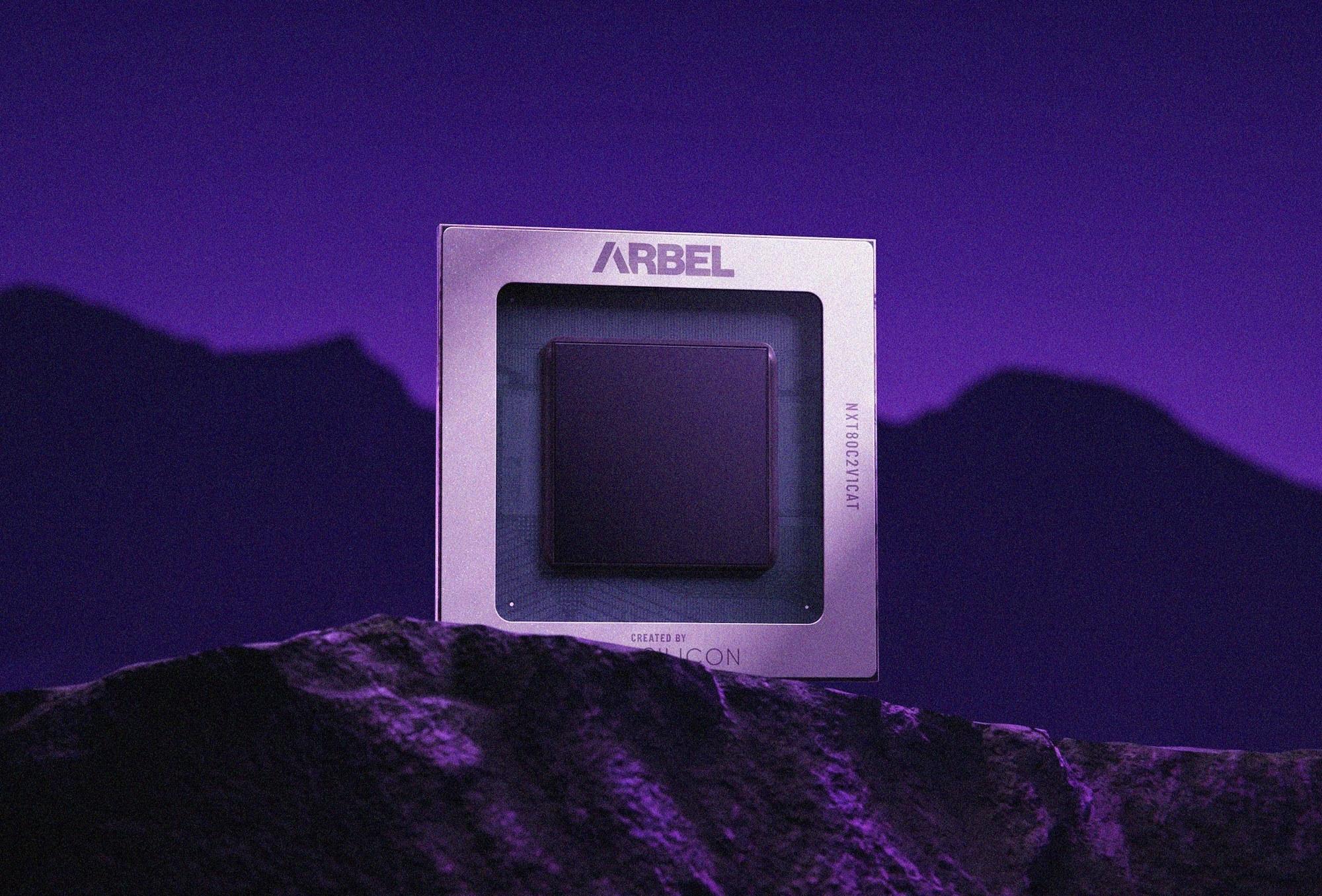
NextSilicon's promotional image of the Arbel processor. It is not a photo of the test chip shown at SC26.
Image: NextSilicon
Source · Press image from the NextSilicon release, used for news reporting.
NextSilicon's Arbel RISC-V server processor has appeared as a TSMC 5nm test chip running at 2.5 GHz, which ServeTheHome reported on Nov 28, 2026 that it saw at the SC26 supercomputing conference. The figures match NextSilicon's own release.
The chip sat on a small carrier board in a glass case at the booth, ServeTheHome reported. The reporter noted that the "34" marking may mean it is the 34th test chip off the line, which is a guess, not a NextSilicon statement. Arbel began as the control processor inside the company's Maverick-2 dataflow accelerator, then became a separate server CPU effort.
What the test chip is, and what the product is meant to be
The test chip and the planned product are different parts. In a June 10, 2026 release, carried by HPCwire, NextSilicon said it would turn Arbel into 64-core and 128-core processors expected in early 2028. It said the product targets 3.4 GHz and moves to a more advanced process node, which it did not name. Today's test chip runs at 2.5 GHz against that 3.4 GHz production target. NextSilicon's product page, meanwhile, describes Arbel as built on "a modern 5nm process", so the two documents do not agree on the node that will set power and density.
The Arbel test chip runs at 2.5 GHz; the 3.4 GHz figure is NextSilicon's target for the production part.
Graphic: Voltgrid News
The two documents also differ on the vector hardware. The June release describes four 128-bit vector units on the test chip. NextSilicon's current Arbel page lists three 256-bit units for the 64-core processor. The release and the page both give a 10-wide instruction pipeline and a 480-entry reorder buffer. Both also describe full RVA23 compliance (the RISC-V profile that standard Linux distributions target), though the release states it for the core generally, not for the test chip. ServeTheHome added that the chip is meant to support CXL, a memory-attach interconnect, alongside DDR5.
Performance claims are the company's estimates
NextSilicon estimates that Arbel's target will beat today's leading processors per GHz. The company's page shows an estimated 2.6 SPECint2017 per GHz against 2.3 for an unnamed "latest generation processor", and 3.4 against 3.0 for SPECfp2017. NextSilicon says its own figures come from cycle-level simulation plus public data as of May 2026, and that SPEC has not reviewed them; its page itself calls SPEC CPU 2017 a retired benchmark that SPEC no longer reviews. They describe the product target, not the chip on display, and no independent result exists yet.
What per-GHz benchmark figures do and do not show
Dividing a SPEC CPU 2017 score by clock speed measures work done per cycle, so it compares core designs, not finished chips. The estimates above all come from NextSilicon's own simulation.
Absolute speed also needs the clock the part reaches. The test chip runs at 2.5 GHz, and the 3.4 GHz target belongs to a production part planned for early 2028 on a node NextSilicon has not named. Until that part exists, the per-GHz lead is a design estimate, not a server result.
Why it matters for data-center buyers
NextSilicon's page says Arbel is built to keep accelerators fed. In Voltgrid's view, server-class alternatives to x86 and Arm remain few. For context, as Voltgrid reported, AMD's server CPU share reached 35.5% in the third quarter. ServeTheHome expects more RISC-V in data centers from 2028, the same year NextSilicon is targeting. For power planning the missing figures are TDP and core power, which NextSilicon has not published.
What is not confirmed yet
NextSilicon has not disclosed a TDP, memory configuration, pricing or named customers, and its documents disagree on the production node. The June release says customers and partners evaluated test silicon but names none. ServeTheHome said it hopes to test Arbel nearer launch, and expects a shipping part to need clocks above 3 GHz and 64 to 128 cores, which is the reporter's view. Until independent benchmarks exist, treat the per-GHz figures as marketing targets.
Sources
- Published
- Sources
- 3 cited