NTT DATA, Bloom Energy Announce 900 MW Fuel Cell Agreement for Data Centers
NTT DATA's agreement with Bloom Energy covers 900 MW of fuel cells as primary power for data centers worldwide, with first shipments in 2027. The release names no site, gas supplier or terms.
Nuclear & Microgrids DeskEdited by Ege Erten
6 min readAI-assisted

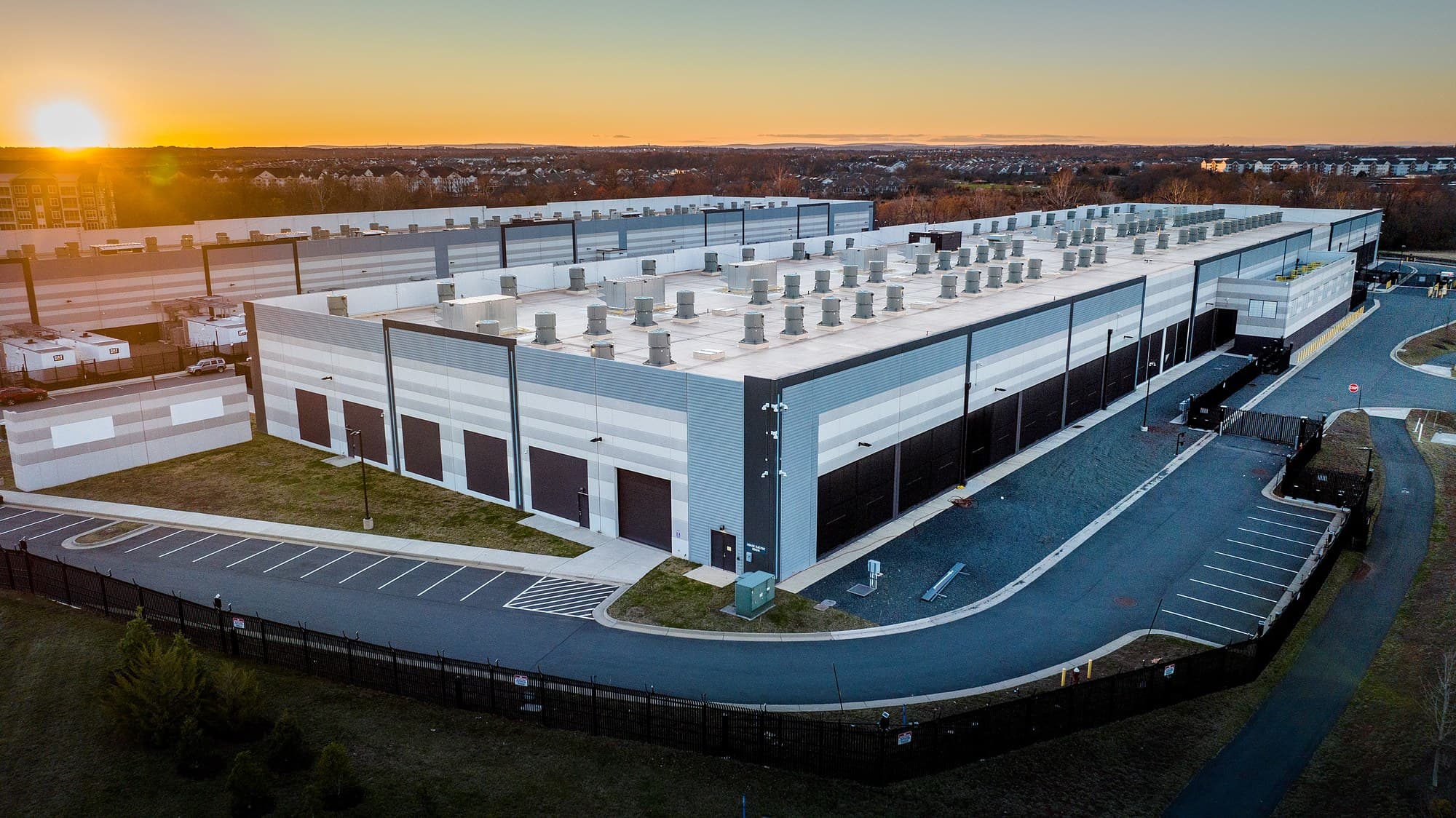
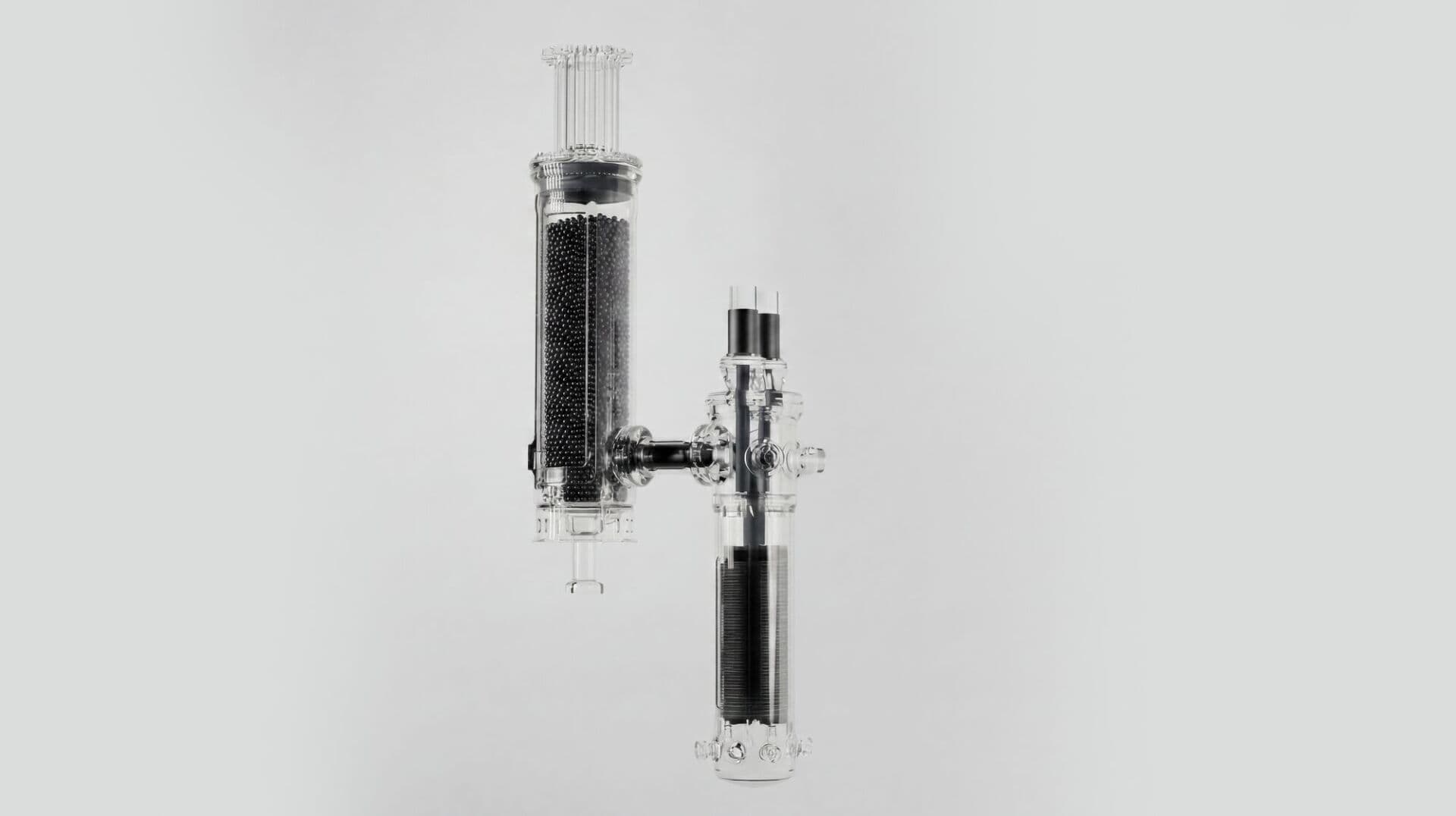
Bloom Energy Servers, the fuel-cell systems NTT DATA plans to use as primary power. The photo is a Bloom file image, not an NTT site.
Image: Bloom Energy
Source · Press image from the Bloom Energy newsroom, used for news reporting. · License
NTT DATA said on Nov. 5 that its NTT Global Data Centers business will use 900 MW of Bloom Energy fuel cells as on-site primary power across several data center projects worldwide, with first shipments targeted for 2027. The agreement suggests fuel cells are moving from a US answer to slow grid hookups into a power plan that a global operator will take abroad, but with no sites, gas supply or terms disclosed, it is a statement of scope rather than a build schedule.
The two companies announced the agreement in a Business Wire release at 14:00 UTC on Nov. 5. NTT DATA says the 900 MW will serve multiple data center projects globally and that NTT Global Data Centers will run the fuel cells as primary power, so that capacity can come online sooner in markets short of grid power. Bloom calls it its largest international project to date. Both say the relationship is meant to spread across NTT DATA's data center portfolio and reach gigawatt scale, an aim that carries no date.
The release leaves out most of what defines a power contract. It names no country, campus or end customer and gives no price or contract value. It does not say whether the 900 MW is a firm purchase order, a framework with later call-off orders or a master agreement, who supplies the natural gas, who owns the systems, or whether any site can run islanded from the grid. Bloom's own forward-looking statement lists the megawatts deployed, any expansion and the start of shipments among the items that may differ from plan. The 900 MW is therefore the announced scope, not capacity on order.
Doug Adams, chief executive of NTT Global Data Centers, said clients are building AI capacity faster than the grid alone can always serve, and that speed to power now decides where and when capacity is delivered. Aman Joshi, Bloom's chief commercial officer, said companies that lock in power quickly gain an edge and a faster route to revenue.
Why Bloom's Largest International Project Matters
The first step of the argument is how American Bloom still is. Its third-quarter 10-Q puts US revenue at 97% of the quarter's $1,235.8 million total and 93% of revenue for the first nine months. Overseas shipments go mainly to Korea, Japan, India and Taiwan, plus Germany, the UK and Italy. Its largest data center agreements are also American: Oracle intends to procure up to 2.8 GW under a master services agreement, of which 1.2 GW is contracted for US projects, Bloom said on April 13, and AEP plans a 702 MW Bloom fuel-cell plant near Cheyenne, Wyoming, whose output Google will buy under a 20-year power purchase agreement, AEP said on Oct. 14.
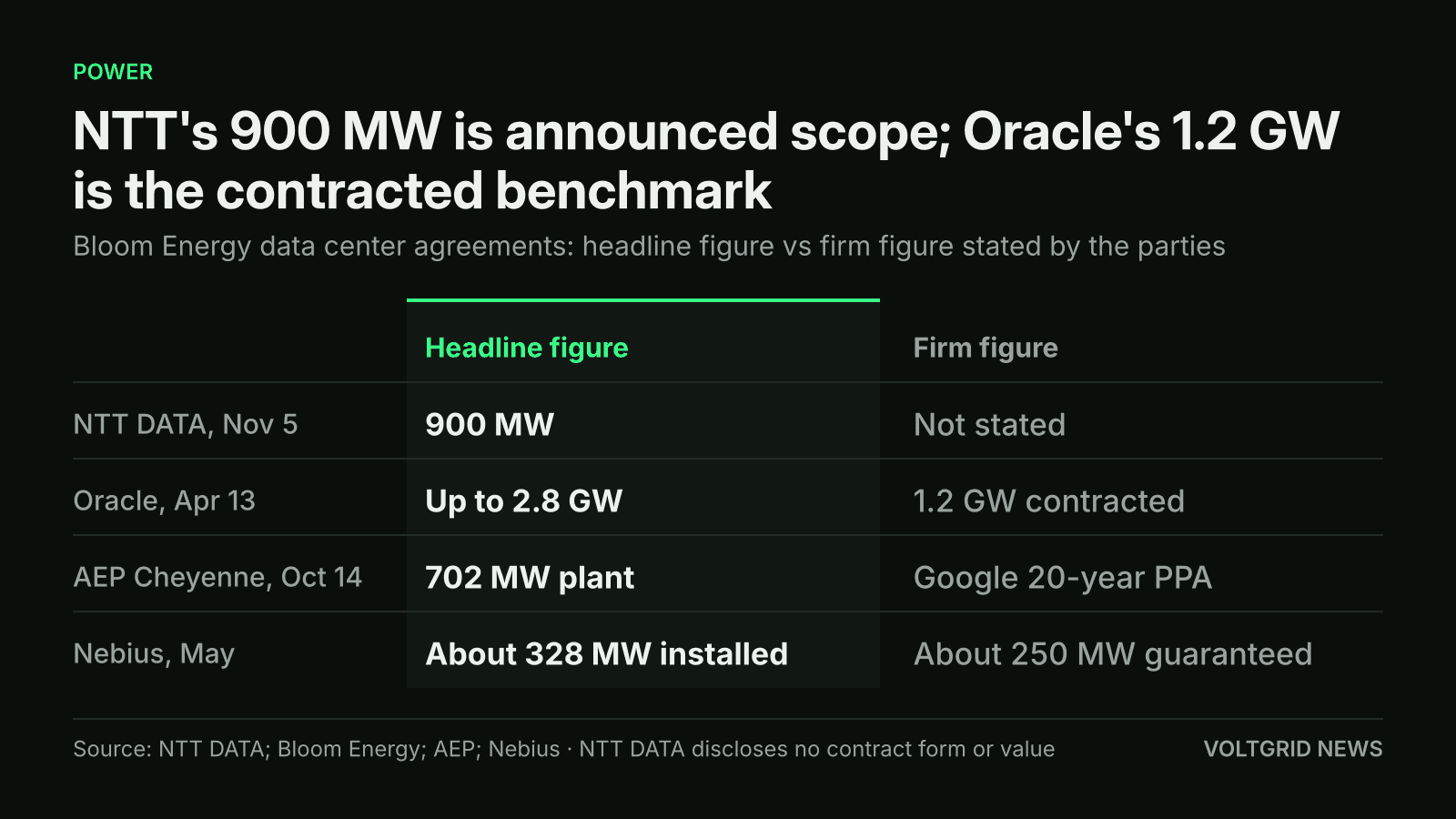
NTT DATA's 900 MW is announced scope with no firm figure stated, unlike Oracle's 1.2 GW contracted.
Illustration (AI-generated)
The second step is the reason buyers give, which is time. Power Engineering reported on Nov. 4 that Omdia projects data centers could deploy 35 GW of behind-the-meter power by 2030, as grid shortages and longer interconnection queues push developers to build their own supply. That report is mostly about gas turbines, engines and batteries rather than fuel cells, and it quotes developers who would rather buy from utilities but will not wait.
The third step is inference. If an operator with data centers in many countries commits 900 MW to on-site fuel cells, that suggests the time-to-power squeeze behind the US orders is now shaping plans in other markets too. The release also frames the systems as primary power, not backup. The fuel cells AEP Ohio installed for AWS and Cologix were described as a bridge until the grid catches up, as Voltgrid's AEP Ohio project file sets out; NTT DATA's release uses no bridge language. If even part of the 900 MW ships outside the US, it could show in the geographic revenue split that Bloom reports every quarter.
How Bloom Fuel Cells Make Power On Site
A Bloom Energy Server is a solid-oxide fuel cell: it makes electricity from fuel by an electrochemical reaction, not by burning it, as the NTT DATA release puts it for the technology. Systems are stacked in modular units beside the data center, so capacity is added in steps and sits behind the meter, on the customer's side of the grid connection, instead of waiting for a utility line. Bloom says it manufactures its systems in the United States.
The 900 MW is the announced scope, not capacity on order. Bloom's other data center deals show the gap: Oracle intends to procure up to 2.8 GW with 1.2 GW contracted, and AEP's Cheyenne plant is 702 MW. Each NTT site still needs a fuel supply, a permit and a grid arrangement, which the release does not disclose.
The Case Against the 900 MW Figure
The strongest objection is that nothing binding is on the record. Bloom's earlier data center agreements show how far headline figures can sit from firm volume: Oracle's ceiling is 2.8 GW but 1.2 GW is contracted, and Nebius's first project counts about 328 MW installed against about 250 MW guaranteed, according to Nebius's May filing. A 900 MW agreement with no stated form or value could be delivered in full, in part, or over many years.
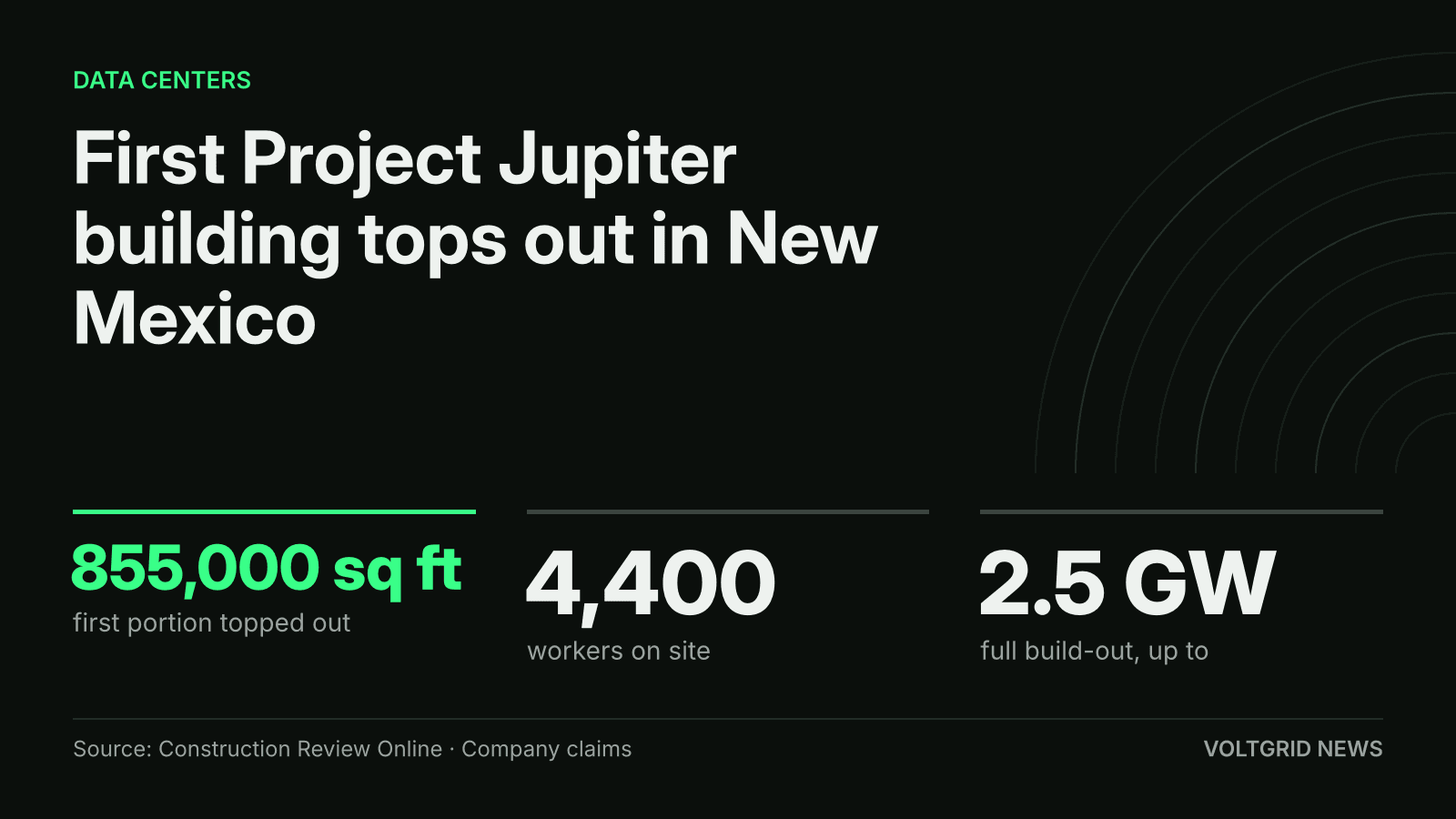
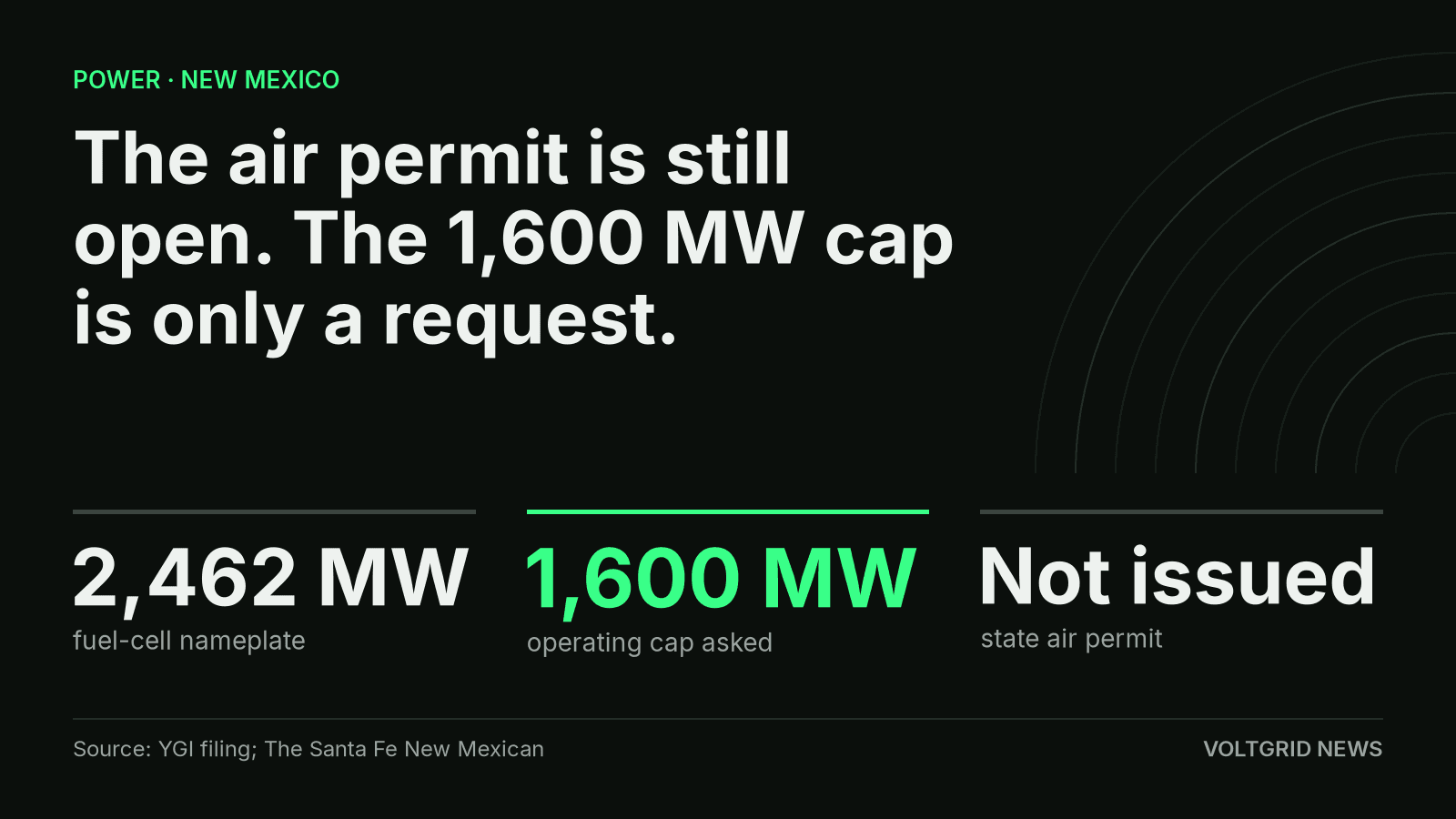
Fuel is the second objection. Bloom's Energy Servers are described as running on natural gas, biogas or hydrogen, and the release does not say which fuel any NTT site will use or who will deliver it. In the US, gas supply is already a contested step at Oracle's Project Jupiter in New Mexico, a planned Bloom fuel-cell plant of 2,462 MW nameplate. There the 17-mile Green Chile pipeline has been rejected twice by the state land office and its in-service target has slipped to February 2027, as Voltgrid reported, and the applicant has asked for a 1,600 MW operating cap to keep its air permit on track. Each NTT site abroad will need a gas connection and an air permit under its own national rules.
Third, gas engines and turbines compete for the same job. Power Engineering lists a 2 GW equipment order for American Intelligence & Power's Monarch campus in West Virginia that includes more than 100 Caterpillar gas generator sets of 1.5 MW each, and dozens of 10 MW Wärtsilä 50SG engines for a project of nearly 300 MW in Ohio. The NTT release makes no cost comparison, and Bloom says it manufactures its systems in the US, so every international site depends on export logistics. Finally, Bloom's buyer base is narrow: two customers accounted for about 43% and 26% of its third-quarter revenue, as Voltgrid's analysis of the 10-Q found.
What it means for buyers, developers and utilities
For NTT DATA, the agreement secures a supply line before it names sites, which could help it promise dates to clients. Those clients cannot plan on it until a campus, a gas contract and a permit are attached. For Bloom, it is its largest international project by its own account, but it does not displace Oracle as the anchor customer. Bloom chief executive KR Sridhar said on the Oct. 22 earnings call, according to the transcript, that annual production capacity is approaching 5 GW, which suggests factory output is less of a limit than site readiness.
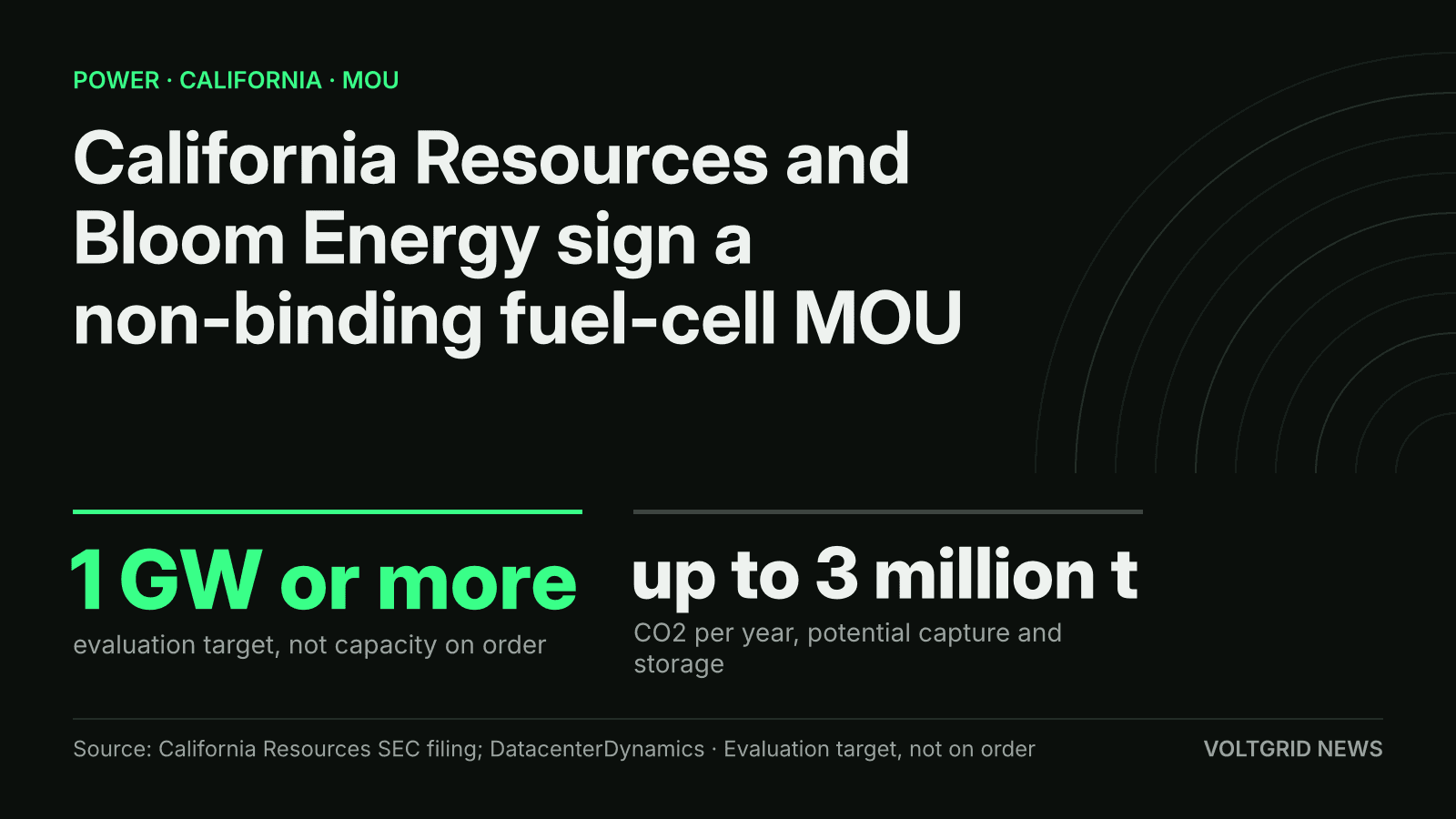
For utilities in NTT's markets, primary-power fuel cells mean large loads that may draw less from the grid at first. Power Engineering notes that some on-site plants could later pass to utilities or independent producers once the grid catches up. That is the bounded scenario to test: if NTT's sites run on fuel cells for years rather than months, the agreement changes grid planning; if they switch to grid supply quickly, it is bridge power by another name. Voltgrid covered a related Bloom announcement on Nov. 3, when California Resources and Bloom signed a non-binding MOU to study 1 GW or more of fuel cells with carbon capture.
What to Watch Before 2027 Shipments
Nov. 23: New Mexico's Environment Department is due to decide on the Project Jupiter air permit, a deadline that could move to Dec. 18, with a public hearing from Dec. 7 in Sunland Park, the Santa Fe New Mexican reported. Through 2026: Nebius said in May it expects its first Bloom-powered project, about 328 MW installed, to be operating in 2026, a test of how fast Bloom can deliver. February 2027: the Green Chile pipeline's latest in-service target. Early 2027: Bloom's fourth-quarter results, when Sridhar said backlog guidance would come, and its 2026 annual report, which last year arrived on Feb. 9 and will show whether the US share of revenue starts to fall. During 2027: NTT DATA's first shipments, the target in the release, and the first named NTT site, country and gas supplier. Until those appear, the 900 MW remains an agreement on scope.