POSCO Signs 3-Year CATL Lithium Supply Contract, 2026-2028
POSCO Group said on Nov. 18 its lithium contract with CATL is already supplying, but BusinessKorea and the Korea Herald report no volume, price or origin.
2 min read
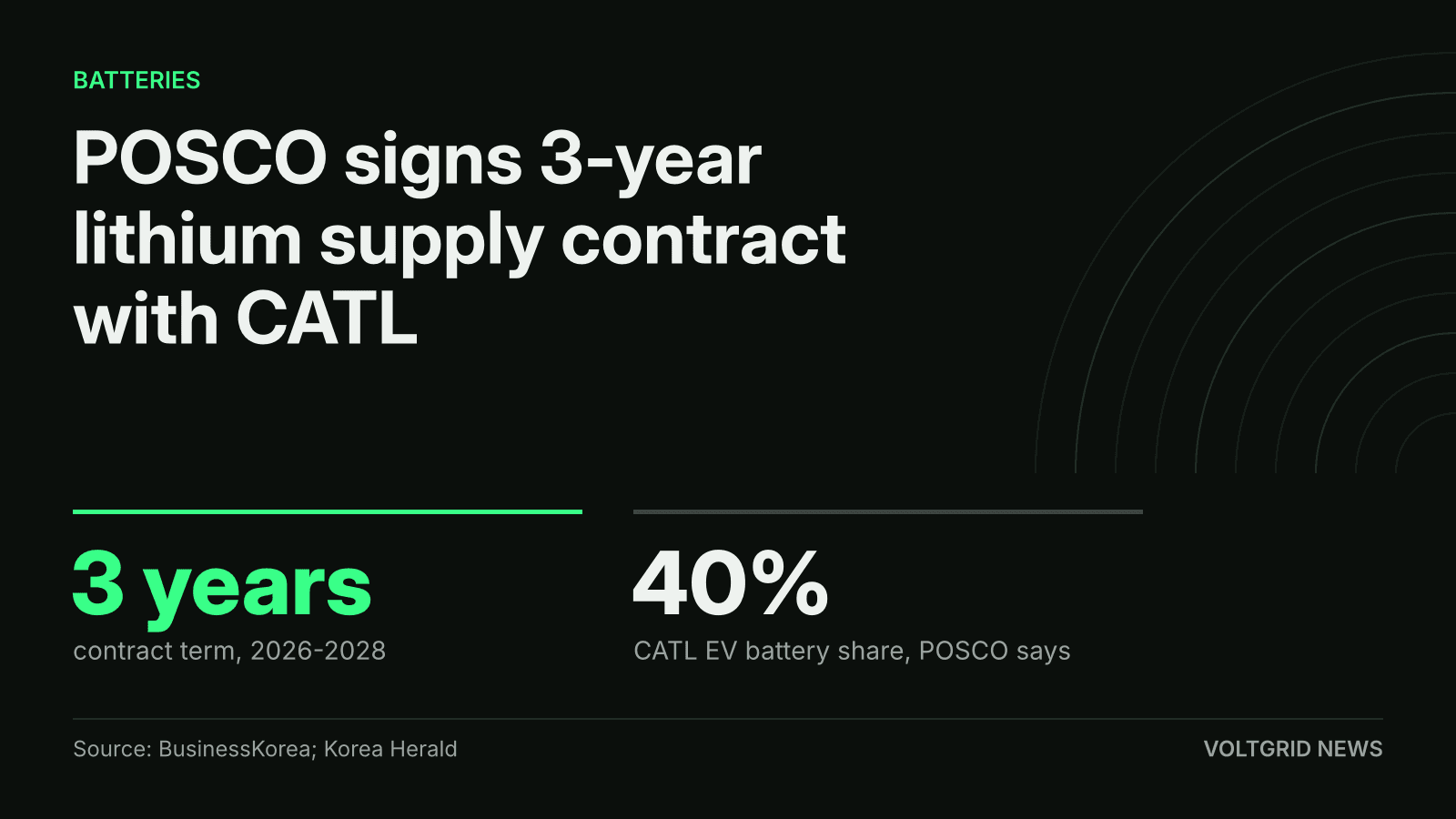
POSCO's contract with CATL covers 2026-2028; volume and price were not disclosed.
Graphic: Voltgrid News
POSCO Group said on Nov. 18 it has signed a three-year lithium supply contract with CATL, the world's largest electric-vehicle battery maker, covering 2026 to 2028, with deliveries already under way.
Neither side disclosed the volume or the contract value, according to BusinessKorea. The Korea Herald reported that the parties also kept the lithium's origin and its target market confidential. The company said, per the Korea Herald, that the deal strengthens its lithium sales base in China, and put CATL's share of the global EV battery market at roughly 40 percent.
For cell makers, the signal is where a non-Chinese lithium producer is placing its output. A Korean group with its own brine and ore assets is selling to the world's largest EV battery maker, not only to Korean customers such as SK On. With no tonnage given, the share of POSCO's output the contract takes cannot yet be sized.
Where POSCO's Lithium Comes From
POSCO has been building capacity around the Hombre Muerto salt lake in Argentina, which it acquired in 2018, BusinessKorea reported. A first lithium hydroxide plant with a 25,000-tonne annual capacity was completed in 2024. The upstream stage of a second plant, rated at 23,000 tonnes a year of lithium carbonate, was completed in October. The Korea Herald put total annual capacity from the two plants at 48,000 tonnes, and the two outlets' figures add up to the same total.
The second plant's downstream stage is scheduled for completion in South Korea in 2027. BusinessKorea said that would bring POSCO's hydroxide system to 50,000 tonnes a year. Separately, POSCO Pilbara Lithium Solution, a joint venture of POSCO Holdings and Australia's Pilbara Minerals, runs a 43,000-tonne-a-year lithium hydroxide plant in Gwangyang, South Korea, which uses Australian ore. The Korea Herald added that POSCO holds an equity stake and concentrate supply rights in Australia.
Under its "Triple Core" strategy, the group aims for annual lithium production capacity of 173,000 tonnes by 2033 and more than 1.8 trillion won ($1.35 billion) in operating profit from lithium by 2035, the Korea Herald reported. Those are targets, not output.
POSCO's 2033 target of 173,000 t/yr compares with 48,000 t/yr in Argentina and 43,000 t/yr in Gwangyang, according to BusinessKorea and the Korea Herald.
Graphic: Voltgrid News
POSCO's Earlier 2026 Lithium and Battery Deals
BusinessKorea listed the other contracts that lead to this one. In February, POSCO agreed to supply up to 25,000 tonnes of lithium to SK On by 2028, enough for about 400,000 EVs by the outlet's figure. In August it signed a strategic agreement with China's Ronbay Group on lithium supply and battery recycling. In September its affiliate POSCO Future M signed a roughly 1.1 trillion won (about $825 million) contract to supply lithium iron phosphate (LFP) cathode materials to SK On for 2027 to 2029.
The group's materials push has also reached cell makers directly. As Voltgrid reported, POSCO Future M and LG Energy Solution signed a memorandum on 720,000 tonnes of cathode and anode materials over 2027 to 2033.
What Is Not Confirmed Yet
The volume, the price and the pricing basis of the CATL contract are unpublished. It is also not stated whether the lithium is hydroxide or carbonate, or whether it comes from Argentina or Australia. The Korea Herald said the parties cited confidentiality. POSCO's own release was not readable for this report, so the figures here come from the two outlets named above.
Sources
- Published
- Sources
- 2 cited