Senate Permitting Bill Faces 60-Vote Test Nov. 9 on 20 MW Data Center Rule
The Senate votes Monday, Nov. 9, on cloture for the bipartisan permitting bill. Revised text makes developers seek state approval for a year before FERC siting and keeps the 20 MW data-center cost rule.
Energy & Cooling DeskEdited by Ege Erten
4 min readAI-assisted
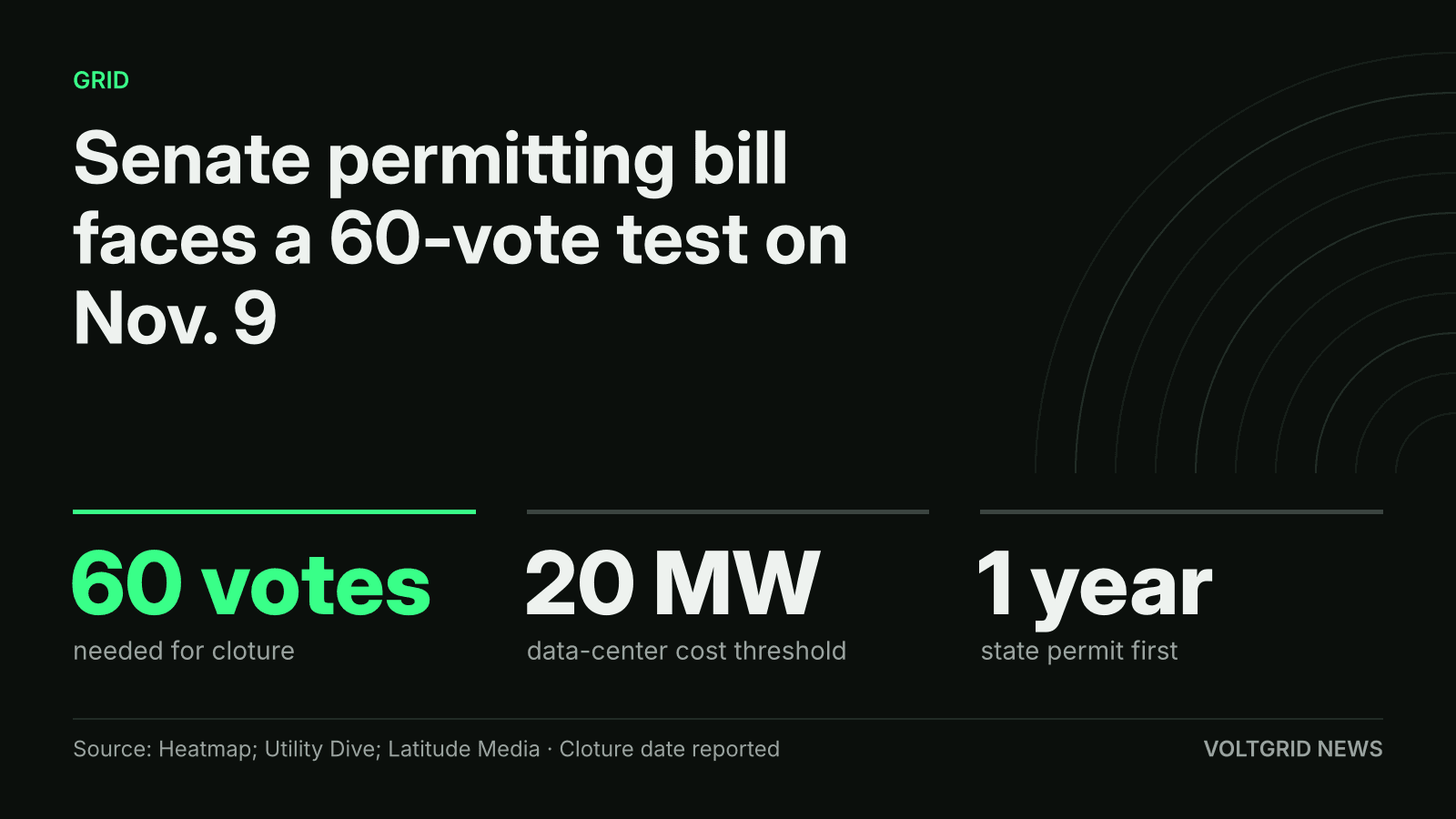
The Senate cloture vote on the permitting bill is reported for Nov. 9 and needs at least 60 votes.
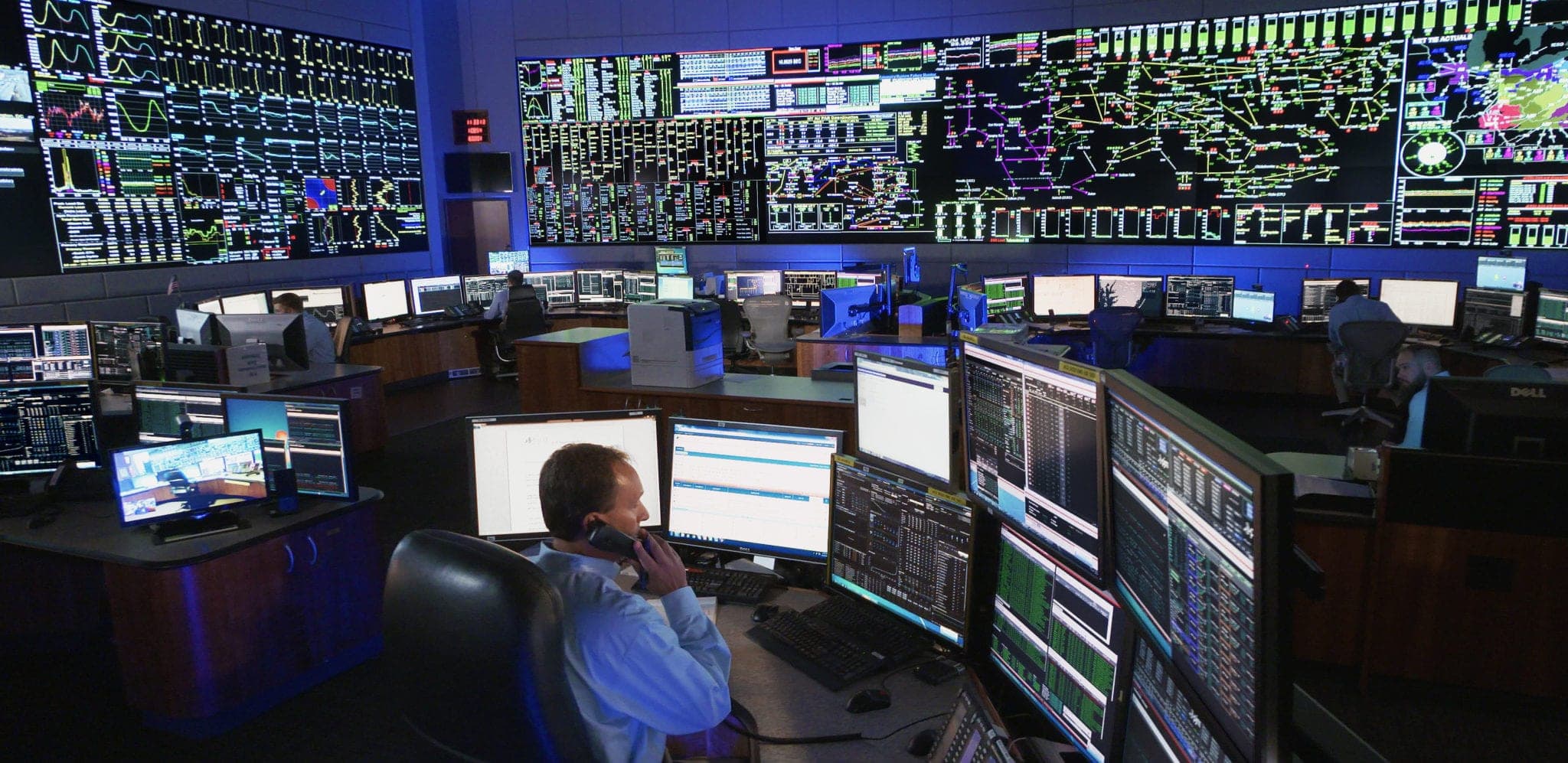
Illustration (AI-generated)
The Senate holds a 60-vote procedural vote on Monday, Nov. 9, on a bipartisan permitting bill whose text was revised on Saturday, Nov. 7, and which still makes data centers of 20 MW and up pay grid costs. The vote has not happened.
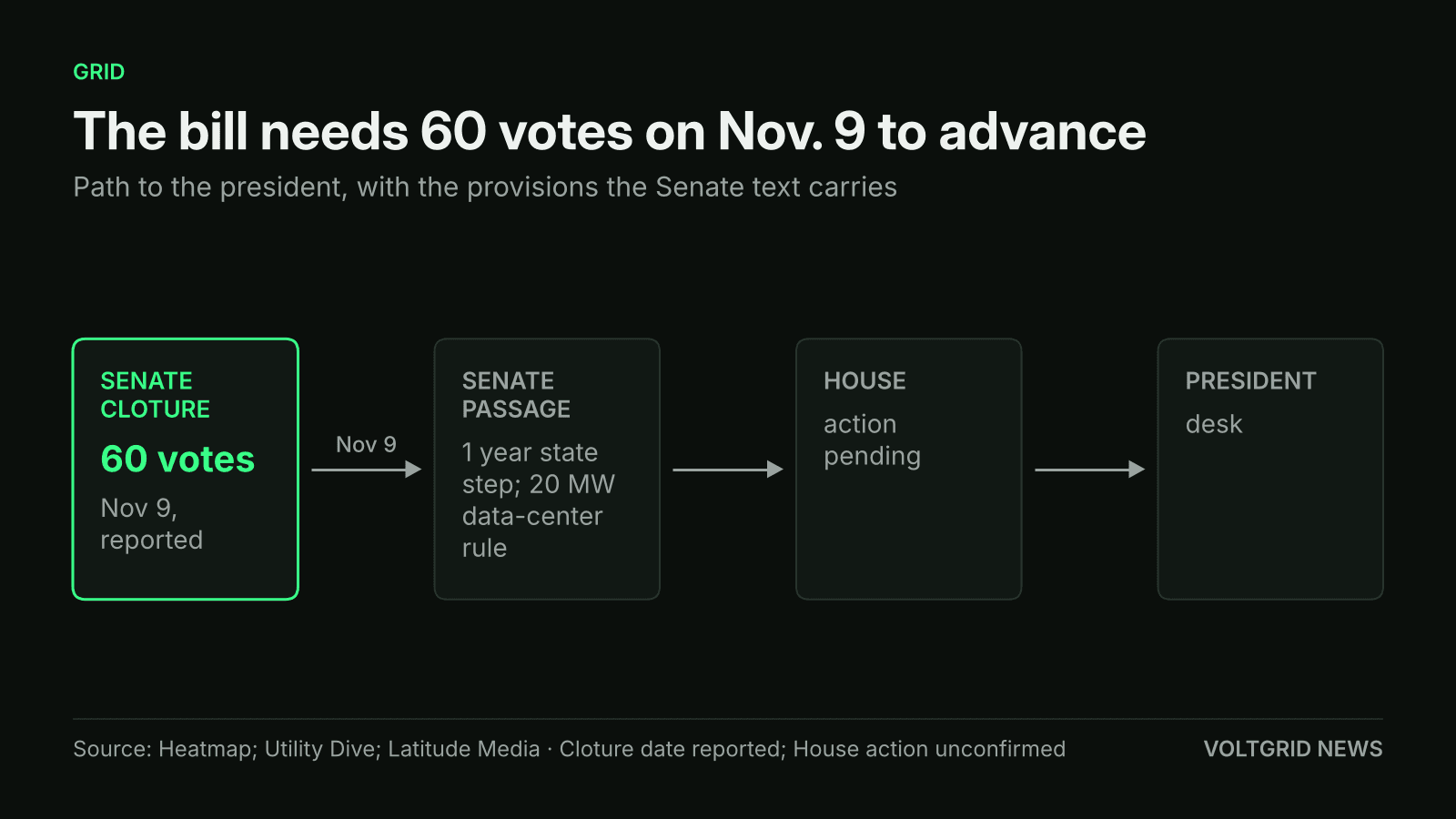
The cloture vote on Nov. 9, reported, needs 60 votes; House action is unconfirmed.
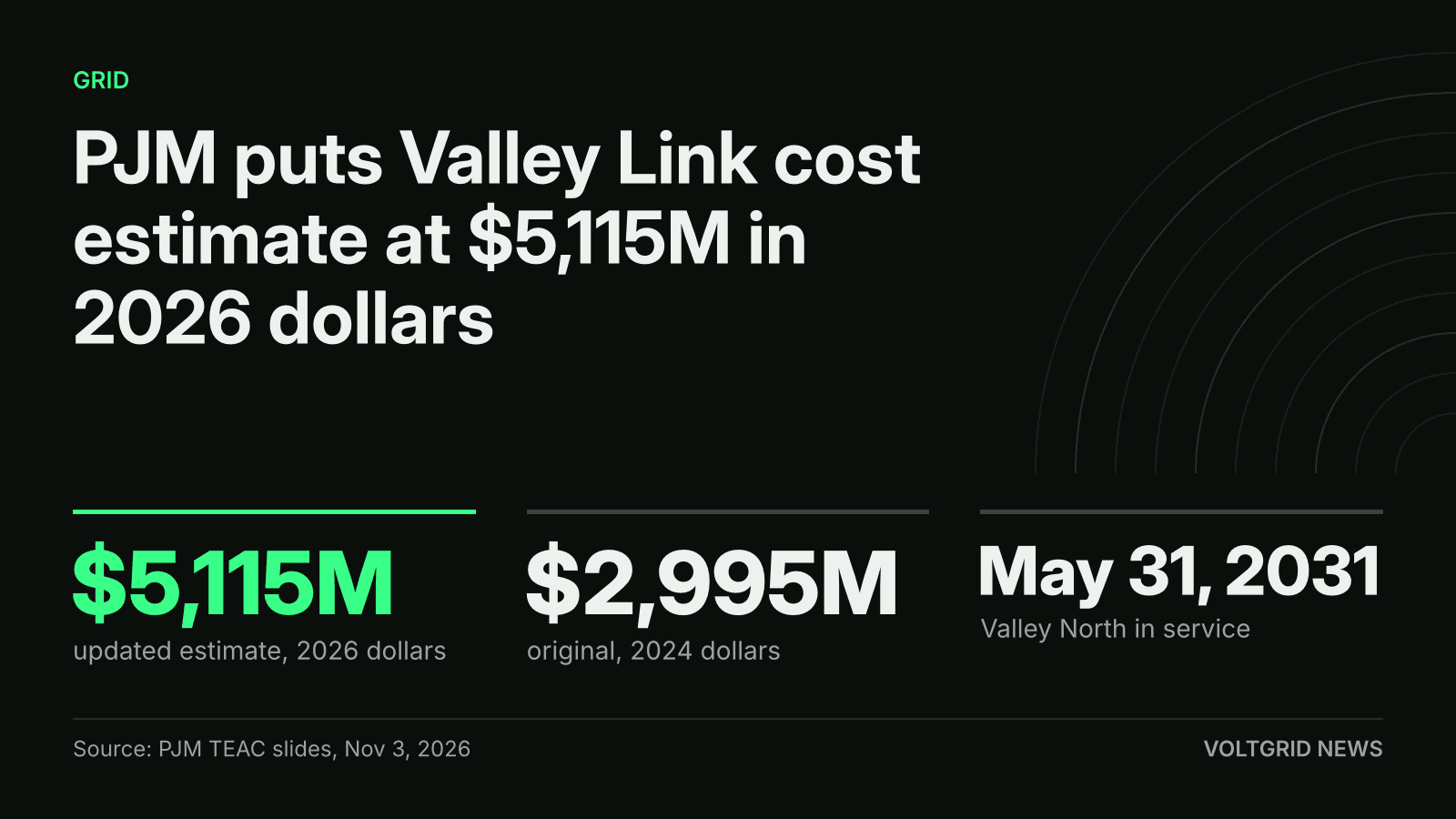
Illustration (AI-generated)
According to Heatmap, citing the Senate cloakroom, the Senate will vote on a motion invoking cloture, which ends debate, and the motion needs at least 60 of 100 votes. The bill is the Bipartisan American Affordability and Jobs Act, sponsored by Sens. Shelley Moore Capito (R-W.Va.), Martin Heinrich (D-N.M.), Mike Lee (R-Utah) and Sheldon Whitehouse (D-R.I.). Heatmap reports that senators are probably hoping for far more than 61 votes, because House rules may require overwhelming bipartisan support to get the measure to the president's desk.
What the revised text changes for transmission
The new version is a manager's amendment, which becomes the official text that gets a Senate vote. Heatmap reports that it keeps the core transmission mechanisms: a long-term planning process for every grid region with its neighbors, overseen by the Federal Energy Regulatory Commission (FERC), a cost allocation formula under which customers who benefit from new lines pay for them, and a federal siting backstop that lets the government approve a route when a state has refused.
The biggest change is sequencing. The original text let a developer apply for state permits and the FERC backstop permit at the same time. The amendment removes that option, so developers must now go to states for a year before they apply for the federal backstop. Heatmap notes that former Republican FERC Commissioner Mark Christie had criticized the simultaneous track in Utility Dive, arguing that it makes the state proceeding meaningless.
In return, the amendment strengthens the backstop for developers. Projects can use the cost allocation formula without using the backstop, and for only part of a project. The backstop now applies to state-owned land, and lines using advanced conductors can qualify without reaching the 230-kilovolt floor if their throughput is roughly similar to a conventional 230 kV line. Heatmap also reports that the amendment keeps existing rights of first refusal to build transmission in federal law and exempts vertically integrated utilities outside an electricity market from the mandatory joint transmission and generation planning process.
Data centers and who pays
For data-center load, the central provision sets a 20 MW threshold. Utility Dive reported on Oct. 1, on the bill as introduced, that transmission costs would be assigned to the owners and operators of computational loads, with exit charges for loads of 20 MW or more and a bar on recovering their incremental costs from other customers. Latitude Media reported on Oct. 29 that the bill would direct FERC to rewrite a 1994 policy so that computational loads above 20 MW pay both the embedded cost of the existing grid and the incremental cost of its expansion, and that utilities would hold data centers liable for capital costs if they leave agreements early.
Heatmap's walkthrough of the revisions does not list a change to that cost rule. The amendment adds a new Data Center Community Assistance Program at the Department of Energy, modeled on legislation from Sens. John Curtis (R-Utah) and Lisa Blunt Rochester (D-Del.), but Heatmap says the text sets no funding authorization. It also limits a battery and virtual power plant provision to resources below 5 MW, so behind-the-meter gas plants at data centers cannot use it to sell excess power to the grid.
For data-center developers, the practical effect would be a higher grid bill in exchange for faster transmission. Two buyer groups representing Amazon, Google, Meta and Microsoft, the Corporate Energy Buyers Association and the Electricity Customer Alliance, have endorsed the bill, Latitude Media reported on Oct. 29. The Data Center Coalition had not, saying it was still reviewing the text with members. Nidhi Thakar of the buyers association said the details of allocating costs for new lines would be settled in a FERC rulemaking. As Voltgrid reported, OpenAI said on Nov. 5 it will pay full power costs at data centers it owns and operates; the bill would write a cost-bearing rule for large loads into federal law.
Who supports and who opposes
Rob Gramlich, president of Grid Strategies, told Heatmap the new text contains improvements that give more types of projects a route through. David Pomerantz of the Energy and Policy Institute welcomed the survival of a section on oversight of local transmission projects and said replacement of local facilities is now covered. Liam Donovan, a Republican strategist, wrote on X that the amendment does a good job of accounting for the stated concerns of anyone looking to get to yes.
Opposition remains. The 106 Coalition, a group of tribal organizations, said it will still oppose the bill and wants the entire historic preservation section removed, even though the amendment strikes a definition of property of traditional religious or cultural importance. The Wilderness Society reaffirmed its opposition, and Rep. Jared Huffman of House Natural Resources called some changes to the permit certainty provision an improvement but asked for a hearing and a more open process. The Coalition of Large Tribes, which has not opposed the bill, said there is still room for improvement.
What is not confirmed yet
The 60-vote count is not known, and no senator's position has been tallied in the reports Voltgrid read. Passing the Senate would not make the bill law, since the House would still have to act, and Heatmap notes that House rules may demand overwhelming bipartisan support. The 20 MW cost rule would also leave the key numbers to a later FERC rulemaking, and the Data Center Coalition's position on the final text has not been reported.