US-Korea Project Power: 8 Large Reactors, Up to $120B, Nothing Binding
Project Power, the non-binding US-Korea framework for six AP1000s and two APR1400s, has no designated sites, named owners or power buyers, and no reported NRC application. Seoul put its $10B advance under review on Nov. 9.
5 min read
Follows South Korea Puts Up-to-$10B US Nuclear Advance Under Feasibility Review
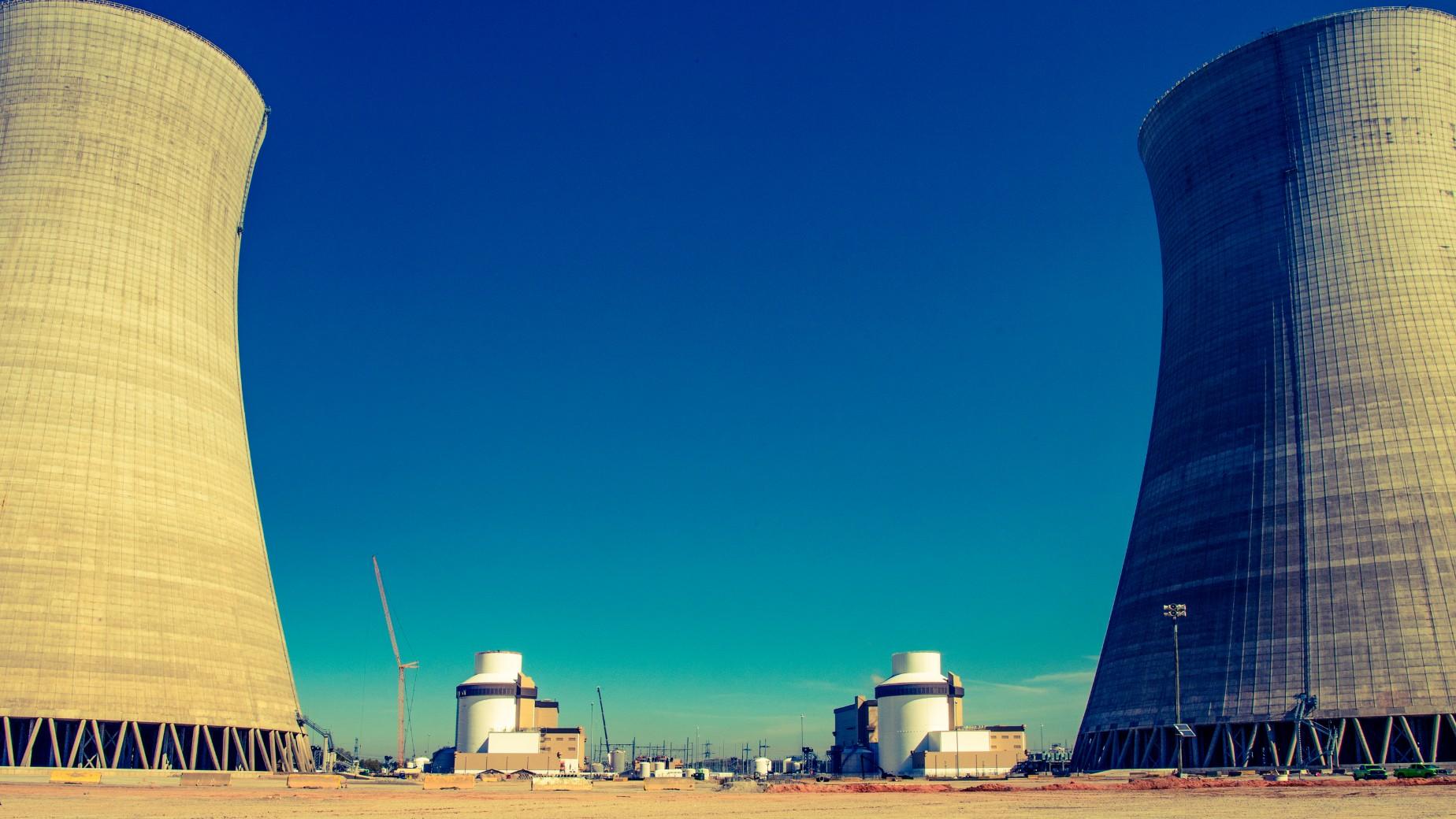
Two AP1000 units under construction, as shown on Westinghouse's AP1000 page. The image is an earlier AP1000 project and does not show a Project Power site; none has been designated.
Image: Westinghouse
Source · Press image from the Westinghouse website, used for news reporting.
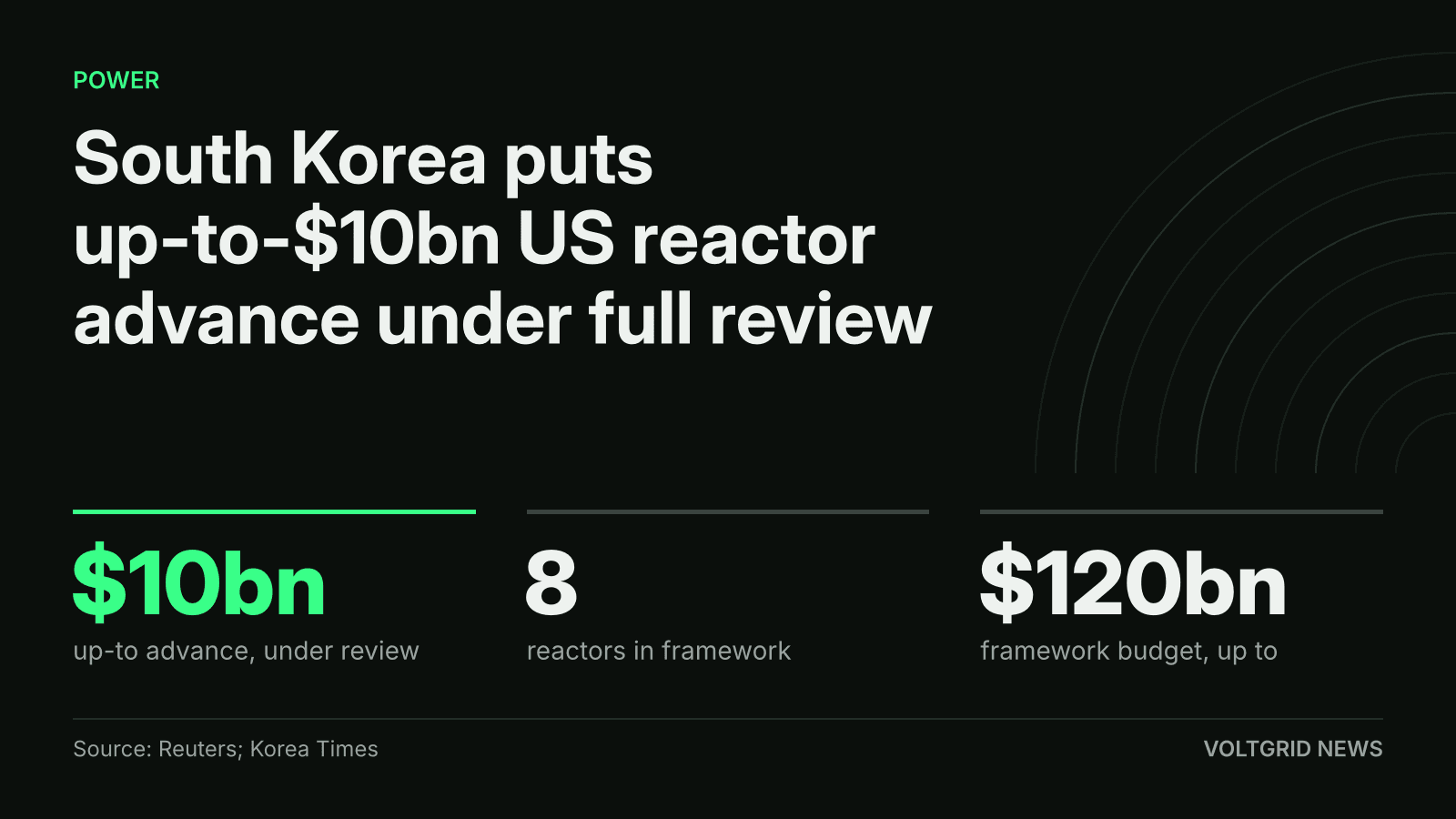
South Korea's finance minister said on Nov. 9 that the first cash step of Project Power, a planned $10 billion advance for long-lead reactor parts, will go ahead only after a full feasibility review, Reuters reported. The advance belongs to a non-binding US-Korea framework, announced on Sept. 30, for up to eight large reactors on federal sites still to be designated by the US government, backed by up to $120 billion of Korean investment.
Lee Hyoung-il told a parliamentary budget committee that the remittance plan was still at a preliminary stage and would be reviewed carefully, according to Reuters, and industry vice-minister Park Dong-il said no investment decision had been finalised. As Voltgrid reported on Nov. 11, that was a review, not a cancellation. Voltgrid found no newer statement on the advance as of Nov. 22.
For data-center builders the framework is a supply signal, not supply. It names no designated site, and no owner, utility or buyer for the electricity appears in the sources Voltgrid read; no NRC application for any of the units has been reported. Its terms are non-binding and subject to final negotiations, Westinghouse part-owner Brookfield said in the announcement.
Two Reactor Designs, Both Already Operating
Six of the eight units are Westinghouse AP1000s, to be built as three two-unit plants; the other two are APR1400s, a Korean design that also incorporates Westinghouse technology, according to the Brookfield release. Cameco, Westinghouse's other owner, describes the plan as up to eight reactors. ANS Nuclear Newswire gives the AP1000 a nameplate capacity of 1,110 MWe per unit and the APR1400 1,400 MWe per unit; Westinghouse's own page gives the AP1000 a nominal net electrical output of 1,150 MWe per unit. The NRC describes the APR1400 as a 4,000-MWt design, its heat output; the electric figure is the one that matters for a grid.
Neither design is new. Six AP1000s are running, two in the United States and four in China, and eight APR1400s are running, four in South Korea and four in the United Arab Emirates, ANS reported, so an APR1400 would be a first for the US. In Voltgrid's reading, that shifts the main risk from the reactor itself to the construction schedule, the supply chain and the money.
How the Up to $120B Is Split
The Commerce Department lists both governments, Westinghouse, Korea Electric Power Corp. (KEPCO) and Korea Hydro & Nuclear Power (KHNP) as signatories of the framework, ANS reported. Of the up to $120 billion, $100 billion is slated for construction and $20 billion for contingency, according to ANS and to Cameco. Cameco called the framework non-binding and subject to definitive agreements and other conditions in its third-quarter report of Oct. 30.
The two governments anticipate transferring the $10 billion advance by the end of 2026, mainly to buy long-lead equipment at once, Cameco said, and it expects about $7.5 billion of that to go toward long-lead equipment for AP1000 reactors. Cameco put Westinghouse's contemplated scope on the two APR1400 units at about $2 billion per reactor. Brookfield said the framework provides for an upfront payment to Westinghouse, guaranteed scope of work on the APR1400s and a fuel-fabrication contract, and for a cornerstone equity investment by Korea of between 5% and 10% in Westinghouse.
Project Power sits beside two other US frameworks. Brookfield said it is separate from the Department of Energy partnership announced in June 2026, which includes a $17.5 billion conditional loan arrangement for long-lead items; Cameco describes that commitment as covering up to ten AP1000s. It builds on the Commerce Department's October 2025 partnership with Westinghouse, Brookfield and Cameco to fund at least $80 billion of Westinghouse reactors on federal sites.
Licensing: Designs Approved, No Sites or Applications
No construction schedule or locations have been given, ANS reported. Commerce Secretary Howard Lutnick said at a Sept. 30 briefing that the plants would go to Ohio, Tennessee, South Carolina and Kentucky, but no designation of federal sites has been reported. No construction permit or combined licence application for these units has been reported either.
What exists is design approval. A design certification is the NRC's approval of a reactor design as a standard written into its rules, so a builder can cite it instead of re-arguing the design's safety each time. The NRC renewed and updated the AP1000 certification in a direct final rule published Oct. 14, making Vogtle Unit 4 the US reference plant; the rule takes effect on Dec. 28, 2026 unless significant adverse comments lead the NRC to withdraw it, and Voltgrid found no withdrawal notice. The NRC lists the APR1400 as an issued design certification, applied for by KEPCO and KHNP, and says it completed that review in April 2019.
A certification does not license a plant. The NRC says the AP1000 update authorizes no siting, construction or operation, and Cameco noted that future projects will still need separate NRC approvals for site-specific environmental, safety and security requirements. For Project Power, the design step is largely behind it; the permits, construction and a buyer for the power are still ahead.
What the Framework Means for Data Centers
Brookfield said locating the reactors on federal sites would support the power and compute buildout the United States needs, including for AI. None of the sources Voltgrid read names a hyperscaler, data-center developer or utility as a buyer of the output. A campus planning around these units has nothing to contract against yet.
The long-lead money is the part that touches near-term supply. The $10 billion advance is meant to pay for such orders, and Cameco says the separate DOE commitment is designed to finance long-lead purchases through special purpose vehicles. That these orders would reserve manufacturing slots is Voltgrid's inference. If Seoul's review delays the advance past the end of 2026, the AP1000 equipment orders it was meant to fund move with it; no party has published such a schedule. For comparison, Fermi America's Project Matador plans AP1000s for an AI campus and also leans on a non-binding letter of intent.
What to Watch Before Any Unit Is Built
The first marker is whether the advance is transferred by the end of 2026, as the two governments anticipate, and what Korea's feasibility review concludes. The AP1000 certification update is due to take effect on Dec. 28, 2026 unless the NRC withdraws it. After that, the steps that would make Project Power a project are the designation of federal sites, a named owner and operator for each plant, definitive agreements between the parties and the first NRC application.
The $10 billion advance is anticipated by end-2026, a target; site designation, definitive agreements, a named owner and operator and the first NRC application have no date.
Graphic: Voltgrid News
Sources
- 01U.S. – Korea Framework Advances Deployment of Westinghouse Nuclear Technology in the United StatesWestinghouseinfo.westinghousenuclear.com
- 02Cameco third quarter 2026 MD&A (Form 6-K exhibit 99.2)Camecosec.gov
- 03South Korea demands feasibility review for $10bn US nuclear planReuters (via TimesLIVE)timeslive.co.za
- 04South Korea to invest in U.S. nuclear projects, including 8 large reactorsANS Nuclear Newswireans.org
- 05Issued Design Certification - Advanced Power Reactor 1400 (APR1400)US Nuclear Regulatory Commissionnrc.govas read on Nov 22, 2026
- 06NRC OKs Westinghouse AP1000 design certification revision, renewalANS Nuclear Newswireans.org
- Published
- Sources
- 6 cited