USTR Proposes Section 301 Tariffs of Up to 35% on 14 Economies
USTR proposed Section 301 excess-capacity tariffs of up to 35% on 14 economies on Nov. 25, naming chips, batteries and power equipment, with comments due Jan. 5, 2027.
2 min read
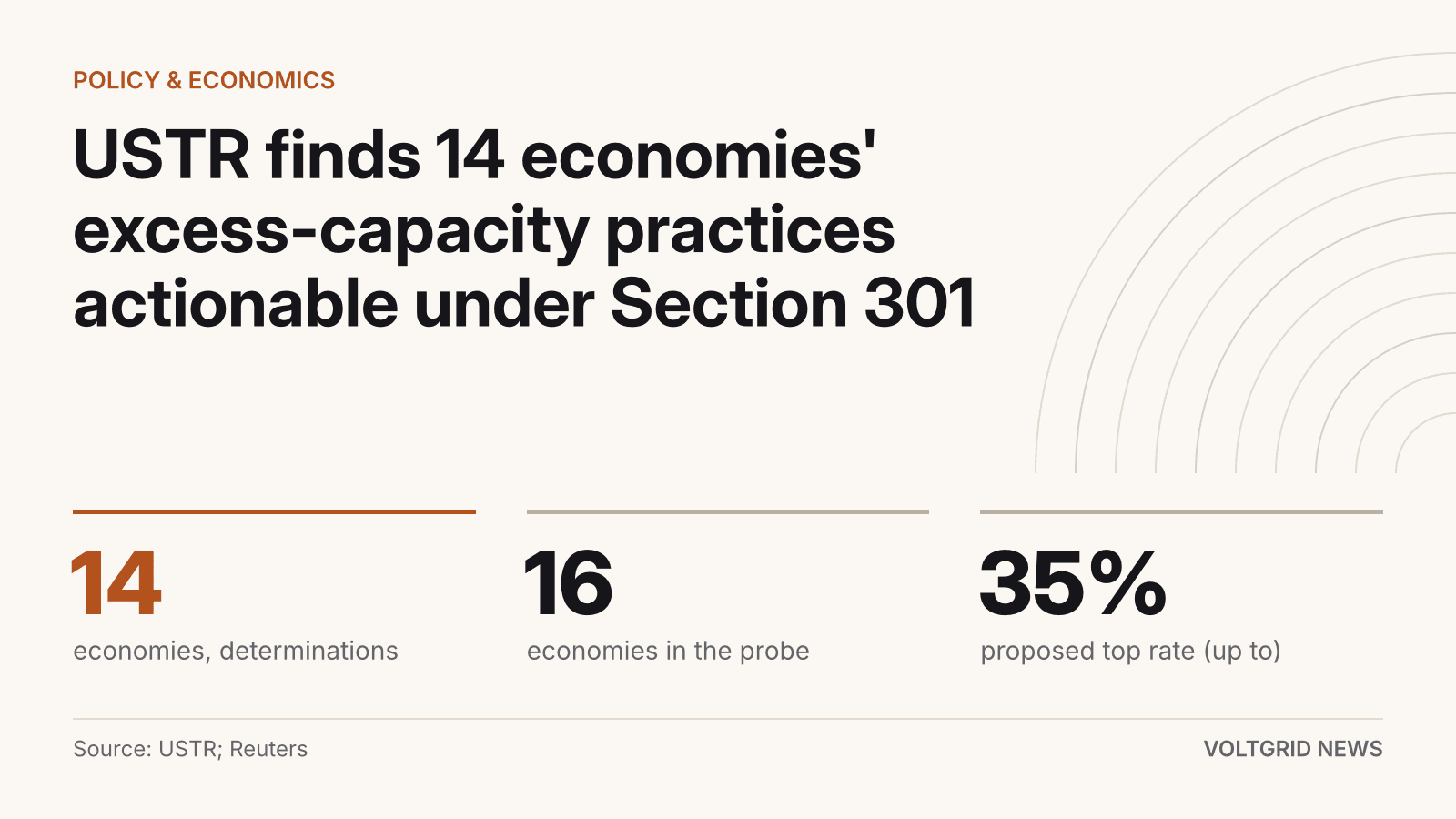
USTR's Nov. 25, 2026 determinations cover 14 of the 16 economies in the excess-capacity probe; the proposed rates run up to 35%.
Graphic: Voltgrid News
The Office of the US Trade Representative (USTR) proposed additional Section 301 tariffs of up to 35% on 14 economies on Nov. 25, 2026, after finding that their industrial policies create structural excess capacity in manufacturing.
According to USTR's release, Ambassador Jamieson Greer found the practices of China, the European Union, Japan, South Korea, Taiwan, India, Singapore, Switzerland, Indonesia, Malaysia, Cambodia, Thailand, Vietnam and Bangladesh unreasonable and actionable under Section 301(b). Mexico and Norway, the other two economies in the 16-economy probe opened on March 11, 2026, have no determination yet. The tariffs are a proposal, not a rule in force.
The rates USTR proposed
For China, USTR proposes tariffs of up to 20%, net of the rate already set under the separate forced-labor Section 301 case, on goods outside the annexes to its notice. Goods listed in Annex A would face up to 10%. Products on the US-China Board of Trade "30-For-30" reduced-tariff list, which Reuters put at about $30 billion of imports, are in Annex B and exempt. Reuters reported that the new duties would come on top of the roughly 25% tariffs from Donald Trump's first term.
Japan, South Korea, Taiwan and Switzerland would face up to 15%, net of existing most-favored-nation rates and Section 301 duties, and the EU a rate of 15%. Singapore would face up to 20%, India up to 25% and Vietnam up to 35%. Indonesia, Malaysia, Cambodia, Thailand and Bangladesh would face up to 18%. For India (17%), Singapore (10%) and Vietnam (20%), USTR names lower rates if each reaches a reciprocal trade agreement.
USTR proposes rates of up to 35% for Vietnam and 15% for the EU; the figures are proposals, not final rates, according to USTR and Reuters.
Graphic: Voltgrid News
Where chips, batteries and power equipment appear
USTR's China finding lists battery, power equipment, semiconductors, solar and wind among the sectors where the harm is most acute. The Japan, South Korea and Taiwan findings name semiconductors, and Singapore's cites electronics and semiconductors. Malaysia, Vietnam and India appear with information and communications technology, and Indonesia with renewable energy. Cambodia and India are tied to solar, and Thailand to electrical equipment.
For data-center builders the exposure is the cost of imported servers, cells and grid hardware, but the release states no product-level rate. A Reuters-cited senior US official said the duties would respect the 15% cap in the deals with the EU, Japan, South Korea and Taiwan and a 19% cap for Malaysia, and would not stack on the 10% and 12.5% forced-labor tariffs imposed in July or on sector tariffs such as those on autos and steel. Voltgrid reported earlier that Trump had promised a tax on US data centers built abroad, with no rate given.
What happens next
USTR set Jan. 5, 2027 as the deadline for written comments and for requests to appear at hearings, which begin Jan. 25, 2027. The senior official told Reuters that implementation could slip into January. China's Foreign Ministry called overcapacity "a false issue" but stopped short of threatening retaliation, according to Reuters. The US-China truce expires on Jan. 10.
Taiwan, which USTR ties to electronics and semiconductors, is also where Taipower has planned a NT$109.6 billion grid build for 8 GW of Tainan chip parks, as Voltgrid reported.
What is not confirmed yet
The contents of the annexes, which decide which chips, battery cells, transformers or other equipment are covered or exempt, are not confirmed here, and the Federal Register notices were published in pre-publication form. Final rates may differ after comment and the effective rate on any one product is not yet published.
Sources
- Published
- Sources
- 2 cited