Cheyenne Light Files 3 Microsoft Data Center Agreements at FERC
Microsoft will pay for grid work at three planned Wyoming data centers, Utility Dive reports, under agreements Cheyenne Light filed at FERC on Nov. 24. The utility's peak is 439 MW; it has also signed to serve Google.
3 min read
Follows Google's Wyoming Data Center: 702 MW Bloom Fuel-Cell Plant, 2.7 GW Black Hills Mix
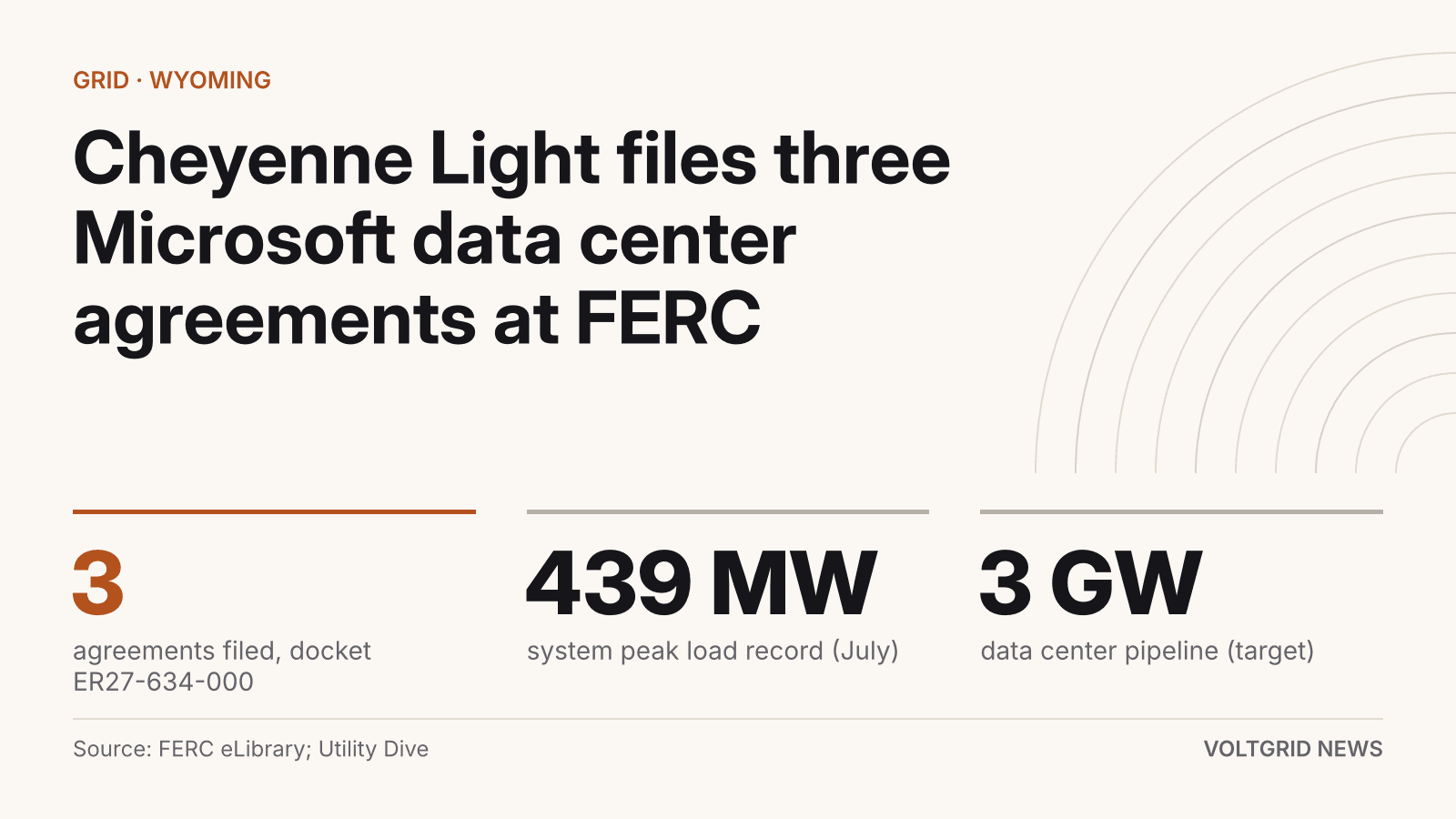
Key facts: the three agreements in FERC docket ER27-634-000, and the utility's 439 MW peak record and 3 GW data center pipeline as reported by Utility Dive.
Graphic: Voltgrid News
Cheyenne Light, Fuel and Power Co. filed three facility expansion agreements at the Federal Energy Regulatory Commission on Nov. 24, 2026, under which Microsoft pays for grid infrastructure serving three planned Wyoming data centers, Utility Dive reported.
The filing sits in FERC docket ER27-634-000 and asks for the agreements to take effect on Dec. 24, 2026. The docket index lists one agreement each for campuses named Meadowlark, Equality and Frontier, plus a proposed protective agreement; the index itself does not name Microsoft. According to Utility Dive, the utility will build distribution and transmission facilities for the sites, and Microsoft pays for them through contribution in aid of construction payments. That is a customer payment toward the utility's construction cost, not a power purchase agreement (PPA), and Utility Dive describes no energy price, volume or supply term in the deals. Utility Dive reports that the agreements are redacted.
Cheyenne Light told FERC it does not believe the commission has jurisdiction over these retail agreements, Utility Dive reported, but filed them out of caution after the agency's recent statements on cost recovery for transmission built for large loads. Its parent is now Bright Horizon Energy Corp., the new name of Black Hills Corp. after its merger with NorthWestern Energy Group, according to Utility Dive.
A second hyperscaler on a small grid
The filing changes the picture in our project file on Google's Cheyenne power stack: Google is no longer the only hyperscaler with a disclosed deal at this utility, because Microsoft has three campus agreements on file, and Meta projects are in the pipeline too. The scale against the existing system is the point. Cheyenne Light has about 46,000 retail electric customers and set a system peak load record of 439 MW in July, according to Utility Dive, citing Black Hills' latest earnings report. That is the whole utility's peak, not data center load. Black Hills officials said on a Nov. 5 earnings call that the utility is executing on a 3 GW data center pipeline that includes 600 MW of Microsoft and Meta projects, with another 2.5 GW in early-stage talks.
Cheyenne Light's 439 MW peak record versus its 3 GW pipeline and 2.5 GW in early-stage talks; peak load and pipeline are not summed.
Graphic: Voltgrid News
Google's deal shows how much supply one campus can take. Black Hills (now Bright Horizon) said on Oct. 6 that, under definitive agreements effective Sept. 30, it will provide up to 590 MW of grid-connected service to Google's planned Cheyenne data center and manage about 2.1 GW of Wyoming-based third-party contracted resources through a privately managed microgrid, inside a total resource mix of 2.7 GW that includes reserve margins. It plans to invest $1.8 billion between 2027 and 2029 to build 564 MW (nameplate) of company-owned gas generation at the existing Cheyenne Prairie Generating Station site, held through a non-regulated affiliate.
Who pays for the wires
Cheyenne Light plans to serve large loads through its Large Power Contract Service tariff and a proposed Large Customer Transmission Cost Adjustment Mechanism, which would make data center customers pay their share of transmission expansion, Utility Dive reported. The utility wants that mechanism to recover the cost of two recently proposed transmission projects, totaling $686 million, that are needed to serve large loads including Google's campus. Black Hills expects the Wyoming Public Service Commission to decide on it by mid-2027.
What a contribution in aid of construction pays for
A contribution in aid of construction is a customer's payment toward the cost of the utility's wires and substations built to serve it. It pays for the connection, not the electricity, so it differs from a PPA, which sets the price and volume of energy delivered. Google's arrangement shows the other half of the job: Black Hills' Oct. 6 release says its up to 590 MW of grid service rests on 564 MW of new nameplate gas generation plus 26 MW of market purchases and retail service. How Microsoft's campuses will get their energy has not been disclosed.
What is not confirmed yet
Utility Dive's report and the docket index do not give the megawatts each Microsoft campus will draw, the amounts Microsoft will pay, or when the sites will be energized; the public agreement documents themselves could not be read. Utility Dive does not say how Microsoft's campuses will be supplied with energy, or whether any will use an on-site microgrid like Google's, and it gives no separate figure for Microsoft within the 600 MW it attributes to Microsoft and Meta together. FERC has not yet acted on the requested Dec. 24 effective date or on the utility's view that it lacks jurisdiction.
Sources
- 01Bright Horizon utility lands Microsoft data center deals amid Wyoming buildoutUtility Diveutilitydive.com
- 02Cheyenne Light, Fuel and Power Co. filing of Load Facility Expansion Agreements, FERC Docket ER27-634-000FERC eLibraryelibrary.ferc.gov
- 03Black Hills Corp. Executes Definitive Agreements to Serve Google's Planned Data Center in Cheyenne, WyomingBlack Hills Corp. (SEC 8-K)sec.gov
- Published
- Sources
- 3 cited