DeepSeek, Kimi on NVIDIA Blackwell: Researcher Alleges 6 Models Initialized
Ex-OpenAI engineer Will DePue says published weights of six DeepSeek, Moonshot, MiniMax and Ant models match Blackwell layouts; the test shows initialization hardware, not where the GPUs sat or a violation.
3 min read
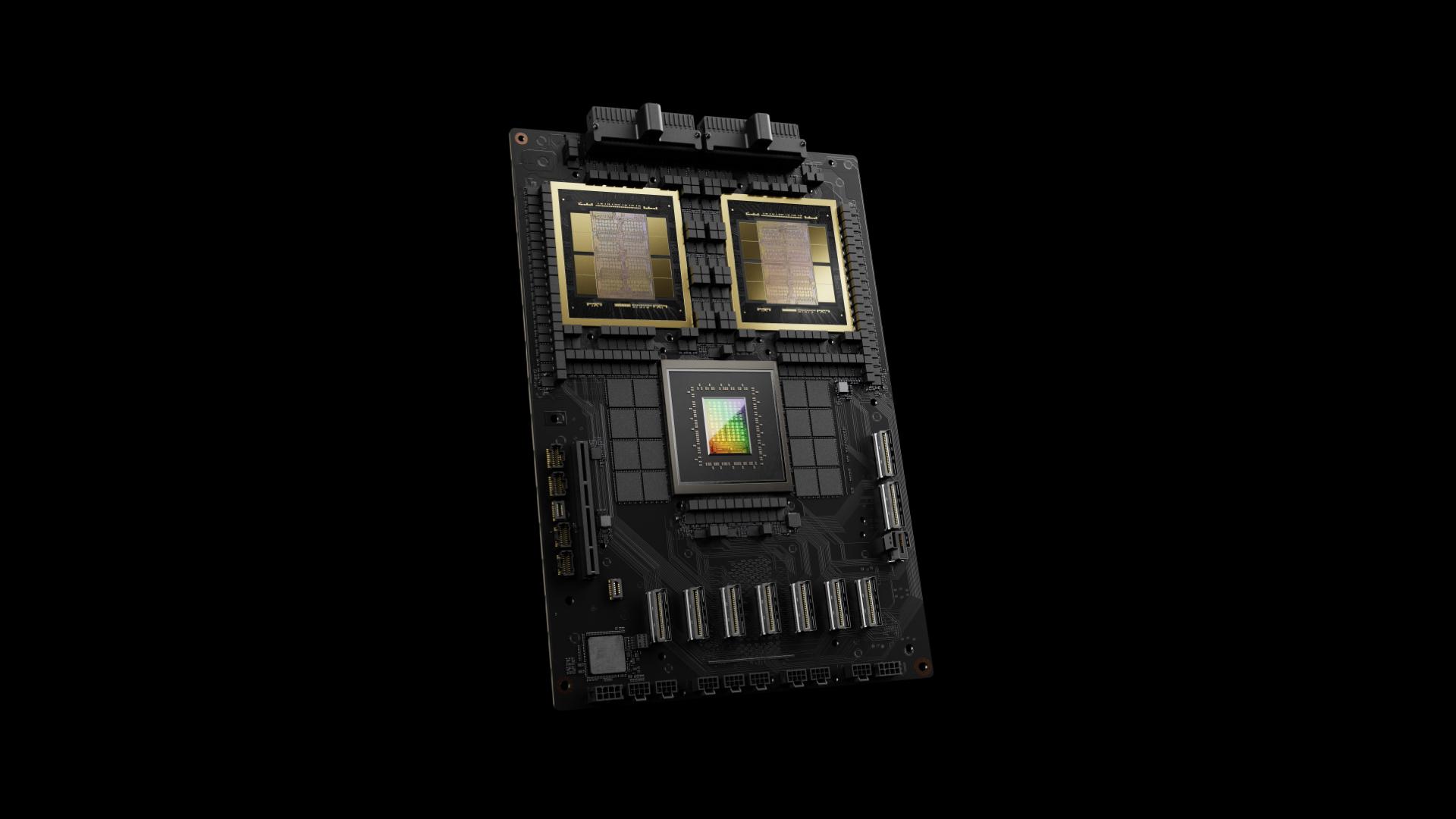
NVIDIA's GB200 Grace Blackwell Superchip, the part whose 152-SM layout the report says four of the six models match. NVIDIA has not commented on the allegation.
Image: NVIDIA
Source · Press image from the NVIDIA newsroom, used for news reporting.
Will DePue, a former OpenAI engineer who now runs the research group Unemployment Labs, alleged in a report dated Nov. 12 that six AI models from DeepSeek, Moonshot AI (maker of Kimi), MiniMax and Ant Group were initialized on export-controlled NVIDIA Blackwell GPUs.
The report says DeepSeek-V4-Flash and MiniMax-M3 match the 148-core layout of Blackwell B200 or B300 chips, while DeepSeek-V4-Pro, Kimi K3, Kimi K3.1-Pro and Ant's Ling-3.1-flash match the 152-core layout of GB200 or GB300 parts. Earlier models from the same labs, such as DeepSeek-V3 and Kimi K2.5, read as Hopper, the previous generation. Tom's Hardware covered the findings on Nov. 14, and The Register on Nov. 13.
The allegation lands in the middle of a US debate over how Blackwell reaches China. The Register notes that several bills to tighten controls are pending in Congress. Voltgrid has reported on Moonshot's search for Blackwell capacity in Europe and on Chinese firms seeking overseas NVIDIA capacity. This report adds a technical test on the models' own published weights, instead of supplier or customs records.
How the method works
Before training, a model's weights need starting values. According to the report, PyTorch generates them with a pseudorandom algorithm called Philox, which gives the same numbers for the same seed. The work is split across GPU threads, so the number of streaming multiprocessors (SMs, the GPU's processing blocks) decides where each number lands in the weight matrix. The report lists 132 SMs for Hopper H100, H200 and H800, 148 for Blackwell B200 and B300, and 152 for GB200 and GB300.
Per the researcher's report, which is not peer reviewed, the six models match Blackwell's 148- or 152-SM layouts rather than Hopper's 132.
Graphic: Voltgrid News
DePue says some weights, such as rows for tokens never seen in training, kept their starting values almost unchanged, and trained weights keep a faint trace. He searched about 6 trillion seed-and-layout combinations, tested the best match on weights held out of the search, and reports evidence of 49 to 1,385 sigma across the six models. He says his method agreed with all 24 models whose developers had disclosed their hardware. For DeepSeek-V4-Flash, he says a B300 reproduced 445 preserved rows bit for bit, and a rented GB200 reproduced all 13 preserved Kimi K3 rows. The code is public.
Why it matters and what it does not show
If the reading holds, the newest models from these labs started on Blackwell hardware, so the power and cooling load of China's frontier training is larger than the Hopper-era record suggests. DePue's rough estimate is about 4,500 Blackwell GPUs for Kimi K3 (range 1,000 to 9,500) and about 3,000 for DeepSeek-V4-Pro (range 750 to 6,500). He puts all five runs at about 12,000 GPUs, or 7,000 to 22,000, and prices the largest clusters at $200 million to $300 million at about $70,000 per GPU. He says he is not confident in these figures: they depend on assumed GPU efficiency, token counts and run lengths that no lab has published.
The limits are substantial. The fingerprint identifies the hardware that created the starting weights, not every chip that trained the model, and a lab could initialize on one system and train on another. It cannot separate a B200 from a B300, and it works only for open weights built with PyTorch on GPUs. It also cannot say where the chips sit or who owns them. Tom's Hardware notes that renting Blackwell capacity abroad is not clearly illegal, and the report itself says it does not establish smuggling or a violation of export controls.
AMD's MI300X could in principle be configured to produce the same layouts. DePue says he excluded it for DeepSeek-V4-Flash and considers it very unlikely for the other five. The Register reports that he says researchers at labs including OpenAI and Anthropic have confirmed the result, a claim the report's author makes himself and that Voltgrid could not check.
What is not confirmed yet
NVIDIA, DeepSeek, Moonshot AI, MiniMax and Ant Group have not commented publicly, as far as Voltgrid found on Nov. 14. The report is not peer reviewed, and how these labs obtained Blackwell access is open. Voltgrid's earlier coverage of H200 and H100 chips in China AI projects shows how restricted hardware is already traced by documents. Independent reproduction of the weight checks is the next thing to watch.
Sources
- 01Chinese frontier AI models carry the fingerprint of export-controlled GPUsHacker News · front pageunemploymentlabs.com
- 02Chinese AI labs are training models on Nvidia's Blackwell despite export controls, says ex-OpenAI engineerThe Registertheregister.com
- 03Researchers allege DeepSeek, Kimi, and other Chinese AI models were trained using banned Nvidia Blackwell GPUsTom's Hardwaretomshardware.com
- Published
- Sources
- 3 cited