Dell Pro Precision 9 T4 Runs MiniMax M2.7 at 83.7 tok/s on Two GPUs
StorageReview's Dell Pro Precision 9 T4 tests put MiniMax M2.7 on two 96 GB RTX PRO 6000 Max-Q cards at 83.7 tok/s for one user, 2.8 times one card spilling into RAM, in a $66,600 build.
5 min read
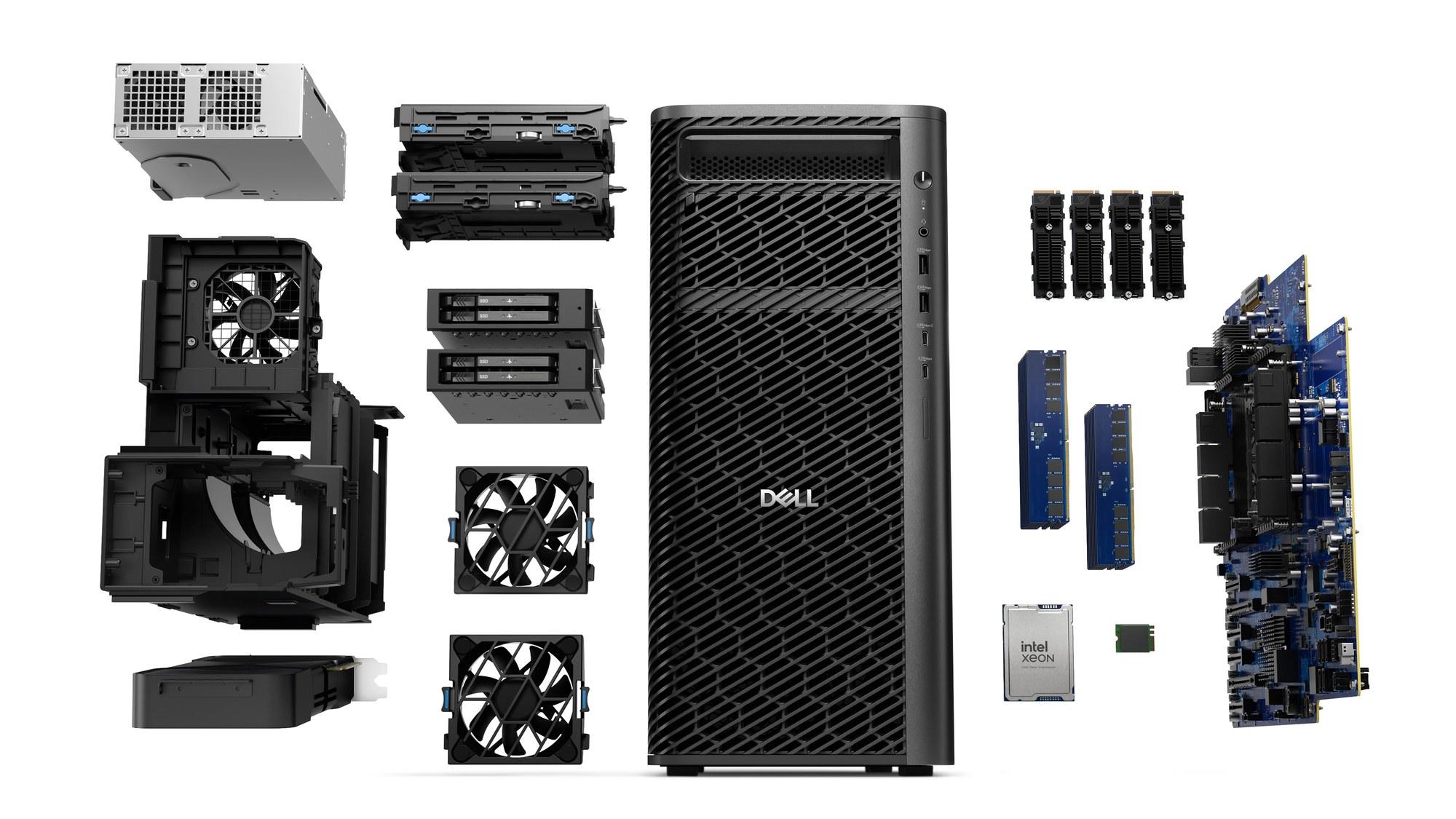
The Dell Pro Precision 9 T4 tower with its main components laid out around it, as shown on Dell's product page.
Image: Dell Technologies
Source · Product image from Dell's own product page, used for news reporting.
Dell's Pro Precision 9 T4 ran MiniMax M2.7, a 129.3 GB model too large for one 96 GB card, at 83.7 tokens per second for one user when StorageReview split it across two RTX PRO 6000 Max-Q cards, in a review published Nov. 13.
That figure is 2.8 times the 30.3 tokens per second the same tower managed with the model on one card and the remainder spilled into system memory. StorageReview ran both tests with the llama.cpp server, build b11716, on Ubuntu 26.04.1 with NVIDIA driver 595.99.02 and CUDA 13, using the 4-bit Q4_K_M quantization of the model and one request at a time. Its unit, an 86-core Xeon 698X with 256 GB of DDR5-6400 and two 300 W Max-Q cards, lists at about $66,600 on Dell.com as configured, the lab reported. Voltgrid found no other lab that had published local-AI measurements of the T4 as of Nov. 14, which is why this is a product file and not yet a review.
Dell Pro Precision 9 T4 Specs and Price
The T4 is what StorageReview calls Dell's flagship single-socket workstation tower. Dell announced it in March alongside the larger Pro Precision 9 T6, and Notebookcheck reported on March 16 that it would go on sale in May. According to that launch report, it takes Intel Xeon workstation processors up to the 86-core Xeon 698X, rated at 350 W, up to 4 TB of RAM with workstation graphics, and a 1,500 W or 2,400 W power supply depending on the build.
Dell gave the T4 three GPU layouts, Notebookcheck reported: one 600 W card, two 300 W cards, or four 50 W cards. For local AI that choice is the product. StorageReview found Dell's configurator lists either one 600 W RTX PRO 6000 or two 300 W RTX PRO 6000 Max-Q cards, each with 96 GB of GDDR7. Memory goes in 16 slots over eight channels, up to 4 TB of DDR5 RDIMM, and CPU options start at the 12-core Xeon 634.
Prices, as StorageReview read them on Dell.com: $5,925 for the base configuration, plus $8,300 for the Xeon 698X, $15,000 for 256 GB of memory and $30,820 for the pair of Max-Q cards, before storage, networking and a 36-month ProSupport upgrade that Dell adds automatically at that level.
Why Two Max-Q Cards Matter for MiniMax M2.7
A large language model generates each token by reading its active weights from memory, so the model must sit in fast memory to run quickly. One RTX PRO 6000 holds 96 GB in GDDR7 on the card. MiniMax M2.7 is a 230-billion-parameter mixture-of-experts model, and its Q4_K_M file needs 129.3 GB. On one card, the overflow lives in the host's DDR5, and StorageReview measured 30.3 tokens per second for one user with a 16.2-second wait for the first token. Split by layer across both cards, 192 GB of GDDR7 holds the whole model: 83.7 tokens per second, a first token in 3.1 seconds, and a peak of 127.3 tokens per second under concurrent load.
The host still counts once the model spills. In the same one-card-plus-RAM test, the T4's eight channels of DDR5-6400 put it at 30.3 tokens per second, against 22.6 on the four-channel Pro Precision 9 T2 and 15.8 on the dual-channel Pro Max Tower T2, which carries a 600 W card, StorageReview found. The T4 measured 328 GB/s in STREAM Triad, a CPU memory test, 53% above the Threadripper PRO 9995WX in Dell's Precision 7875. Yet the 7875 edged the T4 on the spill test at 32.8 tokens per second, and StorageReview said it had not isolated the cause, so bandwidth alone does not explain the result.
Measured by StorageReview with llama.cpp b11716, one request: the T4 reaches 83.7 tokens per second split across two Max-Q cards, against 30.3 with one card plus system RAM.
Graphic: Voltgrid News
What One Max-Q Card Gives Up on Smaller Models
On models that fit in 96 GB, the T4's 300 W Max-Q cards trail Dell's 600 W card. With llama.cpp b11716 and one GPU, StorageReview measured gpt-oss 120B at 166.9 tokens per second for one request and 424.8 at the peak of 64 concurrent requests. The Pro Max Tower T2's 600 W RTX PRO 6000 reached 193.0 and 520.7 on the same model and tool, and was 13 to 25% faster at peak on every model that fits one card.
The second card buys back throughput rather than single-user speed on those models. Running one llama.cpp server per GPU lifted the T4's gpt-oss 120B peak to 787.9 tokens per second, 1.85 times one card, while splitting that model across both cards served one user at 170.6 tokens per second, within 3% of one card, and peaked at 539.2. Splitting did cut the time to a first token on 8,192-token prompts from 1,189 ms to 719 ms, StorageReview found. The Precision 7875, with the same two Max-Q cards, ran MiniMax M2.7 split at 85.0 tokens per second and gpt-oss 120B at a 905.8 peak with one server per GPU.
Why Tokens Per Second Needs a Test Label
A tokens-per-second figure describes one test, not one machine. The T4's 83.7 tokens per second is MiniMax M2.7 in 4-bit Q4_K_M, split by layer across two Max-Q cards, served to one user by llama.cpp build b11716. The same tower managed 30.3 with one card and the overflow in system memory.
The 787.9 tokens per second for gpt-oss 120B is a different kind of result: throughput summed across concurrent requests, with one llama.cpp server per card, not one user's speed. Only results from the same model, quantization, tool and number of users can be set against each other.
How it sits against the alternatives
Our RTX PRO 6000 review covers the card itself: 96 GB, a 600 W board power on the Workstation Edition, and a $16,000 listing on NVIDIA's US marketplace, shown out of stock when read on Aug. 10. Those vLLM serving figures were measured with a different tool and workload from the llama.cpp numbers here, so the two sets do not compare directly.
Above 192 GB, Dell's own route is the Dell Pro Precision with GB300, a DGX Station listed at $160,195 on Dell.com in its default configuration when read on Nov. 8, with 252 GB of HBM3e on the GPU and 496 GB of LPDDR5X on the CPU. For buyers weighing several cards against a GB300 tower, our look at DGX Station alternatives sets four RTX PRO 6000s against it on vLLM. The DGX Station review sets out NVIDIA's 1,600 W total system power rating and single-user speeds.
What is not known yet
Voltgrid found no lab other than StorageReview that had published local-AI measurements of the T4 as of Nov. 14, so every speed above comes from one lab, one llama.cpp build and the medians of repeated passes on one unit. No second outlet has confirmed the MiniMax M2.7 or gpt-oss 120B figures. The review does not give wall power under LLM load, so the cost in watts of the second card is not yet measured. StorageReview did not test vLLM or SGLang on the T4, which leaves its multi-user serving under those engines unknown.
The prices here are Dell.com's as StorageReview read them, and Dell's configured prices move. The next milestone is a second independent measurement, along with any change to the price of the dual Max-Q option; when those land, this file becomes the base for a full review.
How it compares
Full table| Product | Memory | Bandwidth | AI compute | Measured speed | Price |
|---|---|---|---|---|---|
| ASUS ExpertCenter Pro ET900N G3ASUS (NVIDIA DGX Station GB300 platform) | 748 GB coherent: 252 GB HBM3e (GPU) + 496 GB LPDDR5X (CPU)[1] | 7.1 TB/s (GPU HBM3e); 396 GB/s (CPU LPDDR5X)[1] | up to 20 PFLOPS AI performance (ASUS gives no precision or sparsity label) (sparse)[2] | GPT-OSS-120B MXFP4, vLLM, 512/512, 1-128 streams: 9,280 aggregate output tok/s at 128 streams; 5,023 on 8,192/1,024 (StorageReview, ASUS-supplied unit, no add-in GPU)[3] | $111,999.99 at Central Computers, US (ET900N G3-2SSD-V2, read Nov 8, 2026); no ASUS list price[4] |
| HP ZGX Fury AI StationHP | 252 GB HBM3e GPU + 496 GB LPDDR5x CPU (4x 128 GB SOCAMM); 748 GB unified[5] | 7.1 TB/s (GPU HBM3e); 396 GB/s (CPU LPDDR5x)[5] | up to 20 petaFLOPS FP4 (HP gives no sparsity label) (sparse)[5] | Two-unit cluster with an ASUS ET900N G3 over two 400G DACs: GLM-5.3 NVFP4 5,018 output tok/s at 256 streams, 512/512, vLLM 0.27.1 TP2 with MTP (StorageReview); no single-unit HP result[6] | $132,000.00 on HP Store US (ZGX Fury G1n, 3-yr warranty, no graphics card, 4x 2 TB SED SSDs; Add to cart; read Nov 11, 2026)[7] |
| NVIDIA DGX StationNVIDIA (systems built by ASUS, Dell, GIGABYTE, HP, MSI, Supermicro and Exxact) | 748 GB coherent: 252 GB HBM3e (GPU) + 496 GB LPDDR5X (CPU)[8] | GPU HBM3e 7.1 TB/s; CPU LPDDR5X 396 GB/s; NVLink-C2C 900 GB/s between them[8] | 15 PFLOPS FP4 (without sparsity)[8] | gpt-oss-120b MXFP4, vLLM, 512/512 chat workload: 9,280 output tok/s at 128 streams (MSI WS300 9,294), single GB300 (StorageReview, ASUS ExpertCenter Pro ET900N G3)[3] | No NVIDIA list price; lowest US partner listing read Nov 4, 2026: Exxact Valence VWS-158270643 from $98,450 (Tom's Hardware found $94,930 in Aug); Dell Pro Precision with GB300 lists $160,195[9] |
| Supermicro Super AI Station (ARS-511GD-NB-LCC)Supermicro (NVIDIA DGX Station platform) | 748 GB total coherent: 252 GB HBM3e GPU + 496 GB LPDDR5X system[10] | 7.1 TB/s (GPU HBM3E); 396 GB/s (CPU LPDDR5X)[11] | up to 20 PFLOPS FP4 (Supermicro gives no sparsity label; ServeTheHome describes it as sparse FP4)[10] | Qwen3.8 Flash Next NVFP4, vLLM, tool-loop 4,096-in/512-out: several scenarios exceeded 3,000 output tok/s at 32 concurrent users, still rising (ServeTheHome; RTX PRO 2000 installed)[12] | $92,887.47 before tax and shipping on Supermicro's online store (ARS-511GD-NB-LCC-01-G2); about $90,101.05 with a 3% new-customer discount (TechRadar, Sep 1, 2026)[13] |
| NVIDIA RTX PRO 6000 Blackwell Workstation EditionNVIDIA (sold through PNY, TD SYNNEX and workstation makers) | 96 GB[14] | 1,792 GB/s[14] | 4,000 AI TOPS (FP4, with sparsity) (sparse)[14] | gpt-oss-120b MXFP4, stock vLLM, 512/512 chat workload: 3,064 output tok/s at 128 streams (1,169 on 8,192/1,024 prompts); Server Edition at 600W (StorageReview)[15] | $16,000 on NVIDIA's US marketplace (Workstation Edition), listed out of stock[16] |
| Apple Mac Studio (M5 Ultra)Apple | up to 512 GB unified (96 GB on 30-core M5 Ultra; 256 GB or 512 GB on 36-core/80-core M5 Ultra)[17] | 1.2 TB/s[17] | — | GLM-5.3-Flash MLX 4-bit with MTP on TensorFold, ISL 2048/OSL 512: 94.0 tok/s at 0 context, 96.5 at 128K, 79.4 at 512K; TTFT 1.1 s at 0, 66.3 s at 128K (Tom's Hardware, 256 GB M5 Ultra)[18] | $22,299 minimum with 512 GB ($6,799 36-core CPU/80-core GPU M5 Ultra config plus $15,500 memory upgrade; Oct 28, 2026)[19] |
| NVIDIA RTX Spark (N1X) PCsNVIDIA (MediaTek collaborated on the custom CPU design) | Up to 128 GB LPDDR5X (20-core CPU / 6,144-core GPU version); up to 64 GB (18-core / 5,120-core laptop version)[20] | Up to 300 GB/s: LPDDR5X-9400 on a 256-bit bus (NVIDIA's product page lists no bandwidth)[21] | — | gpt-oss:20b via Ollama in a Codex CLI coding agent, 64K context: 58.5 tok/s generation, 3 of 4 tasks passed (Dell XPS 16, 20-core N1X, 64 GB; StorageReview)[22] | Laptops from $2,599; pricing and configurations vary by region[23] |
| AMD Ryzen AI Halo (Ryzen AI Max+ PRO 495, 192 GB)AMD | 192 GB LPDDR5X (256-bit)[24] | 273 GB/s[24] | — | — | $7,299.99 for the Linux version (released the week of Oct 12, 2026); Windows version coming soon[24] |
Show the other 30 machinesHide the other 30 machines
| Product | Memory | Bandwidth | AI compute | Measured speed | Price |
|---|---|---|---|---|---|
| ASUS Ascent GX10ASUS | 64 GB or 128 GB LPDDR5X-8533 unified[25] | 273 GB/s (8533 MT/s), as listed by StorageReview; ASUS's spec page states no bandwidth[26] | Up to 1 PFLOP FP4 (GB10; NVIDIA's footnote: theoretical, using the sparsity feature). ASUS's pages say 1 petaFLOP / FP4 with no sparsity label (sparse)[27] | gpt-oss-120b, vLLM online serving, equal ISL/OSL: 70 tok/s at batch 1 rising to 680 tok/s aggregate at batch 64 (StorageReview)[26] | $5,999 (128 GB, 1 TB, GX10-GG0010BN, ASUS eShop US, Oct 30, 2026)[28] |
| Dell Pro Precision with GB10 (model FCM1253; launched as Dell Pro Max with GB10)Dell | 128 GB LPDDR5x up to 8533 MT/s onboard (64 GB option also listed)[29] | 273 GB/s (128 GB LPDDR5x, 256-bit)[30] | — | gpt-oss-120b, vLLM online serving, equal ISL/OSL: 68.57 tok/s at batch 1 rising to 670.83 tok/s aggregate at batch 64 (StorageReview)[31] | $7,901.00 (default FCM1253, 128 GB, 2 TB Gen4 QLC); 4 TB TLC SED SSD option +$2,450.00; 64 GB option listed at a $2,150.00 difference (Dell.com US, read Nov 10, 2026)[32] |
| Framework Desktop (Ryzen AI Max+ PRO 495, 192 GB)Framework | 192 GB LPDDR5X-8533 soldered[33] | 273 GB/s (256-bit)[33] | — | — | $6,799 (Max+ PRO 495 192 GB DIY Edition pre-order, Nov 3, 2026; storage not included)[34] |
| GIGABYTE AI TOP ATOMGIGABYTE | 128 GB unified system memory[35] | 273 GB/s (LPDDR5x-8533, 256-bit)[36] | — | gpt-oss-120b, vLLM online serving, equal ISL/OSL: 60.71 tok/s at batch 1 rising to 649.62 tok/s aggregate at batch 64 (StorageReview)[36] | $7,499.99 (128 GB, 4 TB PCIe 4.0) and $9,405.63 (128 GB, 4 TB PCIe 5.0; more options from $7,999.99); 128 GB from $5,999.99 (1 TB) and $6,999.99 (2 TB) at Newegg US, read Nov 9, 2026[37] |
| GMKtec EVO-X5 Pro AI Mini PCGMKtec | 192 GB LPDDR5X-8533 onboard (8 x 24 GB, non-upgradeable); up to 160 GB allocatable as VRAM[38] | Up to 273 GB/s[39] | — | GMKtec Laboratory table: GLM-5.3-Flash UD-IQ4_XS (146.05 GB) decode 17.79 tok/s, prefill 70.18, TTFT 14.71 s; Qwen3.8-Flash-Next ROCmFP4-FAST (93.48 GB) decode 45.08 tok/s[38] | $6,799 (192 GB/2 TB) and $7,099 (192 GB/4 TB), all variants available, GMKtec US store, read Nov 9, 2026[38] |
| HP ZGX Nano AI Station (G1n)HP | 128 GB coherent unified system memory[40] | 273 GB/s (128 GB LPDDR5x)[41] | GB10: up to 1 PFLOP FP4, theoretical, using the sparsity feature; HP and reviewers list 1,000 TOPS FP4 (sparse)[27] | gpt-oss-120b, vLLM online serving, equal ISL/OSL: 69.6 tok/s at batch 1 rising to 722.9 tok/s aggregate at batch 64 (StorageReview)[42] | $7,399.00 at the HP Store for the 4 TB model; $4,759 on Amazon (Notebookcheck, review updated Oct 5, 2026)[43] |
| Lenovo ThinkStation PGXLenovo | 128 GB LPDDR5X unified (256-bit)[44] | 273 GB/s[44] | — | — | US from $5,079 (1 TB base model) on Lenovo's site, per TechRadar's review (Jun 9, 2026); UK from GBP 5,200[45] |
| MSI EdgeMesa N AI+ (128 GB, X-005US)MSI | 128 GB LPDDR5X unified system memory[46] | 273 GB/s[46] | — | — | $7,999.00 (128 GB, 4 TB, X-005US, MSI US store, read Nov 11, 2026)[46] |
| MSI EdgeXpert (MS-C931)MSI | 64 GB or 128 GB LPDDR5x unified (256-bit)[47] | 273 GB/s[47] | 1 PFLOPS FP4 (sparse)[47] | — | No list price; MSI sells via quote (Get a quote)[47] |
| NVIDIA DGX SparkNVIDIA (partner GB10 systems from Acer, ASUS, Dell, GIGABYTE, HP, Lenovo and MSI) | 128 GB; a 64 GB configuration is sold only through OEM partners[27] | 273 GB/s[27] | Up to 1 PFLOP FP4 (theoretical, using the sparsity feature) (sparse)[27] | Qwen 3.8 27B (dense) with multi-token prediction: decode of about 20 tokens/s, with time-to-first-token staying interactive out to the full 262K context.[48] | $6,950.00 (128 GB, 4 TB) on NVIDIA's enterprise marketplace with an Add To Cart button in a copy cached 07:59 UTC on 2026-10-31; stock unverified (listed out of stock on 2026-10-21); 64 GB partner systems from $4,999[49] |
| NVIDIA DGX Spark 64 GBNVIDIA (sold by Acer, ASUS, Dell, Gigabyte, HP and MSI) | 64 GB LPDDR5X unified (two units pool 128 GB over ConnectX-7)[50] | 273 GB/s (256-bit; NVIDIA spec table covers both 64 GB and 128 GB)[27] | 1 PFLOPS FP4 (sparse; NVIDIA spec table covers both memory configurations)[27] | — | from $4,999 (partner systems, Oct 2026; no Founders Edition)[50] |
| Sipeed MaixStationSipeed | 128 GB LPDDR5X (256-bit)[24] | 273 GB/s (Sipeed claim)[24] | 256 TOPS FP4 (native FP4, no sparsity; Axera/Sipeed claim)[24] | — | about $3,999 expected for 128 GB, with Kickstarter launch discounts (Sipeed to Tom's Hardware, Oct 2026)[24] |
| AMD Ryzen AI Halo Developer PlatformAMD | 128 GB LPDDR5x-8000 unified[51] | 256 GB/s[51] | — | gpt-oss-120b, vLLM online serving, equal ISL/OSL 256/256: 222 tok/s aggregate at batch 64 vs 701 on DGX Spark (StorageReview)[52] | $3,999 with 2 TB SSD (Jul 2026)[52] |
| Framework Desktop (Ryzen AI Max+ 395)Framework | 128 GB LPDDR5x-8000 soldered (32 GB and 64 GB options)[53] | 256 GB/s[54] | — | gpt-oss-120b MXFP4 in LM Studio (out-of-the-box setup): roughly 45 tok/s (ServeTheHome; Ryzen AI Max+ 395, 128 GB, Windows 11 Pro)[55] | $3,449 (DIY Edition, Max+ 395 with 128 GB, system only; out of stock, Nov 3, 2026)[56] |
| Acer Veriton GN100 AI Mini WorkstationAcer | 128 GB LPDDR5x coherent unified[57] | — | — | gpt-oss-120b, vLLM, total token throughput: prefill heavy 303.61 to 2,777.56 tok/s; decode heavy 38.38 to 292.41 tok/s (batch 1 to 64, StorageReview)[58] | from $3,999 in North America (announced Sep 3, 2025; prices vary by region)[57] |
| ASRock Industrial AI BOX-A395ASRock Industrial | 128 GB LPDDR5X-8000 soldered[59] | — | — | AgentSTH V7, 32 threads: 15% ahead of the next-closest Ryzen AI Max+ 395 box (single-core within 1%); estimated SPEC CPU2026 int rate: top of a 44% spread across four 395 systems; measured by ServeTheHome, Ubuntu 26.04[60] | — |
| Beelink GTR9 Pro (Ryzen AI Max+ 495, 128 GB)Beelink | 128 GB LPDDR5X-8533 unified (soldered)[61] | — | 132 AI TOPS on Beelink's page; AMD lists the PRO 495 at Overall TOPS up to 132 and NPU TOPS up to 55; no precision stated by either[61] | 4.24 tok/s, LM Studio, Qwen3.8-35B-A3B (Beelink's own figure on its store page; quantization, context, backend and RAM size not stated)[61] | $4,799 (128 GB/2 TB), Beelink store, pre-order (read Nov 13, 2026)[61] |
| Beelink GTR9 Pro (Ryzen AI Max+ 495, 192 GB)Beelink | 192 GB LPDDR5X-8533 unified (soldered)[61] | — | 132 AI TOPS on Beelink's page; AMD lists the PRO 495 at Overall TOPS up to 132 and NPU TOPS up to 55; no precision stated by either[61] | 4.24 tok/s, LM Studio, Qwen3.8-35B-A3B (Beelink's own figure on its store page; quantization, context, backend and RAM size not stated)[61] | $7,399 (192 GB/2 TB) or $7,799 (192 GB/4 TB), Beelink store, pre-order (read Nov 13, 2026)[61] |
| Bosgame M5 MAX AI Mini PCBosgame | 192 GB unified LPDDR5 (soldered); up to 160 GB allocatable to the GPU[62] | — | — | — | $6,199 introductory first-batch pre-order price (192 GB, 2 TB PCIe 4.0 SSD), from Nov 3, 2026, until the first allocation sells out[62] |
| Dell Pro Precision 9 T4Dell | Up to 2x 96 GB GDDR7 (two RTX PRO 6000 Max-Q) + up to 4 TB DDR5 RDIMM in 16 slots, 8 channels[63] | — | — | MiniMax M2.7 Q4_K_M (129.3 GB) split across 2x RTX PRO 6000 Max-Q: 83.7 tok/s one user, 127.3 peak; 30.3 on one card plus system RAM (StorageReview, llama.cpp b11716, Ubuntu 26.04.1)[63] | From $5,925.00 on Dell.com US; dual RTX PRO 6000 Max-Q option +$30,820.00 (read Nov 14, 2026). StorageReview's tested build (Xeon 698X, 256 GB, 2x Max-Q) about $66,600[64] |
| Dell Pro Precision with GB300 (model FCT6263; announced as Dell Pro Max with GB300)Dell | 252 GB HBM3e GPU + 496 GB LPDDR5X CPU[65] | — | — | — | $160,195.00 (Dell.com US default config FCT6263, read Nov 8, 2026)[65] |
| Gigabyte AI TOP Aero | up to 128 GB LPDDR5X unified[66] | — | — | — | — |
| GMKtec EVO-X2 AI Mini PCGMKtec | 64 GB or 128 GB onboard LPDDR5X-8000 (non-upgradeable)[67] | — | — | Llama 3.3 70B Q6_K Instruct: 3.7-3.8 tok/s generation fully on the Radeon 8060S (about 2 tok/s CPU-only); Qwen3-32B 10.4-10.5 tok/s; 128 GB unit, short prompt, tool not named (ServeTheHome)[68] | $3,499.99 (128 GB/1 TB) and $3,649.99 (128 GB/2 TB), each against a $3,999.99 compare-at price (GMKtec US store, read Nov 11, 2026)[67] |
| HP Z2 Mini G1a WorkstationHP | up to 128 GB unified, up to 96 GB assignable to the GPU, up to 8000 MT/s[69] | — | up to 50 NPU TOPS[69] | gpt-oss-120b GGUF (63.39 GB, full GPU offload) in LM Studio: close to 40 tok/s (StorageReview)[70] | $4,781 list for StorageReview's review configuration; about $3,300 street (B&H top spec with 2 TB SSD at $3,342.65, Aug 2025)[70] |
| Microsoft Surface RTX Spark Dev BoxMicrosoft | 128 GB unified memory[71] | — | up to 1 PFLOP of AI compute (Microsoft; precision and sparsity not stated on the page) (sparse)[71] | — | From $5,999.99 (Microsoft Store US, pre-order, read Nov 1, 2026)[71] |
| MSI EdgeMesa N AI+ (64 GB) | — | — | — | — | from $4,699 in the US (64 GB soldered LPDDR5X, 1 TB PCIe Gen 5)[72] |
| MSI XpertStation WS300MSI (NVIDIA DGX Station platform) | 252 GB HBM3e GPU + 496 GB LPDDR5X CPU (748 GB coherent)[73] | — | — | StorageReview vLLM: gpt-oss-120b MXFP4 9,294 output tok/s at 128 streams (512/512), 5,038 on 8,192/1,024; MiniMax M3 NVFP4 1,041 at 32 streams with EAGLE3-GQA at a forced acceptance length of 3 (best-case)[73] | $99,999.00 'Start From' at Newegg US (model WS300T60L, 2x 2 TB NVMe RAID1), sold by Newegg as a request-a-quote listing (read Nov 4, 2026)[74] |
| Tenstorrent TT-QuietBox 2 (Blackhole)Tenstorrent | 128 GB GDDR6 on the accelerators + 256 GB DDR5-5600 system memory[75] | — | — | — | $9,999 (Oct 30, 2026)[75] |
| WiCi One (RTX 5060 Ti edition)WiCi | 16 GB GDDR7 VRAM; 1 TB NVMe 4 SSD for TurboStream weight paging (WiCi's claim: NVMe used as working VRAM). System RAM not stated[76] | — | — | — | $2,599 list (WiCi shop, Oct 2026); a $600-off code (WICIWELCOME) is applied at checkout. Early-access price was $1,999 (Notebookcheck, Engadget, Sep 2026)[76] |
| WiCi One (RTX 5090 edition)WiCi | 32 GB GDDR7 VRAM; 4 TB NVMe 5 SSD for TurboStream weight paging (WiCi's claim: NVMe used as working VRAM). System RAM not stated[76] | — | — | — | $9,999 list (WiCi shop, Oct 2026); a $600-off code (WICIWELCOME) is applied at checkout[76] |
Italic values are reported by an outlet or measured by an independent lab; the rest come from the maker. Measured speeds use different models, quantizations and tools, so read each with its source rather than against the others. Voltgrid News does not test hardware itself.
Sources (76)
- [1] ASUS
- [2] ASUS
- [3] StorageReview
- [4] Central Computers
- [5] HP
- [6] StorageReview
- [7] HP
- [8] NVIDIA
- [9] Exxact
- [10] Supermicro
- [11] ServeTheHome
- [12] ServeTheHome
- [13] TechRadar
- [14] NVIDIA
- [15] StorageReview
- [16] NVIDIA
- [17] Apple
- [18] Tom's Hardware
- [19] MacRumors
- [20] NVIDIA
- [21] ServeTheHome
- [22] StorageReview
- [23] NVIDIA
- [24] Tom's Hardware
- [25] ASUS
- [26] StorageReview
- [27] NVIDIA
- [28] ASUS eShop
- [29] Dell
- [30] HotHardware
- [31] StorageReview
- [32] Dell
- [33] Framework Blog
- [34] Framework
- [35] GIGABYTE (PR Newswire)
- [36] StorageReview
- [37] Newegg
- [38] GMKtec
- [39] GMKtec
- [40] HP
- [41] HotHardware
- [42] StorageReview
- [43] Notebookcheck
- [44] Lenovo PSREF
- [45] TechRadar
- [46] MSI
- [47] MSI
- [48] Tom's Hardware
- [49] NVIDIA Marketplace
- [50] NVIDIA Blog
- [51] AMD
- [52] StorageReview
- [53] Framework
- [54] Framework Blog
- [55] ServeTheHome
- [56] Framework
- [57] Acer
- [58] StorageReview
- [59] ServeTheHome
- [60] ServeTheHome
- [61] Beelink
- [62] Notebookcheck
- [63] StorageReview
- [64] Dell
- [65] Dell
- [66] Notebookcheck
- [67] GMKtec
- [68] ServeTheHome
- [69] HP
- [70] StorageReview
- [71] Microsoft
- [72] Notebookcheck
- [73] StorageReview
- [74] Newegg
- [75] Tenstorrent
- [76] WiCi
Sources
- Desk
- Local AI Desk
- Published
- Sources
- 2 cited