First published Changes log
HBM4 Ships at 11-11.7 Gb/s vs JEDEC's 8; No HBM4E Is in Volume Yet
JEDEC's HBM4 standard sets 8 Gb/s per pin and 2 TB/s per stack. Samsung, SK hynix and Micron all ship HBM4 above that line; the Samsung and SK hynix HBM4E samples reach 14 to 16 Gb/s, but no HBM4E stack is in volume production.
7 min read
- JEDEC HBM4 standard per pin
- 8Gb/sbaseline for this comparison
- with HBM4 in volume production
- 3makersSamsung, SK hynix, Micron
- with HBM4E in volume production
- 0makerssamples or development only
- Highest HBM4E sample pin speed
- 16Gb/sSK hynix maximum
All three memory makers have HBM4 in volume production, at 11 to 11.7 Gb/s, and the Samsung and SK hynix HBM4E samples reach up to 16 Gb/s; none has HBM4E in volume production.
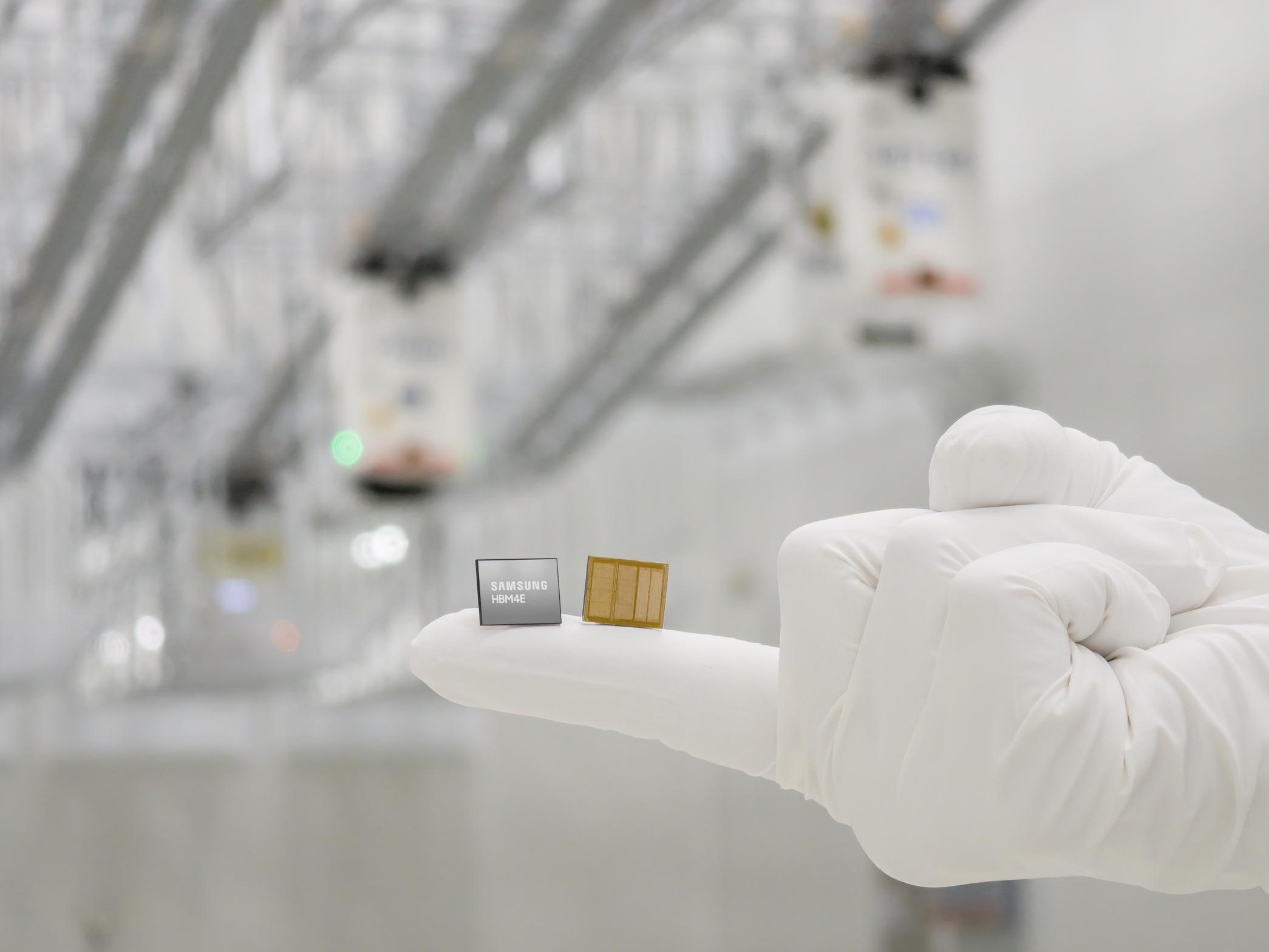
Samsung's 12-layer HBM4E, which it began shipping as samples on June 1, 2026.
Image: Samsung
Source · Press image from the Samsung Newsroom, used for news reporting.
How far past 8 Gb/s do the HBM4 stacks run?
JEDEC's HBM4 standard, JESD270-4, was released on April 16, 2025. It sets a transfer speed of up to 8 Gb/s per pin across a 2,048-bit interface, for up to 2 TB/s per stack, and a maximum cube capacity of 64 GB. The standard is the baseline here; there is no JEDEC HBM4E standard.
The three makers' HBM4 parts clear that line. Samsung says its HBM4 runs at 11.7 Gb/s consistently and can be enhanced to 13 Gb/s; it puts the 11.7 Gb/s part at about 46% above 8 Gb/s. SK hynix says its 12-layer 36 GB HBM4 demonstrated 11.7 Gb/s, in its release for CES 2026. Micron says its HBM4 runs at over 11 Gb/s. The table sets the stacks side by side.
| Stack | Status | Pin speed | vs 8 Gb/s | Bandwidth per stack | Capacity |
|---|---|---|---|---|---|
| Samsung HBM4 | Volume | 11.7 Gb/s (up to 13) | 1.46x | 3.3 TB/s | 24–36 GB |
| SK hynix HBM4 | Volume | 11.7 Gb/s | 1.46x | >2 TB/s (2025 samples) | 36 GB |
| Micron HBM4 | Volume | >11 Gb/s | >1.375x | >2.8 TB/s | 36 GB (48 GB samples) |
| Samsung HBM4E | Sampling | 14 Gb/s (up to 16) | 1.75x | 3.6 TB/s | 48 GB |
| SK hynix HBM4E | Sampling | Up to 16 Gb/s | 2.00x | Not stated | 48 GB |
| Micron HBM4E | Development | Not stated | Not stated | Not stated | Not stated |
The gap is not uniform. Samsung's 11.7 Gb/s is 46% above the standard; Micron's over-11 Gb/s is more than 37.5% above; Samsung's 13 Gb/s ceiling is 62.5% above. The HBM4E samples go further: Samsung's 14 Gb/s is 75% above 8 Gb/s, and SK hynix's 16 Gb/s maximum is twice the standard.
HBM4E samples reach 16 Gb/s, twice JEDEC's 8 Gb/s HBM4 line
Pin speed in Gb/s: JEDEC HBM4 standard and the makers' HBM4 and HBM4E stacks
- Note 1: JEDEC HBM4 standard: 8 Gb/s per pin.
Data table
| Category | Pin speed (Gb/s) |
|---|---|
| JEDEC HBM4 | 8 |
| Samsung HBM4 | 11.7 |
| SK hynix HBM4 | 11.7 |
| Micron HBM4 | 11 |
| Samsung HBM4E | 14 |
| SK hynix HBM4E | 16 |
Bandwidth per stack is the product of pin speed and interface width. All three HBM4 parts use a 2,048-bit interface, so a higher pin speed translates directly into more bandwidth per stack. The HBM4E samples keep the same broad stack format and push pin speed higher, but SK hynix states no interface width for its part, so its per-stack bandwidth cannot be worked out the same way.
Which HBM4 stacks are in volume production?
All three. Samsung said on Feb. 12, 2026 that it had begun mass production of HBM4 and shipped commercial products. Micron said on March 16, 2026 that volume shipment of its HBM4 36 GB stack began in the first quarter of calendar 2026. SK hynix said in its second-quarter 2026 results, published July 29, that mass shipments of HBM4 began in the second quarter and would ramp in the second half.
That makes three makers with HBM4 in volume production and zero with HBM4E in volume production. The count uses the companies' own status words: mass production or volume shipment for HBM4; sampling or development for HBM4E. A sample is not a volume product.
Confirmed
- Samsung, SK hynix and Micron all say HBM4 is in volume production.
- Samsung's HBM4 runs at 11.7 Gb/s, scalable to 13 Gb/s; SK hynix demonstrated 11.7 Gb/s; Micron says over 11 Gb/s.
- Samsung and SK hynix have HBM4E samples at 14 Gb/s and 16 Gb/s; Micron expects HBM4E volume production in calendar 2027.
- Micron's prepared remarks call NVIDIA's NVHBM the industry's first custom-HBM4E implementation.
Reported
- The Bell reports Samsung is developing a custom HBM4E for Meta on a 2nm base die; no sampling or volume date.
Not stated
- SK hynix gives no HBM4E bandwidth, interface width or mass-production date.
- Micron gives no HBM4E pin speed, bandwidth, capacity or stack height.
- There is no JEDEC HBM4E standard; HBM4 is the baseline.
Volume production is the line that matters for buyers. A sampling part can be designed into a system, but it cannot be ordered in the quantities a rack-scale AI program needs. The three HBM4 lines are past that line; the HBM4E lines are not.
How much bandwidth does each stack deliver?
Per-stack bandwidth follows pin speed and interface width. JEDEC's 2 TB/s is the reference. Samsung puts its HBM4 at up to 3.3 TB/s, 1.65 times the standard. Micron puts its HBM4 at greater than 2.8 TB/s, 1.4 times. SK hynix says its 12-layer HBM4 samples, shipped in 2025, deliver more than 2 TB/s, just over the standard. Samsung's HBM4E sample is up to 3.6 TB/s, 1.8 times the standard.
SK hynix does not give a per-stack bandwidth for its HBM4E, and Micron gives no HBM4E speed or bandwidth. Those gaps are left out of the comparison rather than filled by calculation. The bandwidth multiples here use only the figures the companies state.
The missing HBM4E bandwidth for SK hynix is not a small omission. Without interface width, a 16 Gb/s pin speed cannot be converted into a per-stack TB/s figure. The comparison therefore puts SK hynix's HBM4E on pin speed and capacity only.
How close do the stacks come to JEDEC's 64 GB?
JEDEC's ceiling is 64 GB per cube, built from 32 Gb dies in a 16-high stack. No shipping HBM4 part reaches it. The 12-high HBM4 stacks in volume production hold up to 36 GB: Samsung offers 24 GB to 36 GB, SK hynix 36 GB and Micron 36 GB. Capacity, not speed, is where the standard still leads the shipping parts.
The 16-high HBM4 parts move closer. Micron has shipped 48 GB 16-high samples, which it says is 33% more capacity per placement than its 36 GB part. SK hynix showed a 16-layer 48 GB HBM4 at CES 2026 and says it is under development to customers' schedules; its packaging plans for 16-high stacks are the subject of our report on its hybrid bonders. Samsung plans 16-layer stacking up to 48 GB.
HBM4E starts where those parts are going. Samsung's and SK hynix's 12-layer HBM4E samples hold 48 GB. Samsung plans a 32 GB 8-layer part and a 64 GB 16-layer part. Only that planned 64 GB HBM4E reaches the maximum the HBM4 standard allows, and it is a plan, not a shipping part.
What does HBM4E add, and is any of it in volume production?
Samsung began shipping HBM4E samples on June 1, 2026. It gives a stable pin speed of 14 Gb/s, scalable to 16 Gb/s, and up to 3.6 TB/s per stack in a 48 GB package. SK hynix shipped HBM4E samples on June 18, 2026, with a maximum of 16 Gb/s per pin and 48 GB capacity. It gives no interface width or per-stack bandwidth, so its bandwidth versus the 2 TB/s HBM4 standard cannot be stated.
Micron's HBM4E is in development. Micron expects volume production in calendar 2027 and gives no pin speed, bandwidth, capacity or stack height. At SC26 in November, SK hynix showed HBM4E beside HBM4 and the prior generation but stated no HBM4E bandwidth, interface width or mass-production date. Our SC26 report found the same gap. Micron is also building HBM packaging capacity in Singapore, where it installed the first tool at a new plant, as we reported on Nov. 20.
Samsung's HBM4 and HBM4E use a Samsung Foundry 4nm logic base die, the company says in both releases. The base die carries the interface between the DRAM stack and the processor, and it is where custom work starts: a customer that wants its own memory controller changes the die under the stack, not the DRAM above it.
The Bell reported on Nov. 17, 2026 that Samsung is developing a custom HBM4E for Meta on a 2nm base die, with no sampling or volume date. Our report on that development set out the plan. That is a reported item, not a confirmed product.
Micron's prepared remarks for its fiscal fourth-quarter call, dated Sept. 30, 2026, call NVIDIA's NVHBM the industry's first custom-HBM4E implementation. That is Micron's own description of a customer part, not a specification, and it sits apart from the reported Meta part.
What does the ISSCC 2027 program change?
The ISSCC 2027 advance program, dated Nov. 23, 2026, lists Samsung paper 22.5, 'A 48GB 17Gb/s/pin HBM4E', for Feb. 16, 2027. That 17 Gb/s is a paper title, not a product rating: it is above Samsung's 14 Gb/s sample and its 16 Gb/s scalable figure, and the program gives no product date. The same session lists Huawei paper 22.6, a 64-channel 4096-DQ custom HBM. Our earlier report on the session set out the two papers.
The paper does not change the count. The comparison stays on the companies' product statements and uses the HBM4 standard as its baseline. The paper is a watch item: its title describes a 48 GB HBM4E part at 17 Gb/s per pin, and the program gives no product date behind it.
What dates decide the next step?
SK hynix expects HBM4 to surpass its prior HBM generation in both shipment volume and revenue in the fourth quarter of 2026. Micron puts HBM4E volume production in calendar 2027. ISSCC session 22 on Feb. 16, 2027 will show whether the 17 Gb/s paper title turns into a product specification.
The next checkpoints are company results and product releases, not conference titles. SK hynix's fourth-quarter results will show whether HBM4 has passed its prior generation in volume and revenue. Micron's calendar 2027 target will show whether HBM4E moves from development to volume. Samsung's HBM4E sample speed will show whether the 16 Gb/s scalable figure becomes a shipping specification.
Terms in this story
- HBM4
- The fourth-generation high-bandwidth memory standard from JEDEC, with a 2,048-bit interface and up to 8 Gb/s per pin.
- HBM4E
- An extended HBM4 generation from the memory makers; there is no JEDEC HBM4E standard, so HBM4 is the baseline.
- pin speed
- The data rate per input/output pin, in Gb/s; a stack's bandwidth rises with pin speed and interface width.
- stack
- One vertical package of DRAM dies with a logic base die, the unit a GPU or accelerator attaches.
- JEDEC
- The industry standards body that published the HBM4 standard, JESD270-4, on April 16, 2025.
- sampling
- A stage in which a maker ships early parts to customers for evaluation; it is not volume production.
- base die
- The logic die at the bottom of an HBM stack that connects the DRAM dies to the processor.
- interface width
- The number of data pins in a stack's interface; HBM4 uses 2,048 bits.
How we counted
The count covers the three makers' public HBM4 and HBM4E product statements and the JEDEC HBM4 standard. HBM4 volume production means the company says mass production or volume shipment has begun. HBM4E volume production means the company says volume production has begun; sampling and development do not count. Capacity is compared with JEDEC's 64 GB maximum. Figures are as of Nov. 29, 2026. SK hynix's HBM4E bandwidth and Micron's HBM4E speed are left out because the companies give none. The ISSCC 17 Gb/s figure is a paper title, not a product rating.
What to watch
Under way
SK hynix: HBM4 to pass prior generation
SK hynix expects HBM4 to surpass its prior HBM generation in both shipment volume and revenue in the fourth quarter.
Scheduled
ISSCC 2027 session 22
Samsung paper 22.5 is titled 'A 48GB 17Gb/s/pin HBM4E'; a paper title is not a product rating.
Scheduled
Micron HBM4E volume production
Micron expects HBM4E volume production in calendar 2027; it gives no speed.
Changes
First published.
Sources
- 01SK hynix Ships Samples of 12-Layer Next-Gen HBM4ESK hynixnews.skhynix.com
- 02Samsung Ships Industry-First Commercial HBM4Samsung Newsroomnews.samsung.com
- 03ISSCC 2027 Advance Program (draft of Nov. 23, 2026)ISSCCsubmissions.mirasmart.com
- 04Micron in High-Volume Production of HBM4 Designed for NVIDIA Vera RubinMicroninvestors.micron.com
- 05JEDEC and Industry Leaders Collaborate to Release JESD270-4 HBM4 StandardJEDECjedec.org
- 06Samsung Begins Shipment of Industry-First HBM4E SamplesSamsung Newsroomnews.samsung.com
- Published
- Sources
- 6 cited