NVIDIA DLSS 5 Reaches Hogwarts Legacy Nov 5 on a 24% Smaller Model
DLSS 5 reaches Hogwarts Legacy on Nov. 5 with Game Ready driver 621.14, and NVIDIA says its October model is 2x faster. Independent tests of the first release found a 41% to 58% frame-rate cost on RTX 50 cards.
Hardware & Analysis DeskEdited by Ege Erten
5 min readAI-assisted
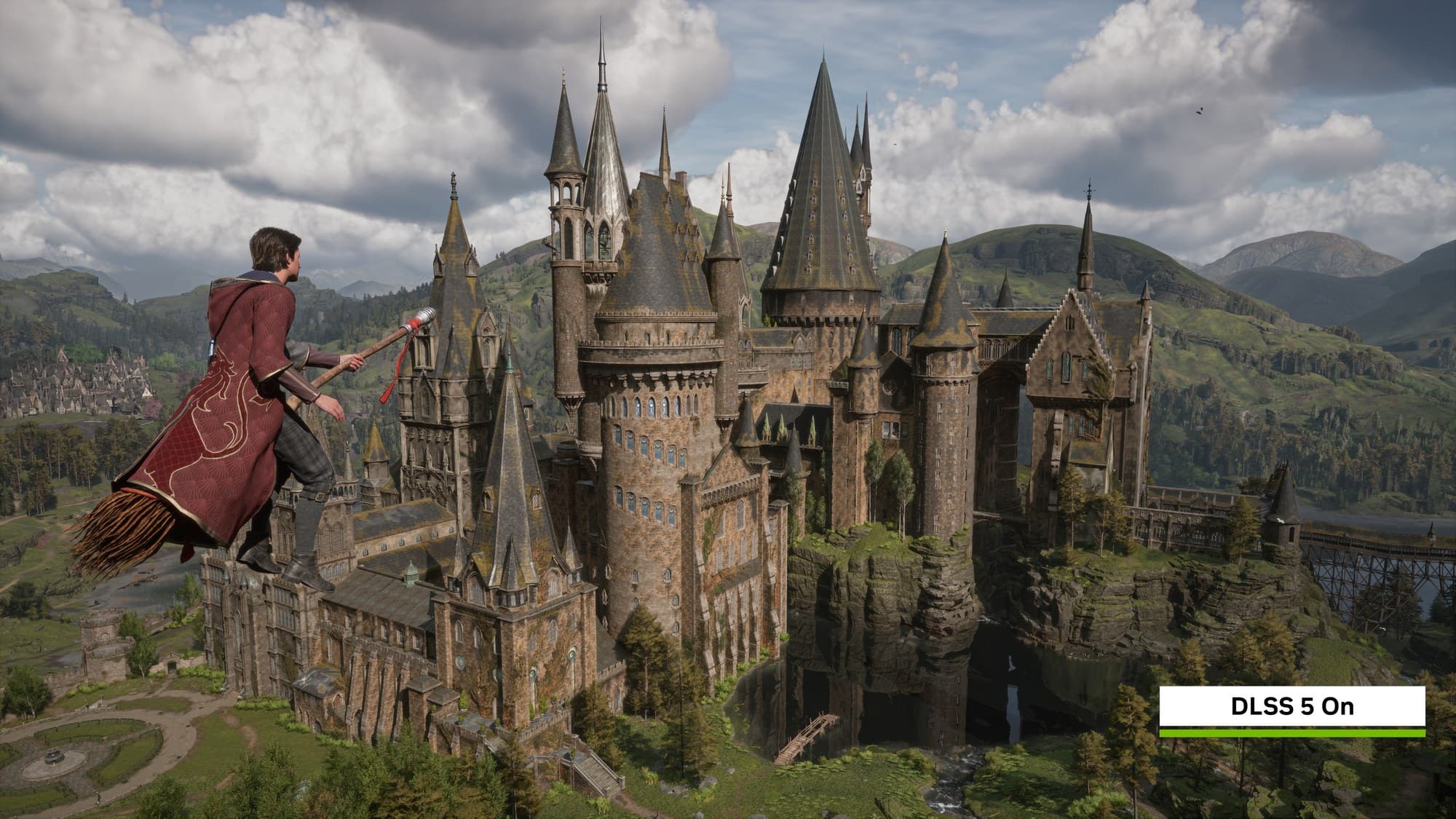
Hogwarts Legacy with DLSS 5 on, from NVIDIA's announcement of the Nov. 5 update.
Image: NVIDIA
Source · Press image from the NVIDIA newsroom, used for news reporting.
NVIDIA's DLSS 5, a neural rendering model that adds lighting and material detail to each frame the engine renders, reaches Hogwarts Legacy on Nov. 5 on a version NVIDIA says is 24% smaller, at roughly 118 million parameters. The company posted Game Ready driver 621.14 on Nov. 4 to support it.
War Thunder follows in mid-November with its Eagle's Shadow update, and Where Winds Meet on Nov. 23, NVIDIA said in its Nov. 3 announcement. All three games ship with what NVIDIA calls its October 2026 Neural Rendering model. NVIDIA claims that model cuts 4K memory use by 20% and runs twice as fast as the previous version, which launched in NBA 2K27 on Sept. 3. DLSS 5 works on GeForce RTX 50 desktop and laptop GPUs, RTX Spark PCs and GeForce NOW Ultimate. RTX 40 cards are not on that list.
The product matters beyond gaming because it turns a graphics card into a continuous AI inference machine. Each frame the game engine renders now ends with a generative model pass on the Tensor Cores. With Multi Frame Generation, most displayed frames are generated, not rendered. Independent tests of the first release found losses of 41% to 58% of frame rate on desktop RTX 50 cards (Digital Foundry), and Tom's Hardware found cards from the RTX 5060 to the RTX 5070 Ti at their power limits at 1440p, with the RTX 5080 and RTX 5090 at theirs at 4K.
Inside DLSS 5
DLSS 5 takes the color and motion vectors of a frame the game engine has already rendered and adds lighting and material detail on top, as the final stage of the pipeline, NVIDIA says. The engine's geometry and textures set what must stay. Developers choose among several models and tune Structure Intensity and Tone Intensity, and semantic masking lets them treat characters and scenery differently. For players it is a single switch, called "Neural Rendering" in Hogwarts Legacy.
The design choice that defines the product is where the cost lands. Tom's Hardware found the model has a fixed cost per output frame that grows with the target resolution. Rendering at a lower internal resolution with DLSS upscaling therefore saves less time than usual, because the game still waits for the generative step at full output size. At 4K that step works on more than twice the pixels of 1440p. Notebookcheck reported that DLSS 5 uses the FP8 number format, which the fourth-generation Tensor Cores in RTX 40 cards support and RTX 30 cards lack. The RTX 5090 carries 680 fifth-generation Tensor Cores and 32 GB of GDDR7, according to NVIDIA's Blackwell documentation.
How it compares with the first release
NVIDIA says that since DLSS 5's announcement in March it went from needing two RTX 5090s to running on one card, a 10x performance gain in seven months. In September NVIDIA put the gain at 5x, Notebookcheck reported. The October model's 2x speedup and 20% 4K memory cut are NVIDIA's own figures. Its headline frame rates include Multi Frame Generation. NVIDIA claims Hogwarts Legacy reaches up to 300 FPS at 4K on an RTX 5090 with ray tracing, DLSS 5 and 6X frame generation. NVIDIA's figure counts every displayed frame, including those made by 6X Multi Frame Generation. NVIDIA also claims War Thunder reaches up to 400 FPS at 4K in its ground battle benchmark (Ultra preset with path-traced global illumination; NVIDIA names no GPU for that figure) and up to 300 FPS at 1440p on an RTX 5090 Laptop GPU, again with up to 6X frame generation.
AMD's FSR 4.1 is a machine-learning upscaler, not a relighting model, so the two do not compete on the same metric. ComputerBase measured FSR 4.1's cost against FSR 3.1, as Voltgrid reported. That figure says nothing about DLSS 5's on/off cost.
DLSS 5 is a neural network that runs after the game engine has drawn a frame. It takes that frame's color and motion vectors and adds lighting and material detail, NVIDIA says. The model works at full output size, so Tom's Hardware found it adds a fixed cost per output frame that grows with resolution. Upscaling from a lower internal resolution therefore saves less time than usual.
The cost showed in Digital Foundry's NBA 2K27 tests as a 51.2% frame-rate loss on an RTX 5090 at 4K and 41% on an RTX 5060. NVIDIA says its October model is 2x faster, but its 300 FPS and 400 FPS figures include 6X Multi Frame Generation, so they do not measure that cost. What matters for buyers is how much of the loss remains on their card.
DLSS 5 Performance: What Reviewers Measured So Far
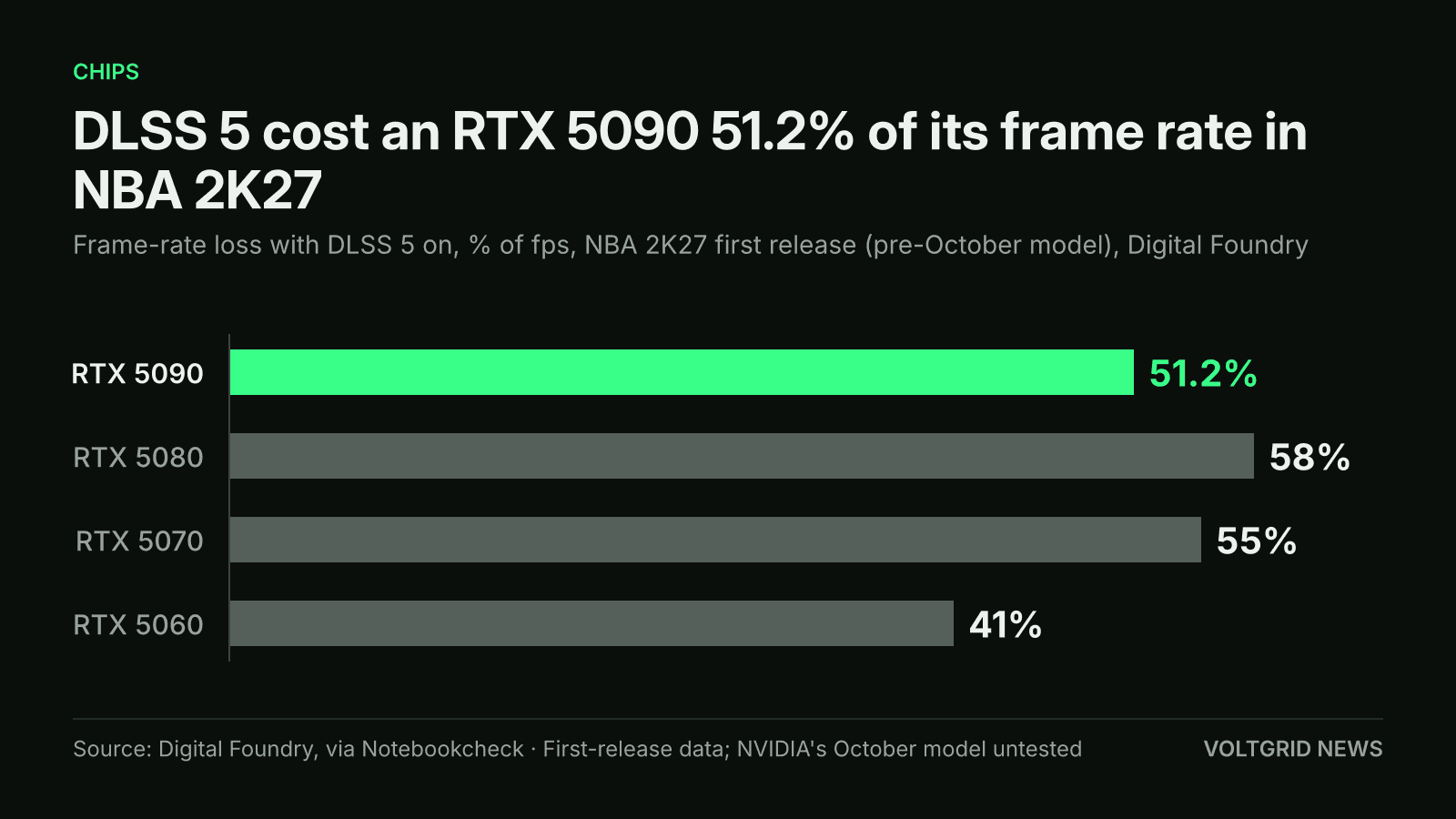
Digital Foundry's first-release NBA 2K27 tests, via Notebookcheck: DLSS 5 cost an RTX 5090 51.2% of its frame rate; NVIDIA's October model is untested.
Illustration (AI-generated)
Every independent figure below comes from NBA 2K27 in early September, on the first official release, before the October model. None of them tests NVIDIA's 2x claim.
Digital Foundry, as reported by Notebookcheck, measured an RTX 5090 at 4K Ultra falling from 128.4 fps to 62.7 fps with DLSS 5 on, a 51.2% loss and an 8.3 ms frame-time cost. Across the range it measured losses of 58% on an RTX 5080 at 4K Ultra with ray tracing, where the card barely stayed above 40 fps, 55% on an RTX 5070 and 41% on an RTX 5060. Notebookcheck's report does not give the settings for the two smaller cards.
Notebookcheck ran its own test on a Lenovo Legion Pro 7 with an RTX 5090 Laptop GPU and NVIDIA-supplied drivers. At 4K with DLSS Quality upscaling, the average fell from 104.8 fps to 28.0 fps with DLSS 5 on and no frame generation. With 6X frame generation it showed 130.9 fps, at an average PC latency of 126.6 ms.
Tom's Hardware tested every RTX 50 card at native resolution with maximum settings and ray tracing, without frame generation, on a Ryzen 7 9800X3D with driver 616.64. The RTX 5060 averaged nearly 60 fps at 1080p with DLSS 5. The three 8 GB cards showed low-memory warnings at 1440p. The power data is the striking part. Cards from the RTX 5060 to the RTX 5070 Ti ran at their power limits at 1440p, and the RTX 5080 and RTX 5090 hit theirs at 4K. An MSI RTX 5090 Lightning Z averaged nearly 850 W at 4K, 48% more power than the Founders Edition for 22% more performance.
DLSS 5 Supported GPUs, Price and Software
DLSS 5 arrives through game updates and the driver. It needs a supported game, an RTX 50 GPU or RTX Spark PC, and driver 621.14 or later, or a GeForce NOW Ultimate subscription. The hardware is the expensive part. Voltgrid has reported the lowest in-stock RTX 5090 price at 262% over MSRP across 10 countries. The feature also runs on RTX Spark laptops, NVIDIA's Arm-based Windows machines. NVIDIA confirmed in September that RTX 40 support will follow, Notebookcheck reported, but it has given no date.
What to Watch After the Hogwarts Legacy Update
Voltgrid could not read an independent retest of the October model on Nov. 4; a TechSpot follow-up published in October could not be opened. Hogwarts Legacy on Nov. 5 is the first test of the model in these three games. The numbers to check are the frame-rate cost against the 51.2% Digital Foundry found on an RTX 5090, card power against the limits Tom's Hardware hit, and whether 8 GB cards benefit from the claimed 20% memory saving. War Thunder's update in mid-November and Where Winds Meet on Nov. 23 add two more engines. A date for RTX 40 support would widen the installed base well beyond Blackwell.
Sources
- 01Nvidia DLSS 5 on an RTX 5090 laptop: Our initial impressionsNotebookcheck · notebookcheck.net
- 02Hogwarts Legacy, War Thunder DLSS 5 3D-Guided Neural RenderingNVIDIA · nvidia.com
- 03Nvidia confirms DLSS 5 is coming to RTX 40-series GPUs, but no release date yetNotebookcheck · notebookcheck.net
- 04First DLSS 5 game tested: DLSS 5 humbles RTX 5090 with over 50% performance lossNotebookcheck · notebookcheck.net
- 05World of Warcraft: Forever GeForce & RTX Spark Game Ready Driver ReleasedNVIDIA · nvidia.com
- 06We tested DLSS 5 in NBA 2K27 with every RTX 50 series GPUTom's Hardware · tomshardware.com