Oracle's Project Jupiter Fuel-Cell Plant: 2,462 MW Nameplate, Permit Pending
Oracle's Project Jupiter fuel-cell plant in New Mexico: 2,462 MW nameplate, a requested 1,600 MW cap, an air permit with no hearing date after a Nov. 3 motion, and a gas pipeline without FERC construction authorization.
5 min read
Follows Project Jupiter Air Permit: Developer Waives Nov. 23 Deadline, Seeks Delay
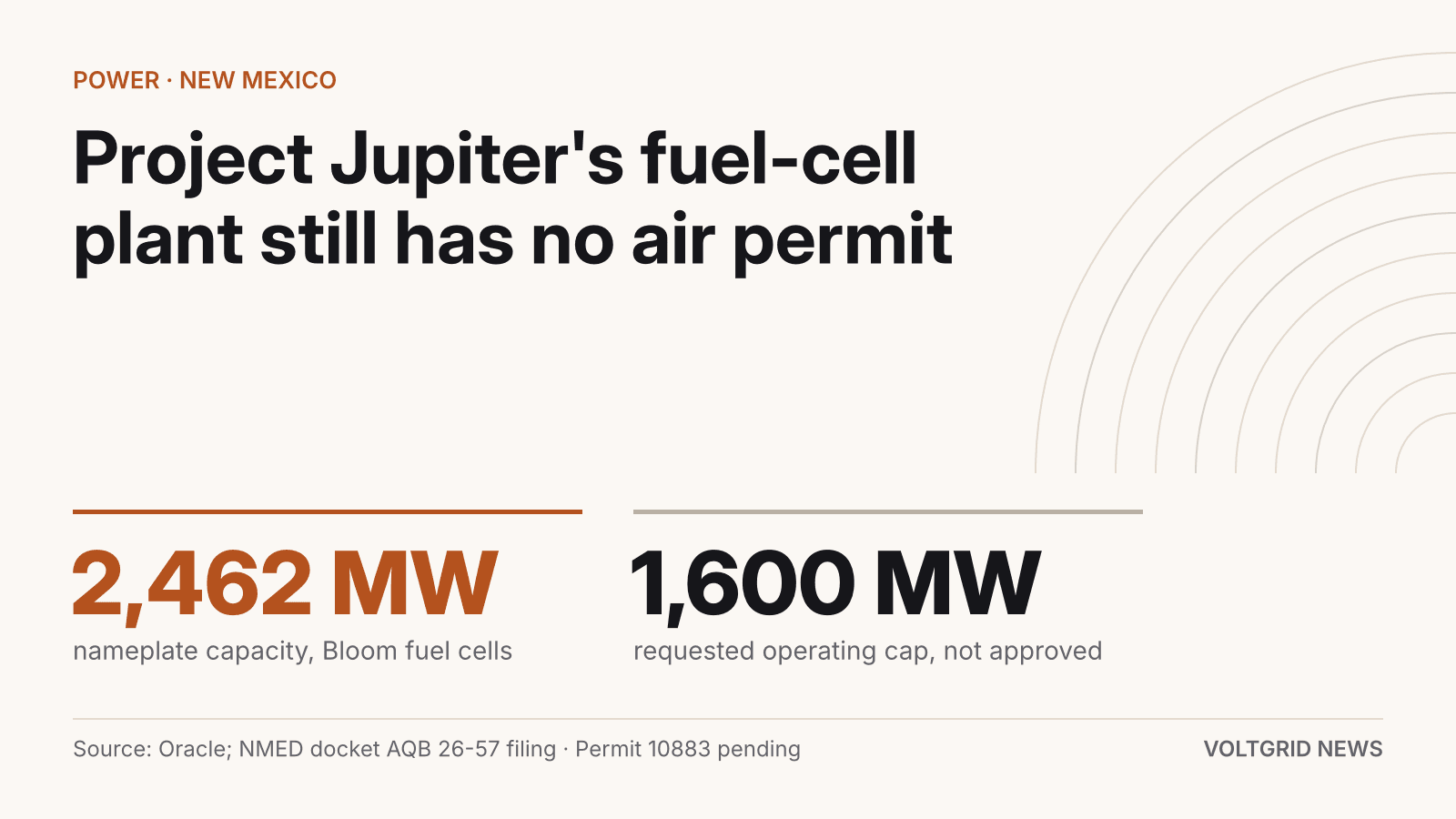
Nameplate capacity of the planned Bloom fuel-cell plant against the operating cap requested in the permit application, which is not approved.
Graphic: Voltgrid News
The air permit for the Bloom Energy fuel-cell plant meant to power Oracle's Project Jupiter campus in New Mexico has no hearing date after a month of procedural steps: on Oct. 26 a hearing officer refused to dismiss the application, and on Nov. 3 the developer and the state jointly moved to vacate the Dec. 7 hearing. The plant would hold 2,462 MW of nameplate fuel-cell capacity, and the developer has asked to run no more than 1,600 MW.
On Oct. 26, hearing officer James O. Browning refused to dismiss the application as incomplete, The Santa Fe New Mexican reported. On Nov. 3, the New Mexico Environment Department (NMED) and the applicant, Yucca Growth Infrastructure (YGI), jointly moved to vacate the Dec. 7 hearing, Searchlight New Mexico reported, and YGI waived the Nov. 23 deadline. A Nov. 6 order granted that motion, according to Microgrid Media, which said it read the four-page order; the order did not appear on the NMED docket pages available on Nov. 26. Status conferences were set about every two weeks from Nov. 19; no report of the first conference's outcome had surfaced by Nov. 26.
For Oracle, the stakes are plain. The buildings at the Santa Teresa site were without power as of those reports (Oct. 26 and Nov. 5), both New Mexico outlets said, and the plant is the campus's planned source of electricity. Oracle calls it a microgrid. Neither Oracle nor the permit filings say whether it could island, or run separately from a utility grid.
The technology
YGI's Oct. 19 filing in the NMED case says the plant would install 2,462 MW of electricity-generating capacity in Bloom solid-oxide fuel cells, built from identical 65-kW modules. An October redesign regrouped them into 1,263 clusters in place of 2,275 stacks: 1,262 clusters rated 1.95 MW each and one rated 1.105 MW, according to the filing. Stacks on most clusters would rise from 30 feet to 45 feet to disperse exhaust.
The planned supply path to Project Jupiter: a proposed pipeline and a plant, both still awaiting approval.
Graphic: Voltgrid News
The one idea that matters is the gap between nameplate and operation, set out below, and the request to cap output at 1,600 MW. Oracle and YGI said on Oct. 15 their proposed refinement would cut the plant's permitted emissions by about 35%, including greenhouse gases. The cap is requested, not approved, and a critic quoted by The Santa Fe New Mexican, chemical engineer Lindsay Leveen, asked why the plant would need 862 "redundant" megawatts, the gap between nameplate and the requested cap.
Under the draft permit, the fuel cells would supply all base-load and backup power, and no other equipment at the site would be allowed to generate, Engineering News-Record (ENR) reported. The application lists maximum gas use of about 375 million standard cubic feet a day, ENR said.
Nameplate capacity versus an operating cap
Nameplate capacity is the most a plant's units can produce if they all run at once. Yucca Growth Infrastructure says it will build 2,462 MW of Bloom fuel cells but asks New Mexico to write a 1,600 MW operating cap into the air permit, about 65% of nameplate, enforced through hourly and annual output limits, according to its Oct. 19 filing. The filing says the extra capacity is redundancy for reliable delivery.
For supply, the cap is the output the permit would allow, so it sets the megawatts the campus could count on and the emissions the state reviews. It is requested, not approved, and YGI says any increase would need a permit revision with its own public process. Until the permit issues, neither number is power the campus can use.
The deal and the money
Oracle is the buyer; YGI is the permit applicant and Bloom would operate the plant, according to ENR. Bloom said, according to ENR, that Oracle remains committed to its contract for 2.4 GW of natural-gas fuel-cell capacity; that is Bloom's figure for the contract, not a measure of this site. No price or term for that contract has been disclosed.
Oracle sent a force majeure notice on Sept. 24 to Blue Owl Capital, owner of STACK, which preserves its contractual protections if the campus does not come online in 2028 as planned, ENR reported, citing Bloomberg. Oracle told ENR the project remains on schedule. At a July hearing, a YGI attorney said her client stood to lose $325 million a month from November, ENR reported.
Licensing and timeline
YGI filed application 10883 in April 2026. An NMED modeling review in June found the plant would not cause or contribute to exceedances of air standards, ENR reported. The October redesign then reopened the technical review: NMED's own counsel called the revised application "not ready for primetime" in a late-October filing, according to Searchlight New Mexico.
Permit 10883 remains pending. Under the Nov. 6 order, a new hearing can be set only after the Air Quality Bureau files a revised recommendation, and, if it recommends a permit, an amended draft permit and modeling report, Microgrid Media reported. The same order also denied, by that outlet's account, renewed dismissal motions by New Energy Economy and the Center for Biological Diversity. An NMED spokesperson told Searchlight New Mexico the agency cannot estimate how long the review will take.
The dates in play are targets. The application anticipated completion of the plant in November 2029 and, separately, a startup of about October 2026, a conflict ENR said the filing does not explain. Oracle's plan for the campus is 2028.
What it means for the campus
Gas is the second gate. Transwestern Pipeline's proposed Green Chile project would deliver up to 400,000 dekatherms a day to the site through a 17.77-mile line, but the Federal Energy Regulatory Commission had not authorized construction as of ENR's report, and its reported in-service target had moved to February 2027. A permit alone would not fuel the plant.
The politics may shift too. Gov.-elect Deb Haaland takes office in the new year and has said she plans an executive order pausing large data-center development on her first day, Searchlight New Mexico reported. A hearing pushed into 2027 would fall under her administration. Construction continues meanwhile: the first building topped out in October, and Oracle counted more than 3,600 construction workers on the campus, ENR reported.
What to watch
The next verifiable step is NMED's revised recommendation, with an amended draft permit if it supports one; only then can a hearing date be set. Status conferences continue about every two weeks. The other markers are a FERC decision on the Green Chile pipeline, against its February 2027 target, and any action on large data centers after Haaland is sworn in.
Sources
- 01Project Jupiter air permit hearing delayed with no new dateMicrogrid Mediamicrogridmedia.com
- 02Project Jupiter microgrid cuts permitted emissions by 35% in response to NMED reviewOracleoracle.com
- 03Project Jupiter foes dealt blow in data center permit fightThe Santa Fe New Mexicansantafenewmexican.com
- 04Oracle invokes force majeure as New Mexico Project Jupiter power work faces hurdlesEngineering News-Recordenr.com
- 05YGI response to New Energy Economy motion to dismiss, AQB 26-57 (with exhibits)New Mexico Environment Departmentenv.nm.gov
- 06State, developers ask to delay public hearing on Project Jupiter air quality permitSearchlight New Mexicosearchlightnm.org
- Published
- Sources
- 6 cited