Intel Shareholder Lawsuit Tests Whether Data Centers Can Offset PC Slump
A Nov. 13 shareholder lawsuit says Intel hid how far the PC slump hit client sales from July 23 to Oct. 29. Intel's own figures show data-center gains running into substrate and memory shortages.
6 min read
Follows Intel Plans for About 10% Fewer PCs in 2027 as Memory Sets Demand
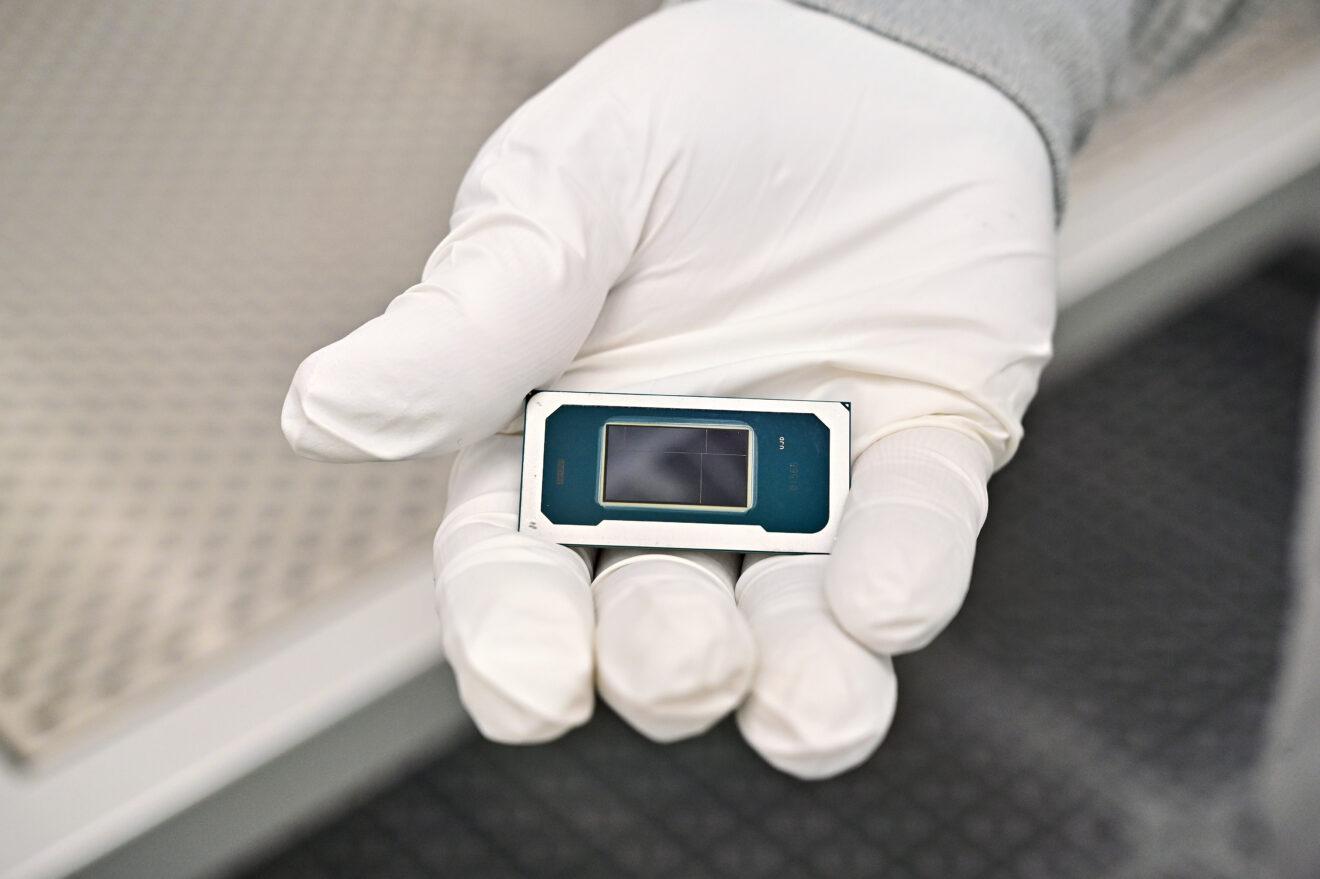
An Intel Core Ultra Series 3 (Panther Lake) processor, built on Intel's 18A process. The image illustrates Intel's client chips and is not specific to the lawsuit.
Image: Intel
Source · Press image from the Intel newsroom, used for news reporting.
A pension fund's proposed securities class action, an Intel shareholder lawsuit filed on Nov. 13 in federal court in San Jose, alleges the company hid how far the PC slump was cutting its client chip sales between July 23 and Oct. 29. Read against Intel's own figures, the suit's sharper point looks hard to dismiss: from the fourth quarter, data-center growth that depends on scarce substrates and memory may not cover a shrinking client business. That is Voltgrid's reading, not a finding of the court or a statement by Intel.
Voltgrid reported the PC outlook itself on Oct. 30, when Intel's CFO said it plans for about 10% fewer PCs in 2027 as memory sets demand, and the $15 billion to $16 billion fourth-quarter guidance a day earlier. This piece sets the complaint's allegations against what Intel said, and when.
What the Intel Class Action Alleges
The case is City of Southfield Fire and Police Retirement System v. Intel Corporation, No. 26-cv-13758, in the Northern District of California, according to the case page of plaintiff's counsel Robbins Geller Rudman & Dowd. It covers buyers of Intel common stock from July 23 to Oct. 29, 2026, and charges Intel and top executives under the Securities Exchange Act of 1934. Tom's Hardware, citing Reuters, reported that chief executive Lip-Bu Tan and chief financial officer David Zinsner are named as defendants and that the suit seeks unspecified damages. The BBC said it had contacted Intel for comment; none of the reports carried a response. The claims are allegations and have not been tested in court.
The complaint alleges Intel failed to disclose five things. First, that the PC slowdown was hurting the third-quarter results of the Client Computing and Physical AI Group (CCPG), Intel's PC chip unit, more than Intel said. Second, that PC makers and distributors were allegedly sitting on unsold inventory as component prices rose. Third, that the AI data-center boom was allegedly more than offset by the PC downturn. Fourth, that substrate shortages allegedly kept Intel from ramping data-center CPUs even by moving resources away from PCs. And fifth, that Intel's statements about capturing AI spending were therefore misleading. Tom's Hardware also reports the plaintiffs' claim that Intel had a reason to stay quiet while it raised $23 billion in a stock offering at $95 a share in mid-August.
On July 23, Intel reported second-quarter revenue of $16.1 billion, up 25% from a year earlier, with CCPG at $8.9 billion, up 13% from a year earlier, and guided third-quarter revenue to $15.8 billion to $16.8 billion. Zinsner said in the release that Intel was meaningfully increasing its investments in equipment, clean room space and substrates to support growth "this year and next." By Oct. 29, Intel's third-quarter release listed the $23 billion equity offering as completed.
The same Oct. 29 release put CCPG at $8.1 billion, down 5% from a year earlier. The complaint frames it on a different base: down 9%, or about $800 million, from the second quarter. It also quotes Intel's quarterly filing as saying notebook and desktop revenue fell $424 million from a year earlier, to $6.9 billion, on a 14% drop in volume. Data Center and AI rose 78% from a year earlier to $7.3 billion, about $1.0 billion above the second quarter's $6.3 billion. Intel guided fourth-quarter revenue to $15.0 billion to $16.0 billion, and Zinsner said he sees the PC slowdown lasting at least through the first half of 2027. Intel's shares fell 28.6% on Oct. 30, erasing about $140 billion of market value, Tom's Hardware reported.
Intel shares fell 28.6% on Oct. 30, the day after the third-quarter results that closed the class period; the suit's allegations are untested.
Graphic: Voltgrid News
Why Data Center Growth Cannot Cover the PC Slump
Intel's own release tables show the offset working in the third quarter. From the second quarter to the third, CCPG lost about $0.8 billion while Data Center and AI gained about $1.0 billion, so total revenue still rose from $16.1 billion to $16.5 billion. The fourth-quarter guide's $15.5 billion midpoint is about $1.0 billion below the third quarter, which the complaint calls a sequential decline in Intel's seasonally strongest quarter. Intel gave no segment split for the guide, so how much of that decline falls on client chips is not yet known.
The reason the data-center side cannot simply grow faster appears to be supply, not demand. Tan said on Oct. 29 that Intel's immediate priority is to unlock more supply to meet demand for its Xeon server chips, and the release lists current industry-wide substrate and memory shortages among its risks. A CPU does not ship on its own: it sits on a package substrate, the layer that wires the chip to the system, and it needs DRAM beside it before a customer can use the machine. Memory works against Intel on both sides. The BBC reports Tan told analysts the industry faced an "unprecedented memory crunch", and Tom's Hardware ties higher DRAM prices to costlier PCs and weaker consumer demand. If the slowdown Zinsner described lasts through the first half of 2027, client chips, still Intel's largest product segment in the third quarter, would become a drag that a supply-limited data-center business may not cancel out.
The Case Against the Suit
Intel did not hide the shortages. Its July 23 release already listed current industry-wide substrate and memory shortages among its risk factors, the same wording as in October, and Zinsner flagged extra investment in substrates that day. Third-quarter revenue of $16.5 billion landed inside the $15.8 billion to $16.8 billion range Intel gave on July 23, and from the second quarter to the third the data-center gain was larger than the client loss. The complaint has to show that statements were misleading when made, not merely that a forecast missed, and its account of what executives knew mid-quarter has not been answered yet. Tom's Hardware notes Intel dropped routine mid-quarter updates in 2006, revising guidance between reports only occasionally since, so there was no standing practice the company broke.
What It Means for Intel, PC Makers and AMD
For Intel, the suit adds pressure to every client statement it makes while the case runs. The roadmap still rests on 18A: Panther Lake, sold as Core Ultra Series 3, is built at Fab 52 in Arizona, and Intel's CEO has said Nova Lake will be its first client chip on 18A-P, with more promised at CES in January. On the Oct. 29 call, Zinsner said Oregon 18A wafer capacity is being swapped for Intel 3 data-center output, as Voltgrid reported. That points to Intel prioritising supply for the parts in demand, while its budget Wildcat Lake chip sells out, as Voltgrid reported on Oct. 30.
For PC makers, the complaint's inventory allegation is the one to watch: if distributors are holding unsold systems because memory made them dearer, chip orders lag sell-through even when new laptops ship. For AMD, the picture is mixed. Mercury Research data put AMD at 29.9% of third-quarter desktop CPU shipments, down from 34.9% in the second quarter, as Voltgrid reported, in a market Intel says is shrinking. In Voltgrid's reading, a smaller market limits what either company can gain from the other's trouble.
What to Watch in the Intel Case
Lead-plaintiff motions are due by Jan. 12, 2027, according to Robbins Geller, after which the court picks the investor who will direct the case. Intel has said it will say more about Nova Lake at CES in January, its first chance to restate 18A-P timing under the new scrutiny. Intel's fourth-quarter report, which the company has not yet dated, will show whether CCPG fell again and whether Data Center and AI grew enough to hold revenue inside the $15.0 billion to $16.0 billion guide. A motion to dismiss, if Intel files one after a lead plaintiff is named, will give the company's first answer to the allegations on the record.
Sources
- 01Intel sued by investors after PC sales slump hits share priceBBCbbc.com
- 02Intel Corporation class action lawsuit (City of Southfield Fire and Police Retirement System v. Intel Corporation, No. 26-cv-13758, N.D. Cal.)Robbins Geller Rudman & Dowdrgrdlaw.comas read on Nov 16, 2026
- 03Intel Reports Second-Quarter 2026 Financial ResultsIntelintc.com
- 04Intel sued by shareholders for misleading investors after stock plunges 29%Tom's Hardwaretomshardware.com
- 05Intel Reports Third-Quarter 2026 Financial ResultsIntelintc.com
- Published
- Sources
- 5 cited