AMD Plans Double-Digit 2027 PC Shipment Drop, Deeper Than Counterpoint
AMD told analysts it plans for 2027 PC shipments to fall by a double-digit percentage and guided Q4 Client and Gaming down over 20%. Counterpoint sees 2027 flat; AMD says supply can shift to data centers.
Hardware & Analysis DeskEdited by Ege Erten
6 min readAI-assisted
Follows our story: AMD Q4 Guidance of $17 Billion Is a Helios Bet, Inventory Up 35%

AMD chair and CEO Lisa Su with a Ryzen processor, in an AMD press photo. Su told analysts AMD plans for a double-digit decline in 2027 PC unit shipments.
Image: AMD
Source · Press image from the AMD website, used for news reporting.
AMD is planning for PC market unit shipments to fall by a double-digit percentage in 2027, chief executive Lisa Su said on the company's Nov. 3 third-quarter call, according to the call transcript, after guiding its Client and Gaming segment down more than 20% sequentially in the fourth quarter. That is a deeper slump than Counterpoint Research's Oct. 22 forecast of broadly flat 2027 volumes, though a company planning assumption and an analyst forecast are different kinds of number. Su said AMD's supply is "quite fungible" between PCs and the data center; AMD did not say it will move PC supply to EPYC or Instinct, so that reading is ours.
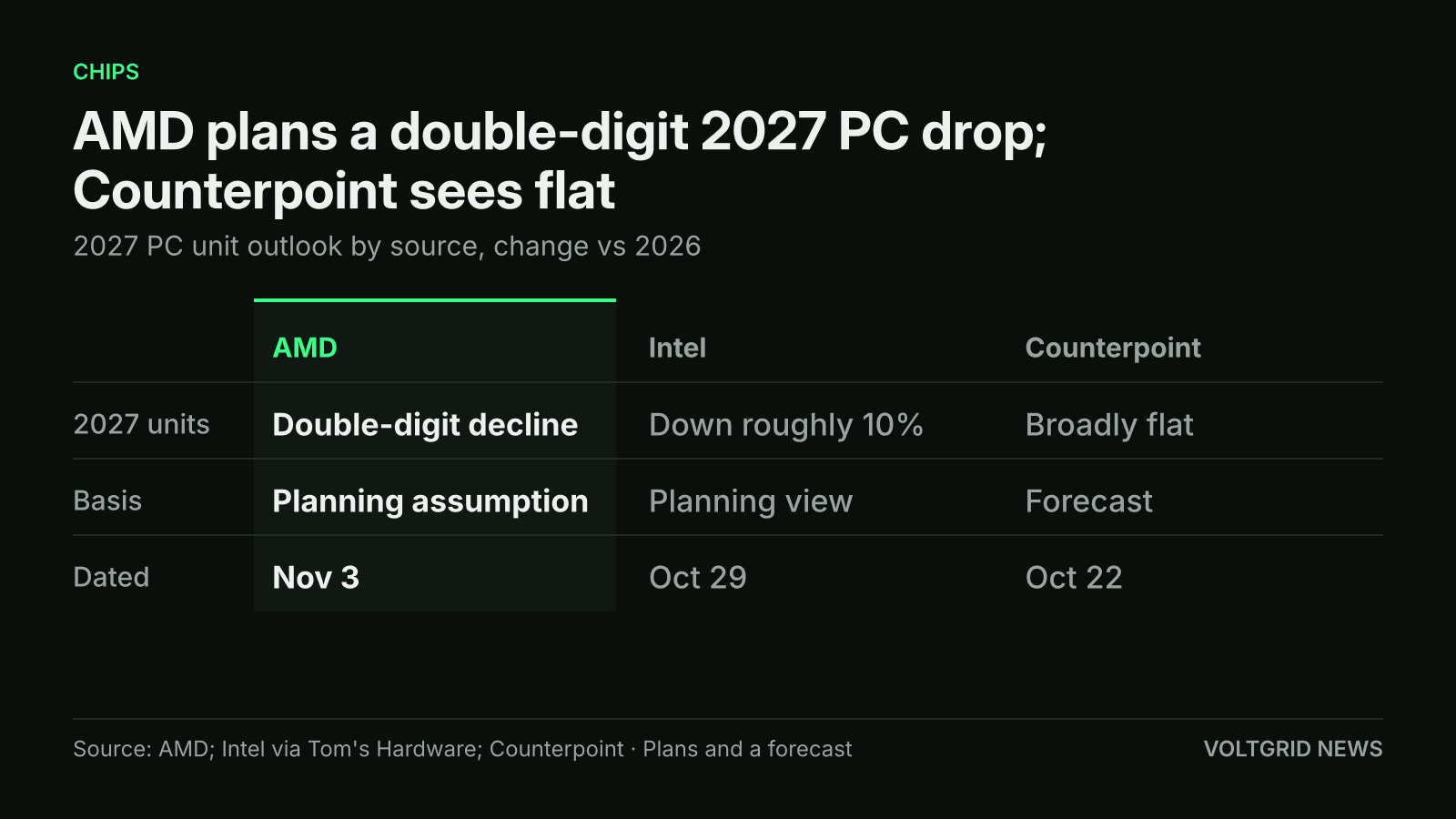
AMD plans for a double-digit 2027 PC unit decline, Intel for roughly 10%, while Counterpoint's forecast is broadly flat.
Illustration (AI-generated)
Our Nov. 3 analysis of AMD's $17 billion fourth-quarter guide was written from the release and slides before the call, and it read the guide as a bet on Helios racks. The call added the other half of that picture: what AMD expects from PCs, and why it is relaxed about it.
What happened
Client and Gaming revenue was $3,722 million in the third quarter, down 8% from $4,048 million a year earlier and 3% from $3,841 million in the second quarter, AMD's earnings slides filed with the SEC show. Segment operating income fell to $573 million from $867 million, and the operating margin narrowed to 15% from 21%, which AMD put down to lower gross profit and lower operating leverage.
Inside the segment the two halves split. Client revenue rose 7% year on year to $2.9 billion on Ryzen mobile processors. But chief financial officer Jean Hu said on the call that it fell 4% from the second quarter as higher memory cost weighed on PC unit demand, partly offset by a richer mix of high-end chips. Gaming fell 40% to $773 million on lower console-chip and graphics sales.
Su said PC sell-through slowed late in the quarter as memory and component costs lifted system prices, and that AMD is matching its shipments into the channel to that slower sell-through to keep inventory healthy. She called the 2027 figure AMD's "planning assumption" and said the company is planning for a down year. For the fourth quarter, Hu guided total revenue to about $17 billion, plus or minus 3%, with Data Center up about 50% and Client and Gaming down more than 20% from the third quarter, according to the transcript.
Why it matters
The argument runs in three steps, each on AMD's own words. First, memory sets the size of the PC market. Su said that when component prices rise, overall system pricing is affected, and that one would expect consumer markets to be more sensitive to it. TrendForce forecasts PC DRAM contract prices up 13% to 18% in the fourth quarter and Korean makers cutting PC DRAM output by more than 20% next year as they add server memory, as Voltgrid reported on Oct. 30.
Second, AMD can move supply. Su said AMD's supply chain is "quite fungible" across its PC and data-center businesses, so it can shift supply as market signals change, and that overall AMD has more demand than supply. She also said AMD has secured the wafers, substrates, advanced packaging and memory for much faster growth next year, and that it expects Data Center to be more than 80% of 2027 revenue.
Third, the margins point one way. In the third quarter Data Center earned $2,882 million in operating income on $8,546 million of revenue; Client and Gaming earned $573 million on $3,722 million, the slides show. If supply is fungible and short, then a weaker PC market may cost AMD less than the unit numbers imply, because capacity it does not sell into PCs could go to the segment with the higher average operating margin. That is our inference: the margins are segment averages, no filing says what a wafer moved between segments would earn, and AMD did not say it will move any specific volume.
The same memory squeeze runs through both halves. Memory makers moving capacity to AI servers lift data-center demand for AMD and raise the cost of the PCs it sells chips into. Su said memory and other component costs face inflationary pressure and that AMD is working with its customers to ensure those costs are shared, in answer to a question about its largest data-center customers.
Sell-in is what a chipmaker ships to PC makers and distributors. Sell-through is what they sell on to buyers. When sell-through slows and sell-in does not, unsold chips pile up in the channel.
Su said PC sell-through slowed late in the third quarter as higher memory and component costs lifted system prices, and that AMD is aligning sell-in with sell-through to keep channel inventory healthy. The guide of Client and Gaming down more than 20% from the third quarter is therefore a statement about AMD's own revenue, which also includes console chips and graphics. It is not a forecast of PC sales, and AMD did not give one for the quarter.
The case against
The strongest counter-case is that AMD is planning conservatively for a market that may already be near its floor. Counterpoint's preliminary data count 57 million PC shipments in the third quarter, down 21% from a year earlier, and it expects the fourth quarter to fall 27%. But it expects 2027 volumes to be broadly flat with 2026, which it called stabilization at a lower level. Part of the 2026 fall, it said, reflects a strong 2025 base inflated by buying ahead of the Windows 10 support deadline and tariff-driven inventory moves, and commercial demand held up relatively well on fleet replacement. A planning assumption is meant to be cautious, and a flat forecast from an analyst firm is a different kind of number; neither is a measurement of 2027.
AMD's own mix also cushions it. Su said AMD will focus on enterprise, where it is underrepresented, premium consumer and desktop channel, and that it has the least exposure to the volatile low end. She said eight of the 10 largest banks use Ryzen PRO PCs, and that the first business laptops and compact desktops built on Ryzen AI Max PRO 400 Series chips are out from HP, Lenovo and other makers, systems AMD says run models of up to 300 billion parameters locally. That is AMD's claim; we found no independent measurements of those systems. Client revenue still grew 7% year on year in a quarter when Intel's Client Computing and Physical AI Group revenue fell 5% (revenue, not units).
What it means for Intel, PC makers and buyers
AMD is not alone. Intel's Client Computing and Physical AI Group fell 5% to $8.1 billion, and its CFO expects the PC slowdown to last at least through the first half of 2027, as Voltgrid reported on Oct. 29. On its call Intel went further, planning for 2027 units down roughly 10% and its client business down more than 20% in the fourth quarter, our Oct. 30 analysis found, citing Tom's Hardware. Barclays analyst Tom O'Malley said on AMD's call that a fourth-quarter client drop of more than 20% matches what others have guided.
For PC makers the pressure is already in the numbers. Counterpoint estimated third-quarter shipments of 15 million for Lenovo, down 23%, 10.3 million for HP, down 31%, and 7.6 million for Dell, down 25%. Both chip suppliers now plan for fewer units next year, so their customers face a second year of shrinking volume with costlier memory. For data-center buyers, the read is the reverse: a supplier that plans for weak PCs and calls its supply fungible may have room to serve server and accelerator orders first. That is our reading: Su said AMD has more demand than supply and can move supply, not that it will serve data-center orders first.
What to watch
AMD speaks at the UBS Technology and AI Conference on Dec. 1 and Barclays' technology conference on Dec. 9, where it may quantify the 2027 PC assumption or say how much supply it is moving. NVIDIA is scheduled to report on Nov. 17. AMD's fourth-quarter report, due in early 2027, and Intel's next report will show whether client revenue fell more than 20% as both guided. If Counterpoint keeps its flat 2027 call after these reports, the gap between the chipmakers' plans and the analysts' forecast becomes the number to track; if it cuts, AMD's caution was the earlier signal.
Sources
- 01Advanced Micro Devices (AMD) Q3 2026 Earnings Call TranscriptStockAnalysis (AMD earnings call transcript) · stockanalysis.com
- 02Global PC Shipments Plunge 21 Percent in Q3 2026Counterpoint Research · counterpointresearch.com
- 03AMD Q3 2026 Financial Results (earnings slides, Form 8-K exhibit)AMD (SEC filing) · sec.gov