GMKtec EVO-X2 Power Draw: 80 W CPU Average vs 105 W for Framework
GMKtec's EVO-X2 averaged 80 W on its CPU power sensor in Phoronix's November 27 Linux review, against 105 W for Framework Desktop and Ryzen AI Halo, finishing just behind both on speed.
4 min read
Follows GMKtec EVO-X2 Review: 128GB Strix Halo Now $3,499.99, Up From $1,999
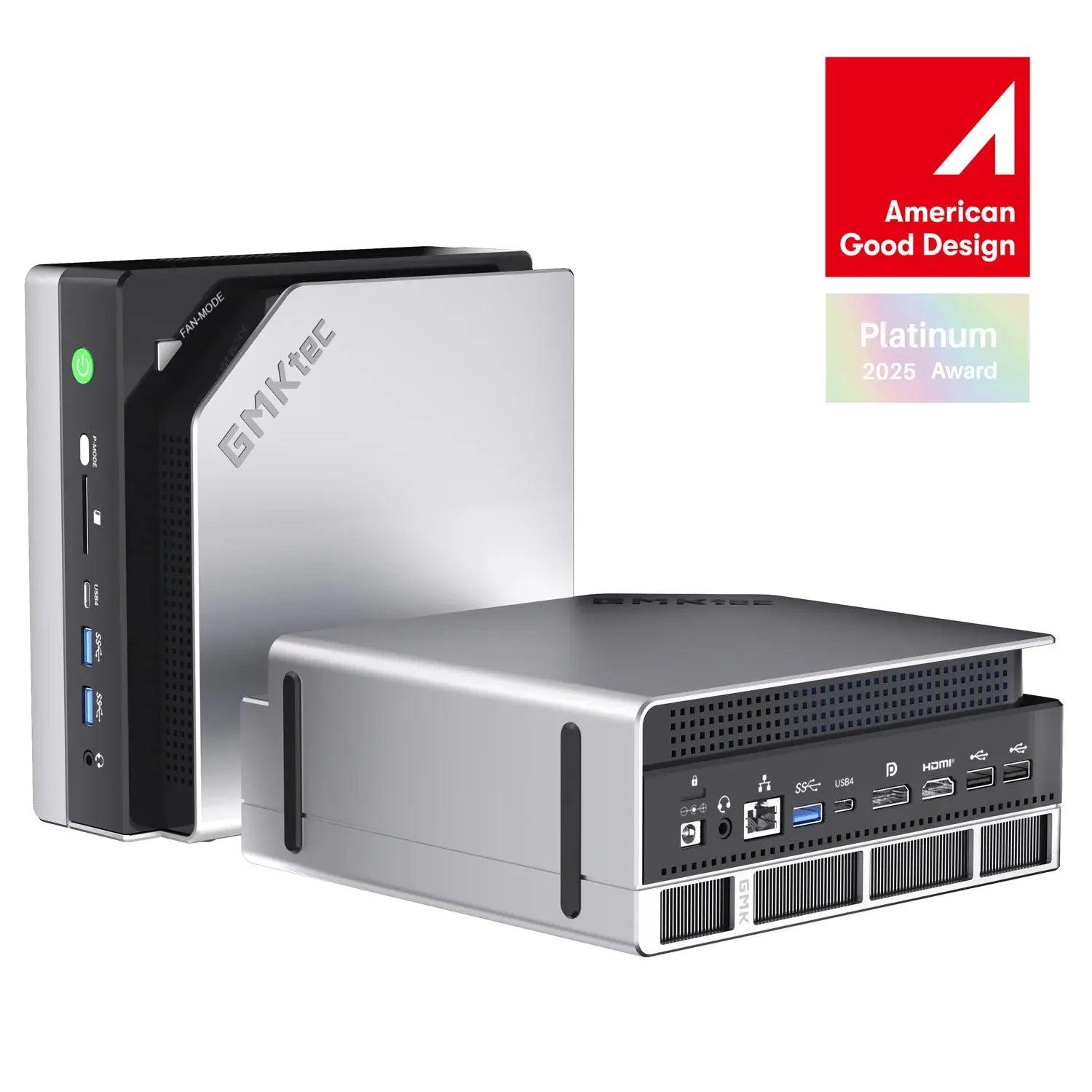
GMKtec's EVO-X2 mini PC, the machine Phoronix tested on Linux (GMKtec product photo).
Image: GMKtec
Source · Press image from the GMKtec product page, used for news reporting.
GMKtec's EVO-X2 mini PC averaged 80 W on its CPU power sensor, with a 132 W peak, across dozens of Linux benchmarks, against a 105 W average and a peak around 180 W for the Framework Desktop and AMD's Ryzen AI Halo, Phoronix reported in a review published on November 27, 2026.
On Phoronix's CPU power sensor, not wall power, the EVO-X2 averaged 80 W against 105 W for Framework Desktop and Ryzen AI Halo.
Graphic: Voltgrid News
All three machines use the same AMD Ryzen AI Max+ 395 (Strix Halo) chip, and Phoronix ran each in its "performance" platform profile. On the geometric mean of every test that completed on all systems, the EVO-X2 finished just behind the Ryzen AI Halo and the Framework Desktop, with the Framework Desktop fastest overall. Phoronix said the EVO-X2 typically matched or exceeded the other two on performance per watt, but it gave no performance-per-watt number in its text.
What a CPU Power Reading Measures
A CPU power reading is the processor's own sensor report of the electricity it takes in while a test runs. It is not wall power, which also counts everything else in the box and the losses in the power adapter. Phoronix's chart is a CPU power consumption log, and the review does not say what else the sensor covers.
A lower power limit caps how much the chip may draw, so clocks peak lower and heat falls. Whether the saving holds at the wall, or under a sustained model-serving load, was not measured.
What the lower draw means for a buyer
Phoronix attributed the EVO-X2's lower peak clocks to reduced power limits. The box still boosted to 5.1 GHz, but its typical peak clocks sat below those of the other two Strix Halo machines, and it ran with the lowest CPU core temperatures of the group. In practice, a buyer gives up some raw speed (Phoronix puts the box just behind on the geometric mean) and gets about a quarter less average CPU power in return, by our arithmetic on Phoronix's figures (80 W against 105 W).
There is a second lever. Phoronix added that the performance gap to the other Strix Halo PCs narrowed when it pressed the physical fan-mode button on the EVO-X2. That mode is not tied to the Linux ACPI platform profile, which Phoronix noted is awkward for racked home-lab use. Phoronix gave no power or speed figures for the button-pressed case, so the 80 W reading should not be taken as that setting.
The setups also differed slightly: the Ryzen AI Halo ran AMD's own Ryzen AI Developer Platform OS, while the EVO-X2 and Framework Desktop ran clean Ubuntu 26.10 installs. The run included a Dell Pro Max GB10 and a BOSGAME mini PC on the Ryzen AI 9 HX 470 for reference, but Phoronix said the Dell exposed no CPU or SoC power metrics, so the power comparison covers the Strix Halo boxes only. Phoronix's charts label the GMKtec unit "EVO-X2S", while its title and text call it the EVO-X2.
No tokens-per-second figure from this review
The review includes llama.cpp runs, on the CPU and on AMD's ROCm HIP backend, with gpt-oss-20b and DeepSeek-R1-Distill-Llama-8B at Q8_0 and MiniMax-M2.5 at UD-TQ1_0. Phoronix publishes those results as charts, and we did not take tokens-per-second values from them. In its text, Phoronix said the EVO-X2 was slower than the Framework Desktop and Ryzen AI Halo on CPU text generation, ahead in CPU prompt processing, and quite close on ROCm HIP.
The most recent independent LLM figure we hold for the EVO-X2 is still ServeTheHome's from July 2025: 3.7 to 3.8 tokens per second generating with Llama 3.3 70B Instruct at Q6_K, run fully on the Radeon 8060S of a 128 GB unit, with the inference software not named. That is a different model, quantization, tool and date from Phoronix's runs, so the two cannot be compared. Phoronix's separate llama.cpp comparison of Windows and Ubuntu on the same machine was covered on November 22, and idle draw across these boxes in a separate roundup.
On software, Phoronix said it ran the EVO-X2 on Ubuntu 26.04, Ubuntu 26.10, Fedora Workstation 45 and CachyOS without problems. The review unit shipped with Windows 11 Pro.
GMKtec EVO-X2 Prices on Its US Store
As read on November 29, GMKtec's US store lists the EVO-X2 at $2,199.99 with 64 GB of memory and a 1 TB drive, against a compare-at price of $2,599.99. The 128 GB model costs $3,499.99 with 1 TB and $3,649.99 with 2 TB, against a compare-at price of $3,999.99. That 128 GB price is the one found in Voltgrid News' November 11 EVO-X2 review, up from a $1,999 listing earlier.
The rivals in this run sit close. Framework listed its 128 GB DIY Desktop at $3,449 for the system alone, out of stock as of November 3. StorageReview reported the Ryzen AI Halo at $3,999 with a 2 TB drive in July.
What is not answered yet
Three questions stay open for local-AI buyers: what the EVO-X2 draws at the wall under a sustained model-serving load, how large its llama.cpp gaps to the Framework Desktop and Ryzen AI Halo are in tokens per second, and whether GMKtec will tie its fan mode to the platform profile in a firmware update. The next price to watch is whether the 128 GB model's $3,499.99 holds into December.
How it compares
Full table| Product | Memory | Bandwidth | AI compute | Measured speed | Price |
|---|---|---|---|---|---|
| ASUS ExpertCenter Pro ET900N G3ASUS (NVIDIA DGX Station GB300 platform) | 748 GB coherent: 252 GB HBM3e (GPU) + 496 GB LPDDR5X (CPU)[1] | 7.1 TB/s (GPU HBM3e); 396 GB/s (CPU LPDDR5X)[1] | up to 20 PFLOPS AI performance (ASUS gives no precision or sparsity label) (sparse)[2] | GPT-OSS-120B MXFP4, vLLM, 512/512, 1-128 streams: 9,280 aggregate output tok/s at 128 streams; 5,023 on 8,192/1,024 (StorageReview, ASUS-supplied unit, no add-in GPU)[3] | $111,999.99 at Central Computers, US (ET900N G3-2SSD-V2, read Nov 8, 2026); no ASUS list price[4] |
| HP ZGX Fury AI StationHP | 252 GB HBM3e GPU + 496 GB LPDDR5x CPU (4x 128 GB SOCAMM); 748 GB unified[5] | 7.1 TB/s (GPU HBM3e); 396 GB/s (CPU LPDDR5x)[5] | up to 20 petaFLOPS FP4 (HP gives no sparsity label) (sparse)[5] | Two-unit cluster with an ASUS ET900N G3 over two 400G DACs: GLM-5.3 NVFP4 5,018 output tok/s at 256 streams, 512/512, vLLM 0.27.1 TP2 with MTP (StorageReview); no single-unit HP result[6] | $132,000 MSRP on HP Store US (ZGX Fury G1n, no graphics card, 4x 2 TB SED SSDs); build-to-order with RTX PRO 2000 $133,000, with RTX PRO 4000 SFF $136,000 (read Nov 29, 2026)[7] |
| MSI XpertStation WS300MSI (NVIDIA DGX Station platform) | 252 GB HBM3e GPU + 496 GB LPDDR5X CPU (748 GB coherent)[8] | 7.1 TB/s (GPU HBM3e); 396 GB/s CPU LPDDR5X[8] | — | StorageReview vLLM: gpt-oss-120b MXFP4 9,294 output tok/s at 128 streams (512/512), 5,038 on 8,192/1,024; MiniMax M3 NVFP4 1,041 at 32 streams with EAGLE3-GQA at a forced acceptance length of 3 (best-case)[8] | $99,999.00 'Start From' at Newegg US (model WS300T60L, 2x 2 TB NVMe RAID1), request-a-quote listing sold by Newegg (read Nov 15, 2026)[9] |
| NVIDIA DGX StationNVIDIA (systems built by ASUS, Dell, GIGABYTE, HP, MSI, Supermicro and Exxact) | 748 GB coherent: 252 GB HBM3e (GPU) + 496 GB LPDDR5X (CPU)[10] | GPU HBM3e 7.1 TB/s; CPU LPDDR5X 396 GB/s; NVLink-C2C 900 GB/s between them[10] | 15 PFLOPS FP4 (without sparsity)[10] | gpt-oss-120b MXFP4, vLLM, 512/512 chat workload: 9,280 output tok/s at 128 streams (MSI WS300 9,294), single GB300 (StorageReview, ASUS ExpertCenter Pro ET900N G3)[3] | No NVIDIA list price; lowest US partner listing read Nov 4, 2026: Exxact Valence VWS-158270643 from $98,450 (Tom's Hardware found $94,930 in Aug); Dell Pro Precision with GB300 lists $160,195[11] |
| Supermicro Super AI Station (ARS-511GD-NB-LCC)Supermicro (NVIDIA DGX Station platform) | 748 GB total coherent: 252 GB HBM3e GPU + 496 GB LPDDR5X system[12] | 7.1 TB/s (GPU HBM3E); 396 GB/s (CPU LPDDR5X)[13] | up to 20 PFLOPS FP4 (Supermicro gives no sparsity label; ServeTheHome describes it as sparse FP4)[12] | Qwen3.8 Flash Next NVFP4, vLLM, tool-loop 4,096-in/512-out: several scenarios exceeded 3,000 output tok/s at 32 concurrent users, still rising (ServeTheHome; RTX PRO 2000 installed)[14] | $92,887.47 before tax and shipping on Supermicro's online store (ARS-511GD-NB-LCC-01-G2); about $90,101.05 with a 3% new-customer discount (TechRadar, Sep 1, 2026)[15] |
| NVIDIA RTX PRO 6000 Blackwell Workstation EditionNVIDIA (sold through PNY, TD SYNNEX and workstation makers) | 96 GB[16] | 1,792 GB/s[16] | 4,000 AI TOPS (FP4, with sparsity) (sparse)[16] | gpt-oss-120b MXFP4, stock vLLM, 512/512 chat workload: 3,064 output tok/s at 128 streams (1,169 on 8,192/1,024 prompts); Server Edition at 600W (StorageReview)[17] | $16,000 on NVIDIA's US marketplace (Workstation Edition), listed out of stock[18] |
| Apple Mac Studio (M5 Ultra)Apple | up to 512 GB unified (96 GB on 30-core M5 Ultra; 256 GB or 512 GB on 36-core/80-core M5 Ultra)[19] | 1.2 TB/s[19] | — | GLM-5.3-Flash MLX 4-bit with MTP on TensorFold, ISL 2048/OSL 512: 94.0 tok/s at 0 context, 96.5 at 128K, 79.4 at 512K; TTFT 1.1 s at 0, 66.3 s at 128K (Tom's Hardware, 256 GB M5 Ultra)[20] | $22,299 minimum with 512 GB ($6,799 36-core CPU/80-core GPU M5 Ultra config plus $15,500 memory upgrade; Oct 28, 2026)[21] |
| AMD Radeon AI PRO R9700AMD | 32 GB GDDR6 (per card, ECC on Linux only)[22] | 640 GB/s (per card, 256-bit GDDR6)[22] | — | ASUS Turbo, 1 card: Qwen3.8-27B 4-bit, STH agent workloads start near 22 tok/s, analysis TTFT 18 s at ~20 tok/s (engine not named, no draft model); Qwen3.6-35B-A3B 4-bit starts at 75+ tok/s, code generation 125 (ServeTheHome)[23] | $1,299 MSRP (AMD, as of Oct 1, 2025)[24] |
Show the other 36 machinesHide the other 36 machines
| Product | Memory | Bandwidth | AI compute | Measured speed | Price |
|---|---|---|---|---|---|
| Corsair FlexPrime V20C Workstation (CSW-9040004-NA)Corsair | 32 GB GDDR6 on the Arc Pro B70 GPU + 32 GB (2x 16 GB) DDR5 system memory[25] | 608 GB/s (GPU GDDR6)[25] | — | Qwen3.8 27B Q4_K_M, llama.cpp server: 19.8 tok/s at 1 request, 33.5 at 4, 35.4 at 8; TTFT 9,005 ms on 8,192-token prompt (StorageReview)[26] | $3,999.99 on Corsair US store (32 GB DDR5, 1 TB SSD; read Nov 15, 2026)[25] |
| ASUS ProArt GR1XASUS | 64 GB or up to 128 GB LPDDR5X unified memory (ASUS spec page, read Nov 18, 2026)[27] | 300 GB/s (ASUS spec page, read Nov 18, 2026)[27] | WITHDRAWN, not a sparse figure: ASUS and NVIDIA say 'up to 1 petaFLOP FP4' with no sparse or dense label; no field asserts either[28] | Qwen3.8 27B Q4_K_M, llama.cpp CUDA, Windows 11: 13.1 tok/s output at 1 request, 31.4 at 4, 40.0 at 8 requests; TTFT 8.6 s (StorageReview, 64 GB unit, sr-client 1.13)[29] | $4,499 (64 GB/1 TB/Windows 11 Home, ASUS eShop US) and $4,499.99 (Best Buy); eShop out of stock, Best Buy coming soon on Nov 18. UK: Scan pre-order GBP 4,199.99 (64 GB/1 TB), due 11 Dec 2026 (read Nov 28).[29] |
| Mechrevo Master Road X10Mechrevo | 64 GB (with 1 TB SSD) or 128 GB (with 2 TB SSD) unified memory[30] | 300 GB/s (unified memory)[30] | up to 1 PFLOP FP4 (sparse)[30] | — | CNY 32,999 (64 GB/1 TB) to CNY 49,999 (128 GB/2 TB), China only[30] |
| NVIDIA RTX Spark (N1X) PCsNVIDIA (MediaTek collaborated on the custom CPU design) | Up to 128 GB LPDDR5X (20-core CPU / 6,144-core GPU version); up to 64 GB (18-core / 5,120-core laptop version)[28] | Up to 300 GB/s: LPDDR5X-9400 on a 256-bit bus (NVIDIA's product page lists no bandwidth)[31] | — | gpt-oss:20b via Ollama in a Codex CLI coding agent, 64K context: 58.5 tok/s generation, 3 of 4 tasks passed (Dell XPS 16, 20-core N1X, 64 GB; StorageReview)[32] | Laptops from $2,599; pricing and configurations vary by region[33] |
| AMD Ryzen AI Halo (Ryzen AI Max+ PRO 495, 192 GB)AMD | 192 GB LPDDR5X (256-bit)[34] | 273 GB/s[34] | — | — | $7,299.99 for the Linux version (released the week of Oct 12, 2026); Windows version coming soon[34] |
| ASUS Ascent GX10ASUS | 64 GB or 128 GB LPDDR5X-8533 unified[35] | 273 GB/s (8533 MT/s), as listed by StorageReview; ASUS's spec page states no bandwidth[36] | Up to 1 PFLOP FP4 (GB10; NVIDIA's footnote: theoretical, using the sparsity feature). ASUS's pages say 1 petaFLOP / FP4 with no sparsity label (sparse)[37] | gpt-oss-120b, vLLM online serving, equal ISL/OSL: 70 tok/s at batch 1 rising to 680 tok/s aggregate at batch 64 (StorageReview)[36] | $5,999 (128 GB, 1 TB, GX10-GG0010BN, ASUS eShop US, Oct 30, 2026)[38] |
| Dell Pro Precision with GB10 (model FCM1253; launched as Dell Pro Max with GB10)Dell | 128 GB LPDDR5x up to 8533 MT/s onboard (64 GB option also listed)[39] | 273 GB/s (128 GB LPDDR5x, 256-bit)[40] | — | gpt-oss-120b, vLLM online serving, equal ISL/OSL: 68.57 tok/s at batch 1 rising to 670.83 tok/s aggregate at batch 64 (StorageReview)[41] | $7,901.00 (default FCM1253, 128 GB, 2 TB Gen4 QLC) on Dell.com US, unchanged; 64 GB option -$2,150.00 (so $5,751 with 2 TB), 4 TB TLC SED +$2,450.00 (read Nov 26, 2026)[39] |
| Framework Desktop (Ryzen AI Max+ PRO 495, 192 GB)Framework | 192 GB LPDDR5X-8533 soldered[42] | 273 GB/s (256-bit)[42] | — | — | $6,799 (Max+ PRO 495 192 GB DIY Edition pre-order, Nov 3, 2026; storage not included)[43] |
| GIGABYTE AI TOP ATOMGIGABYTE | 128 GB unified system memory[44] | 273 GB/s (LPDDR5x-8533, 256-bit)[45] | — | gpt-oss-120b, vLLM online serving, equal ISL/OSL: 60.71 tok/s at batch 1 rising to 649.62 tok/s aggregate at batch 64 (StorageReview)[45] | $7,499.99 (128 GB, 4 TB PCIe 4.0) and $9,405.63 (128 GB, 4 TB PCIe 5.0; more options from $7,999.99); 128 GB from $5,999.99 (1 TB) and $6,999.99 (2 TB) at Newegg US, read Nov 9, 2026[46] |
| GMKtec EVO-X5 Pro AI Mini PCGMKtec | 192 GB LPDDR5X-8533 onboard (8 x 24 GB, non-upgradeable); up to 160 GB allocatable as VRAM[47] | Up to 273 GB/s[48] | — | GMKtec Laboratory table: GLM-5.3-Flash UD-IQ4_XS (146.05 GB) decode 17.79 tok/s, prefill 70.18, TTFT 14.71 s; Qwen3.8-Flash-Next ROCmFP4-FAST (93.48 GB) decode 45.08 tok/s[47] | $6,799 (192 GB/2 TB) and $7,099 (192 GB/4 TB), no compare-at discount on Black Friday, GMKtec US store (read Nov 27, 2026)[47] |
| HP ZGX Nano AI Station (G1n)HP | 128 GB coherent unified system memory[49] | 273 GB/s (128 GB LPDDR5x)[50] | GB10: up to 1 PFLOP FP4, theoretical, using the sparsity feature; HP and reviewers list 1,000 TOPS FP4 (sparse)[37] | gpt-oss-120b, vLLM online serving, equal ISL/OSL: 69.6 tok/s at batch 1 rising to 722.9 tok/s aggregate at batch 64 (StorageReview)[51] | $7,399.00 at the HP Store for the 4 TB model; $4,759 on Amazon (Notebookcheck, review updated Oct 5, 2026)[52] |
| Lenovo ThinkStation PGXLenovo | 128 GB LPDDR5X unified (256-bit)[53] | 273 GB/s[53] | Up to 1 PFLOP FP4 (Lenovo PSREF gives no sparsity label; XDA says NVIDIA's figure assumes structured sparsity) (sparse)[53] | Qwen3-Coder-Next FP8 (FP8 KV cache), vLLM NGC container, one request at a time, 170K context: 25-40 tok/s (XDA Developers, Lenovo-loaned unit)[54] | US from $5,079 (1 TB base model) on Lenovo's site, per TechRadar's review (Jun 9, 2026); UK from GBP 5,200[55] |
| MSI EdgeMesa N AI+ (128 GB, X-005US)MSI | 128 GB LPDDR5X unified system memory[56] | 273 GB/s[56] | — | Qwen3.8 27B Q4_K_M, llama.cpp CUDA, Windows 11: 13.0 tok/s output at 1 request, 31.1 at 4, 39.8 at 8 requests (StorageReview, 128 GB unit, default 62.5 GB GPU allocation)[57] | $7,499.00 (128 GB, 4 TB, X-005US, MSI US store, out of stock, read Nov 25, 2026)[56] |
| MSI EdgeXpert (MS-C931)MSI | 64 GB or 128 GB LPDDR5x unified (256-bit)[58] | 273 GB/s[58] | 1 PFLOPS FP4 (sparse)[58] | — | No list price; MSI sells via quote (Get a quote)[58] |
| NVIDIA DGX SparkNVIDIA (partner GB10 systems from Acer, ASUS, Dell, GIGABYTE, HP, Lenovo and MSI) | 128 GB; a 64 GB configuration is sold only through OEM partners[37] | 273 GB/s[37] | Up to 1 PFLOP FP4 (theoretical, using the sparsity feature) (sparse)[37] | Qwen 3.8 27B (dense) with multi-token prediction: decode of about 20 tokens/s, with time-to-first-token staying interactive out to the full 262K context.[59] | $6,950.00 (128 GB, 4 TB) on NVIDIA's enterprise marketplace with an Add To Cart button in a copy cached 07:59 UTC on 2026-10-31; stock unverified (listed out of stock on 2026-10-21); 64 GB partner systems from $4,999[60] |
| NVIDIA DGX Spark 64 GBNVIDIA (sold by Acer, ASUS, Dell, Gigabyte, HP and MSI) | 64 GB LPDDR5X unified (two units pool 128 GB over ConnectX-7)[61] | 273 GB/s (256-bit; NVIDIA spec table covers both 64 GB and 128 GB)[37] | 1 PFLOPS FP4 (sparse; NVIDIA spec table covers both memory configurations)[37] | Qwen3.8 27B Q4_K_M, llama-server, 8,192-in/1,024-out: 11.0 tok/s at 1 user, 18.0 at 2, 26.9 at 4, 35.3 at 8 (StorageReview, Dell Pro Precision GB10 64 GB, DGX OS 7, driver 580.178.04; backend not named in this review)[62] | from $4,999 (partner systems, Oct 2026; no Founders Edition)[61] |
| Sipeed MaixStationSipeed | 128 GB LPDDR5X (256-bit)[34] | 273 GB/s (Sipeed claim)[34] | 256 TOPS FP4 (native FP4, no sparsity; Axera/Sipeed claim)[34] | — | about $3,999 expected for 128 GB, with Kickstarter launch discounts (Sipeed to Tom's Hardware, Oct 2026)[34] |
| AMD Ryzen AI Halo Developer PlatformAMD | 128 GB LPDDR5x-8000 unified[63] | 256 GB/s[63] | — | gpt-oss-120b, vLLM online serving, equal ISL/OSL 256/256: 222 tok/s aggregate at batch 64 vs 701 on DGX Spark (StorageReview)[64] | $3,999 with 2 TB SSD (Jul 2026)[64] |
| Framework Desktop (Ryzen AI Max+ 395)Framework | 128 GB LPDDR5x-8000 soldered (32 GB and 64 GB options)[65] | 256 GB/s[66] | — | gpt-oss-120b MXFP4 in LM Studio (out-of-the-box setup): roughly 45 tok/s (ServeTheHome; Ryzen AI Max+ 395, 128 GB, Windows 11 Pro)[67] | $3,449 (DIY Edition, Max+ 395 with 128 GB, system only; out of stock, Nov 3, 2026)[68] |
| Acer Veriton GN100 AI Mini WorkstationAcer | 128 GB LPDDR5x coherent unified[69] | — | — | gpt-oss-120b, vLLM, total token throughput: prefill heavy 303.61 to 2,777.56 tok/s; decode heavy 38.38 to 292.41 tok/s (batch 1 to 64, StorageReview)[70] | from $3,999 in North America (announced Sep 3, 2025; prices vary by region)[69] |
| ASRock Industrial AI BOX-A395ASRock Industrial | 128 GB LPDDR5X-8000 soldered[71] | — | — | AgentSTH V7, 32 threads: 15% ahead of the next-closest Ryzen AI Max+ 395 box (single-core within 1%); estimated SPEC CPU2026 int rate: top of a 44% spread across four 395 systems; measured by ServeTheHome, Ubuntu 26.04[72] | — |
| Beelink GTR9 Pro (Ryzen AI Max+ 495, 128 GB)Beelink | 128 GB LPDDR5X-8533 unified (soldered)[73] | — | 132 AI TOPS on Beelink's page; AMD lists the PRO 495 at Overall TOPS up to 132 and NPU TOPS up to 55; no precision stated by either[73] | 4.24 tok/s, LM Studio, Qwen3.8-35B-A3B (Beelink's own figure on its store page; quantization, context, backend and RAM size not stated)[73] | $4,799 (128 GB/2 TB) against $5,099 compare-at, Beelink store, unchanged on Black Friday (read Nov 27, 2026)[73] |
| Beelink GTR9 Pro (Ryzen AI Max+ 495, 192 GB)Beelink | 192 GB LPDDR5X-8533 unified (soldered)[73] | — | 132 AI TOPS on Beelink's page; AMD lists the PRO 495 at Overall TOPS up to 132 and NPU TOPS up to 55; no precision stated by either[73] | 4.24 tok/s, LM Studio, Qwen3.8-35B-A3B (Beelink's own figure on its store page; quantization, context, backend and RAM size not stated)[73] | $7,399 (192 GB/2 TB) and $7,799 (192 GB/4 TB) against $7,699/$8,099 compare-at, Beelink store (read Nov 27, 2026)[73] |
| Bosgame M5 MAX AI Mini PCBosgame | 192 GB unified LPDDR5 (soldered); up to 160 GB allocatable to the GPU[74] | — | — | — | $6,199 introductory first-batch pre-order price (192 GB, 2 TB PCIe 4.0 SSD), from Nov 3, 2026, until the first allocation sells out[74] |
| Dell Creator Edition Desktop (DM1273)Dell | 128 GB LPDDR5X unified[75] | — | WITHDRAWN, not a sparse figure: NVIDIA's RTX Spark page says 'up to 1 petaflop FP4' and its Nov 18 desktop post 'up to 1 petaflop of AI performance'; neither says sparse or dense[28] | — | $7,590.00 Dell Price (128 GB, 2 TB Gen4 QLC, Windows 11 Pro default config; Dell.com US, read Nov 22, 2026)[75] |
| Dell Pro Max Micro (FCM2250)Dell | 24 GB GDDR7 on the RTX PRO 4000 SFF (23.9 GB usable measured) + 96 GB DDR5-6400 CSODIMM system RAM in StorageReview's tested build[76] | — | — | Ministral 3 8B, llama.cpp server (CUDA), 4,096-in/1,024-out: 52.0 tok/s at 1 request, 108.9 at 4; TTFT 1,477 ms (StorageReview, RTX PRO 4000 SFF 24 GB, driver 595.99.02, Ubuntu 26.04.1)[76] | From $1,449.00 on Dell.com US; RTX PRO 4000 SFF 24 GB option +$3,870.00 (read Nov 16, 2026)[77] |
| Dell Pro Precision 9 T4Dell | Up to 2x 96 GB GDDR7 (two RTX PRO 6000 Max-Q) + up to 4 TB DDR5 RDIMM in 16 slots, 8 channels[78] | — | — | MiniMax M2.7 Q4_K_M (129.3 GB) split across 2x RTX PRO 6000 Max-Q: 83.7 tok/s one user, 127.3 peak; 30.3 on one card plus system RAM (StorageReview, llama.cpp b11716, Ubuntu 26.04.1)[78] | From $5,925.00 on Dell.com US; dual RTX PRO 6000 Max-Q option +$30,820.00 (read Nov 14, 2026). StorageReview's tested build (Xeon 698X, 256 GB, 2x Max-Q) about $66,600[79] |
| Dell Pro Precision with GB300 (model FCT6263; announced as Dell Pro Max with GB300)Dell | 252 GB HBM3e GPU + 496 GB LPDDR5X CPU[80] | — | — | — | $160,195.00 (Dell.com US default config FCT6263, read Nov 8, 2026)[80] |
| Gigabyte AI TOP Aero | up to 128 GB LPDDR5X unified[81] | — | — | — | — |
| GMKtec EVO-X2 AI Mini PCGMKtec | 64 GB or 128 GB onboard LPDDR5X-8000 (non-upgradeable)[82] | — | — | Llama 3.3 70B Q6_K Instruct: 3.7-3.8 tok/s generation fully on the Radeon 8060S (about 2 tok/s CPU-only); Qwen3-32B 10.4-10.5 tok/s; 128 GB unit, short prompt, tool not named (ServeTheHome)[83] | $3,499.99 (128 GB/1 TB) and $3,649.99 (128 GB/2 TB) against $3,999.99 compare-at; 64 GB/1 TB $2,199.99 against $2,599.99; unchanged on Black Friday (GMKtec US store, read Nov 27, 2026)[82] |
| HP Z2 Mini G1a WorkstationHP | up to 128 GB unified, up to 96 GB assignable to the GPU, up to 8000 MT/s[84] | — | up to 50 NPU TOPS[84] | gpt-oss-120b GGUF (63.39 GB, full GPU offload) in LM Studio: close to 40 tok/s (StorageReview)[85] | $4,781 list for StorageReview's review configuration; about $3,300 street (B&H top spec with 2 TB SSD at $3,342.65, Aug 2025)[85] |
| Microsoft Surface RTX Spark Dev BoxMicrosoft | 128 GB unified memory[86] | — | up to 1 PFLOP FP4, theoretical, using the sparsity feature (Microsoft's June 2 blog footnote citing NVIDIA); the product page names no precision (sparse)[87] | — | $5,999.99 (128 GB, 2 TB Gen 5 SSD, Windows 11 Pro; Microsoft Store US, in stock, read Nov 25, 2026)[88] |
| MSI EdgeMesa N AI+ (64 GB) | — | — | — | — | $4,399 (64 GB / 1 TB, after MSI's cut from $4,699; Nov 2026)[89] |
| Tenstorrent TT-QuietBox 2 (Blackhole)Tenstorrent | 128 GB GDDR6 on the accelerators + 256 GB DDR5-5600 system memory[90] | — | — | — | $9,999 (Oct 30, 2026)[90] |
| WiCi One (RTX 5060 Ti edition)WiCi | 16 GB GDDR7 VRAM; 1 TB NVMe 4 SSD for TurboStream weight paging (WiCi's claim: NVMe used as working VRAM). System RAM not stated[91] | — | — | — | $2,599 list (WiCi shop, Oct 2026); a $600-off code (WICIWELCOME) is applied at checkout. Early-access price was $1,999 (Notebookcheck, Engadget, Sep 2026)[91] |
| WiCi One (RTX 5090 edition)WiCi | 32 GB GDDR7 VRAM; 4 TB NVMe 5 SSD for TurboStream weight paging (WiCi's claim: NVMe used as working VRAM). System RAM not stated[91] | — | — | — | $9,999 list (WiCi shop, Oct 2026); a $600-off code (WICIWELCOME) is applied at checkout[91] |
Italic values are reported by an outlet or measured by an independent lab; the rest come from the maker. Measured speeds use different models, quantizations and tools, so read each with its source rather than against the others. Voltgrid News does not test hardware itself.
Sources (91)
- [1] ASUS
- [2] ASUS
- [3] StorageReview
- [4] Central Computers
- [5] HP
- [6] StorageReview
- [7] HP
- [8] StorageReview
- [9] Newegg
- [10] NVIDIA
- [11] Exxact
- [12] Supermicro
- [13] ServeTheHome
- [14] ServeTheHome
- [15] TechRadar
- [16] NVIDIA
- [17] StorageReview
- [18] NVIDIA
- [19] Apple
- [20] Tom's Hardware
- [21] MacRumors
- [22] AMD
- [23] ServeTheHome
- [24] AMD
- [25] Corsair
- [26] StorageReview
- [27] ASUS
- [28] NVIDIA
- [29] StorageReview
- [30] Notebookcheck
- [31] ServeTheHome
- [32] StorageReview
- [33] NVIDIA
- [34] Tom's Hardware
- [35] ASUS
- [36] StorageReview
- [37] NVIDIA
- [38] ASUS eShop
- [39] Dell
- [40] HotHardware
- [41] StorageReview
- [42] Framework Blog
- [43] Framework
- [44] GIGABYTE (PR Newswire)
- [45] StorageReview
- [46] Newegg
- [47] GMKtec
- [48] GMKtec
- [49] HP
- [50] HotHardware
- [51] StorageReview
- [52] Notebookcheck
- [53] Lenovo PSREF
- [54] XDA Developers
- [55] TechRadar
- [56] MSI
- [57] StorageReview
- [58] MSI
- [59] Tom's Hardware
- [60] NVIDIA Marketplace
- [61] NVIDIA Blog
- [62] StorageReview
- [63] AMD
- [64] StorageReview
- [65] Framework
- [66] Framework Blog
- [67] ServeTheHome
- [68] Framework
- [69] Acer
- [70] StorageReview
- [71] ServeTheHome
- [72] ServeTheHome
- [73] Beelink
- [74] Notebookcheck
- [75] Dell
- [76] StorageReview
- [77] Dell
- [78] StorageReview
- [79] Dell
- [80] Dell
- [81] Notebookcheck
- [82] GMKtec
- [83] ServeTheHome
- [84] HP
- [85] StorageReview
- [86] Microsoft
- [87] Microsoft Devices Blog
- [88] Microsoft
- [89] Notebookcheck
- [90] Tenstorrent
- [91] WiCi
Sources
- Desk
- Local AI Desk
- Published
- Sources
- 2 cited